Analysis of sales in food and drug stores tracked by ACNielsen shows varietal wines priced under $6 are still the most popular. (It is important to note that many, if not most, food and drug stores do not sell wines costing $40, $50 or more a bottle). However, sales of wines $6 and above are seeing the strongest growth rates.
Between July 2003 and February 2006, overall wine sales rose 22.6 percent. The largest growth was in wines priced $15 and above, which gained 123 percent. However, those wines only account for about 2 percent of the market. By far the largest volume of wine sold in food stores is priced below $6 per 750 ml; a category that includes jug and 5-liter boxed wines. This category's market share is declining. Between July 2003 and July 2004, this category was responsible for 71 percent of the sales volume. Between February 2005 and February 2006, that market share fell 6 percent.
The overall average bottle price has risen from $4.73 to $5.48, but most of that increase came because the cheapest wines are getting slightly pricier.
Friday, April 21, 2006

Sunday, April 16, 2006
Coming Soon, the Blog Book
Want to see those words in print? No not these pages, well not in foreseeable future; my real job has taught me the vagaries of getting published. But if you do have a wine blog or any blog, or you just want to get published Blurb Inc can help. Mind you a little book on Shiraz wouldn’t go astray, now would it?
Thursday, April 13, 2006
They are only words…… and sometimes they are all we have
 Drinking a great wine is a very sensory experience that can evoke a wide range of emotions and memories. But how can we convey the experience of that wine to others who have not tasted it? While facial expressions, and other gestures, may have certain connotations that might prove useful particularly if the wine has been unpleasant, the spoken and written word has proven our best mode of communication. As noted before on Shiraz one problem that affects the ability to communicate the experience of tasting a wine is being able to accurately describe or label the odors, aromas, or bouquet associated with the wine. Another is the art of writing. Within this second facet is the ability to correctly use words to describe the experience.
I’ve been thinking about the correct use of words lately because I’m not satisfied with having to use the term palate in tasting notes. The principal definition of palate is anatomical and refers to “the roof of the mouth, which separates it from the nasal cavity”. A minor definition is “Relish; taste; liking; - a sense originating in the mistaken notion that the palate is the organ of taste.” So imagine, if you will, the accuracy of describing the taste of a wine with the phrase “on the palate”. Apart from the fact that the palate is not a taste organ, you would have to be standing on your head to have the wine on your palate.
The problem is, of course, that the terminology is so widely used. A search of eRobertParker.com will reveal that Parker has used it in the tasting notes of 8,423 wines. (I use Robert Parker as an example simply because his site has such a great search facility.) A comment on Palate is found in Jancis Robinson’s Oxford Companion to Wine, where it is noted as the “term used when describing tasting as a process and an ability.” Palate does not find its way into Wine, A Brief Encyclopedia by Walter James (Published 1960). Being a great fan of James I’m consoled by that. Perhaps in future I might try using simpler terms like mouth or tongue. Oral cavity seems just a little too clinical. Still I’m sure palate will creep back in at some point.
Another word that finds its way into tasting notes is one that is not found in any dictionary I have looked in. The word is minerality. You won’t find it in Jancis Robinson’s Oxford Companion to Wine, or Walter James’s Wine, A Brief Encyclopedia. But Robert Parker likes it, to date he has used it 856 times. And it occurs elsewhere such as “The precision and minerality of quartz and slate following spring showers preface a nose of varietal purity…” tasting notes for Leo Buring 2005 Eden Valley Riesling.
A word that is similar to minerality is minerally. You will find it in Michael Schuster’s Essential Winetasting where it is defined as “Suggestions to both nose and palate of stones; slate granite, chalk, schist and so on. Especially in wines from the Loire, N. Rhone, Bordeaux, Burgundy, Douro, Mosel, Tokay, etc. Fanciful? Maybe, but real enough to many winetasters; see Terrior” Jancis Robinson in How To Taste defines minerally as “smell of assorted minerals and a common component of fine Cabernet and Riesling”. But does minerally really evoke the smell of “quartz and slate following spring showers”? Not to me because the vast majority of minerals have no smell. So if a wine evokes the remembrance of the smell of wet rocks then it must be something separate that is being washed off those wet rocks.
There is a word that describes just that. Petrichor, it means “the pleasant smell that accompanies the first rain after a dry spell”. [From petro- (rock), from Greek petros (stone) + ichor (the fluid that is supposed to flow in the veins of the gods in Greek mythology). Coined by Australian geologists I.J. Bear and R.G. Thomas.] A more lengthy explanation comes from Michael Quinion at World Wide Words where he writes "the smell is an oily essence that comes from rocks or soil that are often (but not always) clay-based. The oil is a complicated set of at least fifty different compounds, rather like a perfume. It turned out that the oils are given off by vegetation during dry spells and are adsorbed on to the surface of rocks and soil particles, to be released into the air again by the next rains."
What an intriguing explanation. Its no wonder that minerality (minerally) has a connotation with terroir. More to the point its easy to see why Robin Garr became so enamored with a word that could have saved a paragraph in a tasting description. Petrichor, I can't wait to find a wine smelling of wet rocks just so I can use it. All I have to do is remember it. Petrichor, petrichor, petrichor.
Looking for more words to use in your next wine tasting note? Check out some of these.
Tuesday, April 11, 2006
A Winemakers’ House Call
When I contacted vineyards on the Mornington Peninsula of Victoria, Australia I was very hopeful of tasting the wines of Yabby Lake Vineyard. Established in 1998, the first vintage of Chardonnay and Pinot Noir had been produced in 2002 from the 40 hectare vineyard. Stephanie Duboudin, Marketing Manager for the BMK Family Vineyards that oversees Yabby Lake, informed me that although there are no visitor facilities she would travel to the Peninsula to meet with me while we were visiting with other vineyards. That seemed a bit extreme, especially as she was going to be coming from Melbourne and we were staying in Melbourne anyway. Why not just meet in Melbourne later in the week? And so it was arranged, or at least that is what I thought. As the day approached Stephanie called to say that Tod Dexter, Winemaker for Yabby Lake, would be doing the tasting. But there was a problem. The hotel where we were staying did not have a room suitable for the tasting. I offered a simple solution. Why not use our room? The only problem would be glassware, but if that was going to be the only problem we could get by.
Tod Dexter has only been with Yabby Lake since January 2004, but his experience with vineyards of the Mornington Peninsula is impressive. He took Stonier’s from a fledgling 250 to 30,000 cases during which time it became one of the most highly regarded wineries on the Peninsula. He was also winemaker at Elgee Park and established his own vineyard on Mornington Peninsula in 1987. Almost a winemaker by default his career started in 1979 at Cakebread Cellars when he found himself in the Napa Valley. After an education at Cakebread and at the University of California at Davis he returned to Australia to study at Roseworthy College before vintages at Brown Brothers. Winemakers always seem to have an international route to their destination.
Like any good wine man Tod came prepared with two bottles of each wine and we could do nothing less than provide cheeses and other nibbles and possibly the worst wine glasses known to oenology – generic bowls. The wines were going to have to be good to make an impression.
First up were the wines from the Yabby Lake Vineyards. The 2004 Chardonnay (French Oak, 30% new) was a light straw with a colorless edge. Nice peach, citrus, and floral aromas with a little anise were released with some swirling of the glass. Excellent oak treatment was revealed in a beautifully textured wine that was soft, round and full in the mouth. The oak is truly understated, allowing the juicy acidity to provide elegance to the lengthy finish. This is a classy wine that conventional wisdom would give 5-7 years of life. I’ll go out on a limb and say that you can easily double or triple that. We consumed the rest of the bottle later in the day with smoked salmon on toast which highlighted the floral aromas and the crisp, invigorating acidity of the wine. 2, 2, 4.3, 10.5 = 18.8/20, 94/100. 13.5% alcohol.
Next was the 2004 Pinot Noir (French Oak). Cherry red in color with a pink edge and loaded with dazzling Pinot character of spices, plum, bright cherry, and faint cinnamon. Medium bodied with wonderful mouthfeel. The supersoft tannins firm up on a lengthy finish that is supported by bright acidity. Simply excellent. It should be at its best in 3-5 years and could well live for two to three times longer. 2, 2, 4.5, 10.3, =18.8/20, 94/100. 14.5% alcohol.
The third wine was not from Mornington Peninsula but from another cool climate Victorian wine region, Heathcote. The Heathcote Estate 2003 Shiraz (French Oak) is not quite pure Shiraz as it has 6% Grenache. It’s surprising to realize that this is only the second vintage of this single vineyard Shiraz from this new estate. An intense chocolate aroma can be smelt as soon as the cork is pulled. The wine is densely colored, literally glass staining. It’s a big fruity wine loaded with blueberry and blackberry and a little nail polish (EA). This full bodied wine has wonderful mouthfeel and great balance. The big, firm tannins will need a few years to soften and by then it should be a beauty. It will live for at least 5-10 years and hopefully much longer. 2, 2, 4.5, 10.5 = 19/20, 95/100, 14.5% alcohol. Tasted December 7, 2005.
We spent two hours tasting the three wines and discussing wine in general, and that is really how wine tasting should go. No fuss, no rush, no bother. All you need is a friendly, down to earth, intelligent winemaker, who makes bloody good wine. There is no doubt about it the wines were excellent to outstanding, especially the Yabby Lake wines. The mouthfeel is almost a sensual experience. The best recommendation I can give these wines is that I have purchased a six-pack of the 2003 Heathcote Shiraz and a dozen of the Yabby Lake 2004 Pinot Noir. And if my wine merchant is true to his word he will have my order for the 2004 Yabby Lake Chardonnay in the distributors’ hands tomorrow.
Yabby Lake and Heathcote Estate are part of the BMK Family Vineyards P/L. Other products in the group include Cooralook which is a second label for the former two vineyards. The other vineyard is Escarpment Vineyards which is in Martinborough, New Zealand. Escarpment is home to Larry McKenna, Consulting Winemaker and the guy who actually made the first two vintages at Yabby Lake. Guess where yours truly will be visiting this December?
Tod Dexter has only been with Yabby Lake since January 2004, but his experience with vineyards of the Mornington Peninsula is impressive. He took Stonier’s from a fledgling 250 to 30,000 cases during which time it became one of the most highly regarded wineries on the Peninsula. He was also winemaker at Elgee Park and established his own vineyard on Mornington Peninsula in 1987. Almost a winemaker by default his career started in 1979 at Cakebread Cellars when he found himself in the Napa Valley. After an education at Cakebread and at the University of California at Davis he returned to Australia to study at Roseworthy College before vintages at Brown Brothers. Winemakers always seem to have an international route to their destination.
Like any good wine man Tod came prepared with two bottles of each wine and we could do nothing less than provide cheeses and other nibbles and possibly the worst wine glasses known to oenology – generic bowls. The wines were going to have to be good to make an impression.
First up were the wines from the Yabby Lake Vineyards. The 2004 Chardonnay (French Oak, 30% new) was a light straw with a colorless edge. Nice peach, citrus, and floral aromas with a little anise were released with some swirling of the glass. Excellent oak treatment was revealed in a beautifully textured wine that was soft, round and full in the mouth. The oak is truly understated, allowing the juicy acidity to provide elegance to the lengthy finish. This is a classy wine that conventional wisdom would give 5-7 years of life. I’ll go out on a limb and say that you can easily double or triple that. We consumed the rest of the bottle later in the day with smoked salmon on toast which highlighted the floral aromas and the crisp, invigorating acidity of the wine. 2, 2, 4.3, 10.5 = 18.8/20, 94/100. 13.5% alcohol.
Next was the 2004 Pinot Noir (French Oak). Cherry red in color with a pink edge and loaded with dazzling Pinot character of spices, plum, bright cherry, and faint cinnamon. Medium bodied with wonderful mouthfeel. The supersoft tannins firm up on a lengthy finish that is supported by bright acidity. Simply excellent. It should be at its best in 3-5 years and could well live for two to three times longer. 2, 2, 4.5, 10.3, =18.8/20, 94/100. 14.5% alcohol.
The third wine was not from Mornington Peninsula but from another cool climate Victorian wine region, Heathcote. The Heathcote Estate 2003 Shiraz (French Oak) is not quite pure Shiraz as it has 6% Grenache. It’s surprising to realize that this is only the second vintage of this single vineyard Shiraz from this new estate. An intense chocolate aroma can be smelt as soon as the cork is pulled. The wine is densely colored, literally glass staining. It’s a big fruity wine loaded with blueberry and blackberry and a little nail polish (EA). This full bodied wine has wonderful mouthfeel and great balance. The big, firm tannins will need a few years to soften and by then it should be a beauty. It will live for at least 5-10 years and hopefully much longer. 2, 2, 4.5, 10.5 = 19/20, 95/100, 14.5% alcohol. Tasted December 7, 2005.
We spent two hours tasting the three wines and discussing wine in general, and that is really how wine tasting should go. No fuss, no rush, no bother. All you need is a friendly, down to earth, intelligent winemaker, who makes bloody good wine. There is no doubt about it the wines were excellent to outstanding, especially the Yabby Lake wines. The mouthfeel is almost a sensual experience. The best recommendation I can give these wines is that I have purchased a six-pack of the 2003 Heathcote Shiraz and a dozen of the Yabby Lake 2004 Pinot Noir. And if my wine merchant is true to his word he will have my order for the 2004 Yabby Lake Chardonnay in the distributors’ hands tomorrow.
Yabby Lake and Heathcote Estate are part of the BMK Family Vineyards P/L. Other products in the group include Cooralook which is a second label for the former two vineyards. The other vineyard is Escarpment Vineyards which is in Martinborough, New Zealand. Escarpment is home to Larry McKenna, Consulting Winemaker and the guy who actually made the first two vintages at Yabby Lake. Guess where yours truly will be visiting this December?
Tuesday, April 04, 2006
Look, In Wine Cyberspace! Is it a Blog? Is it a...
Actually I’m not really sure what it is. But its being written by Campbell Mattinson of Winefront Monthly fame so you will definitely want to bookmark it. Campbell is a very clever wine writer. He was winnner of the 2004 Saltram Wine Communicator Award, the inaugural awarding of this prize, and one of three finalists for the 2005 award.
This new site, called Winefront, has the features of a blog but it also allows subscribers to Campbell’s Winefront Monthly website to login to access extras. But there are free features like the Guides to various wine regions of Australia, including the Barossa Valley in South Australia, Hunter Valley in New South Wales and Mornington Peninsula and Rutherglenregions of Victoria. If you want to learn about the variety that is the life and spice of Aussie wine you should read these regional vignettes.
This new site, called Winefront, has the features of a blog but it also allows subscribers to Campbell’s Winefront Monthly website to login to access extras. But there are free features like the Guides to various wine regions of Australia, including the Barossa Valley in South Australia, Hunter Valley in New South Wales and Mornington Peninsula and Rutherglenregions of Victoria. If you want to learn about the variety that is the life and spice of Aussie wine you should read these regional vignettes.
Saturday, April 01, 2006
Wal-Mart Wine
 Wal-Mart announced that they will soon be offering customers a new discount item. Wal-Mart's own brand of wine. The world's largest retail chain is teaming up with E&G Jallo Winery of California, to produce the spirits at an affordable price, in the $1-3 range. Wine connoisseurs may not be inclined to throw a bottle of Wal-Mart brand into their shopping carts, but "there is a market for cheap wine," said Kathy Micken, Professor of Marketing. She said: "But the right name is important."
Customer surveys were conducted to determine the most attractive name for the Wal-Mart brand.
The top surveyed names in order of popularity are:
10. Chateau Traileur Parc
9. White Trashfindel
8. Big Red Gulp
7. World Championship Riesling
6. NASCARbernet
5. Chef Boyardeaux
4. Pe anut Noir
3. I Can't Believe It's Not Vinegar!
2. Grape Expectations
And the number 1 name for Wal-Mart Wine:
1. Nasti Spumante
The beauty of Wal-Mart wine is that it can be served with either white meat (Possum) or red meat (Squirrel).
Wednesday, March 29, 2006
Off Your Tits On Screwed
I rarely buy wine from supermarkets. Miranda, my wife, would probably add that I rarely buy anything from supermarkets; she does it all. Even so I was the one pushing the shopping cart around Henry’s last weekend as she made her selections. Naturally I was drawn to the wine section, just on the off chance that there might be something interesting on the shelves. The first thing I noticed was that there weren’t any shelf-talkers extolling the virtues of some 90 point plus wine. There weren’t even any simple tasting notes or recommendations tacked up that might indicate a worthy choice. There was a magazine rack with Bon Appetite, Wine and Food, and Wine Spectator but no one was sneaking a quick look in hopes of finding a few pointers about what wines might be good value.
As I stood there leaning on the shopping cart it suddenly occurred to me that unless I knew what I was after how was I going to choose, assuming that I was going to buy wine? A lot of the wine labels didn’t even look familiar. OK, don’t panic. Let’s be sensible about this. You have walked into a store looking for a bottle of inexpensive wine. Find a bottle of wine. It can’t be that hard, after all you are supposed to know a little bit about the subject. A sign said Shiraz. I know what that is! Familiarity does breed contempt. They all seemed to be from places other than Australia. None looked familiar. Several were from California, some of which were even called Shiraz but most were labeled Syrah. Well I could be adventurous but I had seen the ubiquitous [yellowtail] Shiraz when we had come into the store so I knew there was Aussie wine here somewhere. Let’s go with what we know best. But where were they? Ahh huh, over there under the sign Australia.
Like most supermarkets Henry’s does not carry a large or expensive selection of wine in any category. Still inexpensive Aussie wine is the flavor of the month and so there were several dozen reds to pick from; I didn’t to an actual count. Keeping to the plan I checked out the Shiraz lineup. The usual suspects were there including [yellowtail], Rosemount and Jacobs Creek. There was also a Deakin Estate and something called Red Knot. Pretty label. Hmm, made by the Davey Family Wines from McLaren Vale. They make Shingleback Shiraz which is pretty good wine. But I’m supposed to be playing the part of an average consumer who knows that Australian Shiraz is good wine, not what Australian Shiraz wines are better than others. OK, what else is there. Alice White Shiraz! Sounds like something made by the girl next door, or maybe the old guy next door acting as though he’s a girl!
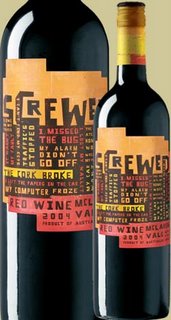 What’s this? Screwed Red Wine from McLaren Vale. Another Davey Family Wines product. At $8.99USD a bottle Screwed is a blend of Shiraz, Cabernet Sauvignon and Tempranillo. Screwed is part of Precept Brands; which I’m presuming owns Davey Family Wines. The back label reads “Your alarm doesn’t go off and you wake up an hour late…you try to open a bottle of wine and the cork breaks…get to the airport and you realize that you forgot your passport…you’re totally screwed! Unscrew yourself by unscrewing a bottle of screwed red wine from Australia’s famed Mclaren Vale. This rich and vibrant red wine has blackberry aromas and flavors. With just a touch of vanilla oak for a smooth finish. And no corkscrews involved for the accident prone.”
This could be a bit of fun. The name is topical, fitting in with the new drive to screwcaps as well as the obvious sexual connotation. If it turns out to be swill we can still get a few laughs from the label, and who knows what else a few glasses might lead to?
Tasted along with some salsa and corn chips the wine was quite attractive with aromas of cigar smoke over sweet oak, faint pepper, cola and dark fruits. Certainly confected and fruit forward. The palate was medium weight with bright acidity and soft tannins. The flavors carried well and provided nice length to the finish. However there was little depth or complexity to the wine. It scored a 16.1/20 or 81/100 from me.
How successful was I at selecting a wine? Well given that I went for something that I thought might be more fun than quality it turned out reasonably well. But I don’t envy the novice wine drinker the task of making a serious choice from the Henry’s wine selection. The lack of shelf talkers or even any staff recommendations makes wine selection difficult. The lack of information on their shelves is unfortunate given that their web site does make an attempt to introduce the consumer to wine. Dare I venture into any more supermarket wine aisles?
Oh, would I get off my tits on Screwed? That would depend on what you think getting off my tits means!
As I stood there leaning on the shopping cart it suddenly occurred to me that unless I knew what I was after how was I going to choose, assuming that I was going to buy wine? A lot of the wine labels didn’t even look familiar. OK, don’t panic. Let’s be sensible about this. You have walked into a store looking for a bottle of inexpensive wine. Find a bottle of wine. It can’t be that hard, after all you are supposed to know a little bit about the subject. A sign said Shiraz. I know what that is! Familiarity does breed contempt. They all seemed to be from places other than Australia. None looked familiar. Several were from California, some of which were even called Shiraz but most were labeled Syrah. Well I could be adventurous but I had seen the ubiquitous [yellowtail] Shiraz when we had come into the store so I knew there was Aussie wine here somewhere. Let’s go with what we know best. But where were they? Ahh huh, over there under the sign Australia.
Like most supermarkets Henry’s does not carry a large or expensive selection of wine in any category. Still inexpensive Aussie wine is the flavor of the month and so there were several dozen reds to pick from; I didn’t to an actual count. Keeping to the plan I checked out the Shiraz lineup. The usual suspects were there including [yellowtail], Rosemount and Jacobs Creek. There was also a Deakin Estate and something called Red Knot. Pretty label. Hmm, made by the Davey Family Wines from McLaren Vale. They make Shingleback Shiraz which is pretty good wine. But I’m supposed to be playing the part of an average consumer who knows that Australian Shiraz is good wine, not what Australian Shiraz wines are better than others. OK, what else is there. Alice White Shiraz! Sounds like something made by the girl next door, or maybe the old guy next door acting as though he’s a girl!
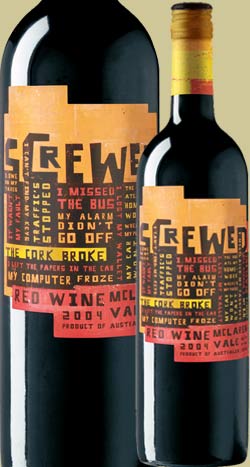 What’s this? Screwed Red Wine from McLaren Vale. Another Davey Family Wines product. At $8.99USD a bottle Screwed is a blend of Shiraz, Cabernet Sauvignon and Tempranillo. Screwed is part of Precept Brands; which I’m presuming owns Davey Family Wines. The back label reads “Your alarm doesn’t go off and you wake up an hour late…you try to open a bottle of wine and the cork breaks…get to the airport and you realize that you forgot your passport…you’re totally screwed! Unscrew yourself by unscrewing a bottle of screwed red wine from Australia’s famed Mclaren Vale. This rich and vibrant red wine has blackberry aromas and flavors. With just a touch of vanilla oak for a smooth finish. And no corkscrews involved for the accident prone.”
This could be a bit of fun. The name is topical, fitting in with the new drive to screwcaps as well as the obvious sexual connotation. If it turns out to be swill we can still get a few laughs from the label, and who knows what else a few glasses might lead to?
Tasted along with some salsa and corn chips the wine was quite attractive with aromas of cigar smoke over sweet oak, faint pepper, cola and dark fruits. Certainly confected and fruit forward. The palate was medium weight with bright acidity and soft tannins. The flavors carried well and provided nice length to the finish. However there was little depth or complexity to the wine. It scored a 16.1/20 or 81/100 from me.
How successful was I at selecting a wine? Well given that I went for something that I thought might be more fun than quality it turned out reasonably well. But I don’t envy the novice wine drinker the task of making a serious choice from the Henry’s wine selection. The lack of shelf talkers or even any staff recommendations makes wine selection difficult. The lack of information on their shelves is unfortunate given that their web site does make an attempt to introduce the consumer to wine. Dare I venture into any more supermarket wine aisles?
Oh, would I get off my tits on Screwed? That would depend on what you think getting off my tits means!
Monday, March 20, 2006
Pricey Grange
Mark Wickman of Wickman’s Fine Wine Auctions has sent out a press release questioning the asking price of the 2001 Penfolds Grange. How much do they want? A paltry $600AUD/bottle. Mark thinks that just a little too much, and I’m inclined to agree. While Grange is unique in terms of the iconic wines of Australia and there is a market for the wine locally it can be quite difficult to get access to bottles of Grange. This is due to allocation of the wine which is based on sales of quantities of other Penfolds wines. Thus a fine wine store selling St Henri, RWT and Magill etc may get a smaller allocation than a supermarket selling larger quantities of Koonunga Hill, Thomas Hyland and the Rawson’s Retreat range.
To read what other think about the price of Grange check out the Auswine forum thread.
The Wickman Press Release is copied below.
Auction expert questions pricing policy of the imminent Penfolds Grange release and urges collectors to consider recent performance before making any buying decisions.
Adelaide, Australia - March 21, 2006 -- Every year, the release of Penfolds Grange sparks excitement among wine drinkers who want to ensure they don’t miss out on their share of Australia’s most prestigious wine.
Penfolds has announced that this year’s release date will be May 1st and asking prices for the 2001 Grange are estimated to be as high as $600.
But according to Mark Wickman of Wickman’s Fine Auctions, paying that much for a bottle of 2001 Grange upon release makes little sense.
“I believe Grange is overpriced at that price and predict that while this new release will sell at a premium initially, it will then drop back below $400 within a year or so,” he says.
“The 2000 vintage was not doing well at auction last year, fetching around the $500 mark if it sold, but demand was poor and many lots around the country were left wanting.
“In fact, recent past vintages including the 1999 and the 1997 are selling below $300 per bottle sometimes as low as $200 each and even the renowned 1998 is selling for approximately $400 or less, so I question Penfolds decision to release it at $600 when buyers can expect better bargains at auction.”
Wickman says that he also expects plenty of Grange to be dumped on to the secondary market as a result of the Heritage collapse, further pushing down the value of this iconic wine.
“At a recent silent auction, a rare full set of Penfolds Grange valued at more than $170,000 failed to sell I think that is as clear a sign you can get that Grange’s secondary market value is slipping,” he says.
“Considering the current state of the market and basic supply versus demand principles, I believe it would be best for buyers to buy their Grange at auction rather than on release.”
About Wickman Fine Wine Auctions;
Distinguished by innovation and driven by passion, Wickman’s Fine Wine Auctions has been a lively and profitable meeting ground for wine buyers and sellers since 2003. A family business based in South Australia, Wickman’s prides itself on its position as a reliable resource with a well-spring of extraordinary values and opportunities.
Being a good “neighbour” in a global community is an important part of Wickman’s corporate identity.
“Philanthropy is in our blood,” explained Wickman, referring to his family’s commitment to annual fundraising.
“In the last three years, Wickman’s has auctioned wine and wine-related services generously donated from wine companies from Australia and overseas and raised over $17,000 to benefit The Multiple Sclerosis society, The Asian Tsunami Appeal, a local South Australian charity; The Eyre Peninsula Fire appeal and the Adelaide Women and Children’s Hospital foundation.”
For additional information contact:
Mark Wickman
WICKMAN'S FINE WINE AUCTIONS
PO Box 1270
North Haven
South Australia, 5018
Australia
Website: http://wineauction.wickman.net.au/
To read what other think about the price of Grange check out the Auswine forum thread.
The Wickman Press Release is copied below.
Auction expert questions pricing policy of the imminent Penfolds Grange release and urges collectors to consider recent performance before making any buying decisions.
Adelaide, Australia - March 21, 2006 -- Every year, the release of Penfolds Grange sparks excitement among wine drinkers who want to ensure they don’t miss out on their share of Australia’s most prestigious wine.
Penfolds has announced that this year’s release date will be May 1st and asking prices for the 2001 Grange are estimated to be as high as $600.
But according to Mark Wickman of Wickman’s Fine Auctions, paying that much for a bottle of 2001 Grange upon release makes little sense.
“I believe Grange is overpriced at that price and predict that while this new release will sell at a premium initially, it will then drop back below $400 within a year or so,” he says.
“The 2000 vintage was not doing well at auction last year, fetching around the $500 mark if it sold, but demand was poor and many lots around the country were left wanting.
“In fact, recent past vintages including the 1999 and the 1997 are selling below $300 per bottle sometimes as low as $200 each and even the renowned 1998 is selling for approximately $400 or less, so I question Penfolds decision to release it at $600 when buyers can expect better bargains at auction.”
Wickman says that he also expects plenty of Grange to be dumped on to the secondary market as a result of the Heritage collapse, further pushing down the value of this iconic wine.
“At a recent silent auction, a rare full set of Penfolds Grange valued at more than $170,000 failed to sell I think that is as clear a sign you can get that Grange’s secondary market value is slipping,” he says.
“Considering the current state of the market and basic supply versus demand principles, I believe it would be best for buyers to buy their Grange at auction rather than on release.”
About Wickman Fine Wine Auctions;
Distinguished by innovation and driven by passion, Wickman’s Fine Wine Auctions has been a lively and profitable meeting ground for wine buyers and sellers since 2003. A family business based in South Australia, Wickman’s prides itself on its position as a reliable resource with a well-spring of extraordinary values and opportunities.
Being a good “neighbour” in a global community is an important part of Wickman’s corporate identity.
“Philanthropy is in our blood,” explained Wickman, referring to his family’s commitment to annual fundraising.
“In the last three years, Wickman’s has auctioned wine and wine-related services generously donated from wine companies from Australia and overseas and raised over $17,000 to benefit The Multiple Sclerosis society, The Asian Tsunami Appeal, a local South Australian charity; The Eyre Peninsula Fire appeal and the Adelaide Women and Children’s Hospital foundation.”
For additional information contact:
Mark Wickman
WICKMAN'S FINE WINE AUCTIONS
PO Box 1270
North Haven
South Australia, 5018
Australia
Website: http://wineauction.wickman.net.au/
Partners Argue Over Ends of the Roogle
(From the Wine Spectator) When U.S. importer Dan Philips teamed with Australian winemakers Sparky and Sarah Marquis to make Marquis Philips wines in 2000, they designed a symbol for the label that had the head of an American eagle on the body of a kangaroo. They called it a roogle. Looks like the roogle is a dead duck. The partnership is kaput, and in the aftermath the parties are suing each other in Australia. Philips has formed a new company that plans to continue the highly promising Marquis Philips brand and add other wines under a new chief winemaker--Chris Ringland, who also makes Rockford, RBJ and Greenock Creek wines. The Marquises also have a new brand, Mollydooker, which is set for release in the United States later this year.
FYI mollydooker is a left-handed person. Also mollydook, molly dook(er), molly-dook(er).
FYI mollydooker is a left-handed person. Also mollydook, molly dook(er), molly-dook(er).
Thursday, March 16, 2006
Of Wine, Books, and Reading for a Head Cold
It seems colder and wetter than normal in San Diego these days. And that always leads to the great nemesis of the wine drinker, the head cold. Mine seems to have come by way of a three year old. “Gracie just has allergies” said her mother as her sweet child coughed, open mouthed, at all and sundry. In fact, now that I remember, I had been nursing her on my hip only a day or two earlier when all this coughing had begun and I had said to Gracie then, “You aren’t going to cough on me are you?” To which the child replied “Yes” and promptly coughed in my face.
Fortunately I have a powerful weapon against this type of assault – Fisherman’s Friends. And they seemed to be working. Miranda predictably came down with a cold. But I was OK. A little sniffly. But OK for four or five days. It finally caught up with me. Probably on the day we visited Orange County. Strangely prophetic, perhaps!
So there I was at home, feeling miserable, and wondering when the weather would begin to warm and I would feel better. With wine never far from my mind, the chill in the room reminded me of J. P. Donealvy’s Leila: Further in the Life and Destines of Darcy Dancer, Gentleman and the sentence on page 16 that reads “Announcing in sepulchral tones the year of vintage as he poured the decanted premier grand cru Margaux with its bouquet shrinking back in the glass from the cold.”
I didn’t fancy rereading Leila, excellent thou it is. I could perhaps begin James Halliday’s Wine Odyssey, or the recently purchased Jamie Goode’s The Science of Wine. But did I want to start something new when the pile of books beside the bed had volumes like A Wine Journey along the Russian River by Steve Heimoff, and Appreciating Wine by Philip Hills that were yet to be finished? Besides I wanted to reread George Taber’s excellent Judgment of Paris: California vs. France and the Historic 1976 Paris Tasting That Revolutionized Wine again, as well as Elin McCoy’s The Emperor of Wine: The Rise of Robert M. Parker, Jr. and the Reign of American Taste. They should be read in that order to get a solid grasp of the recent history of wine in America.
Also in the unfinished pile was Bob Woodward’s Plan of Attack. But I think I know how that one is going to end. Besides I didn’t really want to take up anything long because I wasn’t planning on spending a lot time lying around. There was Playboy. I can always find something in there that catches my eye. This time it was Michael Ruse on Faith and Reason in the April 2006 issue. I followed that with Michael Specter’s piece Political Science in the March 13, 2006 issue of the New Yorker. Two excellent pieces on the growing conflict between science and religion and the all too obvious battleground of red and blue politics. Yes, I think one can be justified by responding with an open mouthed blank stare after reading that the USA supports the vast majority of Nobel Prize winners and yet over 50% of the population does not believe in Darwin’s theory of evolution. I know I stared at the ceiling for a long time after I digested that information. Of course it might have just been the cough medication taking hold.
To regain some composure I thought about flipping through my own recent contribution to the scientific literature. Autoantibodies and Autoimmunity: Molecular mechanisms in health and disease. As the editor I wrote in the Preface "This book would not have been possible without the outstanding contributions of a group of highly talented and internationally respected authors." On a cold day, when you have just read how science is threatened by people who have a literal belief in another book that contains numerous errors in translation, its comforting to know that you have intelligent friends in many countries of this world.
Of course we scientists aren’t without humor. Miranda suggested I add the following to the end of my book bio. "He and his wife Miranda, a veterinarian, share their lives with three Standard Poodles, and four cats named after famous Irishmen." I wonder if J. P. Donleavy would be amused by that. Not that he’s Irish, but the Irishness of it might warm him a bit. Perhaps stir a little flavor from the glass of life. I’ve a feeling a lot of people could use a little warmth to reassure them that there is something good beyond the cold and dark and unnerving.
Fortunately I have a powerful weapon against this type of assault – Fisherman’s Friends. And they seemed to be working. Miranda predictably came down with a cold. But I was OK. A little sniffly. But OK for four or five days. It finally caught up with me. Probably on the day we visited Orange County. Strangely prophetic, perhaps!
So there I was at home, feeling miserable, and wondering when the weather would begin to warm and I would feel better. With wine never far from my mind, the chill in the room reminded me of J. P. Donealvy’s Leila: Further in the Life and Destines of Darcy Dancer, Gentleman and the sentence on page 16 that reads “Announcing in sepulchral tones the year of vintage as he poured the decanted premier grand cru Margaux with its bouquet shrinking back in the glass from the cold.”
I didn’t fancy rereading Leila, excellent thou it is. I could perhaps begin James Halliday’s Wine Odyssey, or the recently purchased Jamie Goode’s The Science of Wine. But did I want to start something new when the pile of books beside the bed had volumes like A Wine Journey along the Russian River by Steve Heimoff, and Appreciating Wine by Philip Hills that were yet to be finished? Besides I wanted to reread George Taber’s excellent Judgment of Paris: California vs. France and the Historic 1976 Paris Tasting That Revolutionized Wine again, as well as Elin McCoy’s The Emperor of Wine: The Rise of Robert M. Parker, Jr. and the Reign of American Taste. They should be read in that order to get a solid grasp of the recent history of wine in America.
Also in the unfinished pile was Bob Woodward’s Plan of Attack. But I think I know how that one is going to end. Besides I didn’t really want to take up anything long because I wasn’t planning on spending a lot time lying around. There was Playboy. I can always find something in there that catches my eye. This time it was Michael Ruse on Faith and Reason in the April 2006 issue. I followed that with Michael Specter’s piece Political Science in the March 13, 2006 issue of the New Yorker. Two excellent pieces on the growing conflict between science and religion and the all too obvious battleground of red and blue politics. Yes, I think one can be justified by responding with an open mouthed blank stare after reading that the USA supports the vast majority of Nobel Prize winners and yet over 50% of the population does not believe in Darwin’s theory of evolution. I know I stared at the ceiling for a long time after I digested that information. Of course it might have just been the cough medication taking hold.
To regain some composure I thought about flipping through my own recent contribution to the scientific
 literature. Autoantibodies and Autoimmunity: Molecular mechanisms in health and disease. As the editor I wrote in the Preface "This book would not have been possible without the outstanding contributions of a group of highly talented and internationally respected authors." On a cold day, when you have just read how science is threatened by people who have a literal belief in another book that contains numerous errors in translation, its comforting to know that you have intelligent friends in many countries of this world.
Of course we scientists aren’t without humor. Miranda suggested I add the following to the end of my book bio. "He and his wife Miranda, a veterinarian, share their lives with three Standard Poodles, and four cats named after famous Irishmen." I wonder if J. P. Donleavy would be amused by that. Not that he’s Irish, but the Irishness of it might warm him a bit. Perhaps stir a little flavor from the glass of life. I’ve a feeling a lot of people could use a little warmth to reassure them that there is something good beyond the cold and dark and unnerving.
Wednesday, March 01, 2006
Wine on the Mornington Peninsula of Victoria, Australia
I could have sworn that I didn’t drink that much during our visit to four wineries (Stonier, Moorooduc, Port Phillip (and Kooyong), and Paringa) on Mornington Peninsula in December last year. But I’ve just looked back over the blog posts and found that I have not made clear that it all happened on Sunday December 4th, 2005. Something has to be killing off my brain cells. Its either all that Shiraz or maybe its just old age!
Tuesday, February 28, 2006
Another Winery on the Mornington Peninsula - Paringa Estate
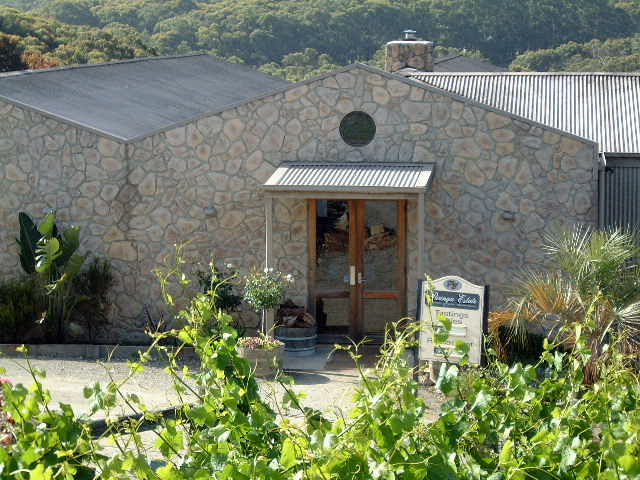
The wineries on the Mornington Peninsula close at 5 PM and as we paid for our non-wine purchase at Port Phillip Estate that witching hour was fast approaching. There was only one thing to be done, we would have to ask for directions to the next winery, Paringa Estate. This young winery was established by the McCall’s in 1985 with the first vintage made in 1988. Their wines are made from both Estate and Mornington Peninsula fruit by Lindsay McCall. Fortunately Paringa Estate, we were informed, was just down the road. “On the left. Just down the road.“ I made sure to ask twice. And he was right, well almost, we had two left turns to make but it was close enough that we pulled into an empty parking lot at five minutes to five. Still this was going to be close! No time to visit any restrooms.
We need not have worried. Although the tasting bar was vacant, the restaurant still had tables occupied with diners admiring the view and in a couple of cases each other. And even though all the staff were in cleanup mode no one seemed to be a hurry, especially the guy behind the wine bar. Even so we thought that maybe we shouldn’t overstay our welcome, so we’d just do the reds. But as I perused the line-up of bottles it was obvious that the Reserve level wines were no where to be seen. This was unfortunate because the 2003 Reserve Shiraz was only the second release of this special barrel selection of Shiraz, and I’d been looking forward to tasting it. I’d even ignored the fact that one email to Paringa had been bounced back and a second try had failed to raise a reply. The wine might just be worth being ignored. But I guess I was going to have to put Paringa Estate down as another winery that pretty much ignores the enthusiastic amateur. Still I could at least take my time getting notes on the reds that were on offer.
Writing tasting notes can have interesting effects on the people around you. In this case I didn’t even need to ask if it might be possible to taste the Reserve wines. As soon as I had finished jotting down notes on the Estate level wine and poured the rest of my glass into the spit bucket the guy behind the bar reached to his right and brought the hidden bottle into view, gave me a pour and then left the bottle so I could make notes from the label. OK, so some wineries only like to pour their best for folks they think are serious about wine. Problem is that one of the best ways to get serious about wine is to taste the best stuff you can get your hands on and one of the least expensive ways to do that is to taste at wineries.
Long story short I’m all for wineries that let you taste the expensive stuff, even if you have to pay a few dollars to do so. Torbreck Vintners in the Barossa in a classic example. If Paringa Estate wants to hide their best wines from all but the most serious then they don't make make my list of wine taster friendly wineries. Which is unfortunate because they make some nice wines like the 2004 Paringa Peninsula Pinot Noir (screw cap) ($25AUD). Light cherry red in color with aromas of ripe cherries and a little nail polish. Soft and supple in the mouth with excellent carry of flavors onto the palate. A very pleasant wine. 2, 2, 3.8, 10.0 = 17.8/20, 89/100. 14.5% alcohol. The 2003 Paringa Estate Pinot Noir ($55AUD) was cherry red and very closed giving up only faint spices. But the quality shows in the excellent mouth feel, impeccable balance, and finely boned structure. 2, 2, 3.6, 10.3 = 17.9/20, 90/100. 13.7% alcohol. Its expensive big brother, the 2004 Paringa Reserve Pinot Noir ($90AUD) also cherry red is another shy wine with soft floral and spicy notes over smoky oak. Very well structured with excellent balance and great varietal definition. 2, 2, 3.9, 10.3 = 18.2/20, 91/100. 14.9% alcohol.
The three Shiraz wines seemed much riper than any other Shiraz tasted during our day on the peninsula. The 2003 Paringa Peninsula Shiraz (screw cap) ($25AUD) was cherry red with pink edge in color and gave aromas of pepper and rich tomato paste. Medium to full bodied it was rich and ripe with blackberry and pepper on the palate. Nicely structured with firm tannins and pleasant length to the finish. Surely the best value. 2, 2, 4.0, 10.1 = 18.1/20, 90/100. 13.4% alcohol. Somewhat unusual for cool climate was the 2003 Paringa Estate Shiraz ($45AUD) (40% New Fench Troncais Oak). Also cherry red with pink edge it gave a hint of chocolate over ripe jammy flavors. Medium weight, with the juicy acidity just a touch overdone, it was not as structurally sound as the other wines. The finish was supported by firm tannins. 2, 2, 4.0, 9.8 = 17.8/20, 89/100. 13.7% alcohol. The 2003 Paringa Reserve Shiraz ($70AUD) (100% New French Troncais Oak) was cherry red with red edge. The aromas are of red and black fruits, and again light chocolate. Nicely balanced, with the flavors carrying well onto the palate and supported by firm tannins it finishes with a slight bitterness. 2, 2, 4.1, 9.9 = 18/20, 90/100. 13.7% alcohol.
Chocolate in cool climate Shiraz? I cannot tell a lie, that is what I smelt in the Estate and Reserve Shiraz wines. Well 2003 did have extremely warm and dry conditions that would have allowed Shiraz to achieve more ripeness and concentration. Before we left I snapped up a bottle of the Estate Shiraz to drink later just to make sure.
Saturday, February 25, 2006
Something to Crow About?
Over the last couple of years I’ve noticed a group of crows that congregate along our street. They seem to show a great deal of interest in the large macadamia nut tree in the front yard. Today in the San Diego Union Tribune an article notes the boom in local crow numbers.
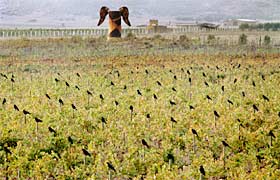 What has this got to do with wine? The article includes a photo by Don Kohlbauer of the Union Tribune which shows crows blanketing a vineyard northeast of Ensenada in Baja California, Mexico, every night at sunset last fall. Almost every post in the vineyard has a crow happily perched upon it. Happy until I guess someone from Crow Busters turns up! The interesting thing about crows and vineyard posts, according to the Crow Buster forum, is that they use the posts to congregate. Judging from the Union tribune photo and the photo on the Crow Busters forum this looks like a common, if potentially suicidal, activity for crows. Whether the crows constitute a serious threat to a vineyard is unclear. Although their diet does include fruit, it is quite varied. Still if you are a vigneron who wakes up every morning to crows occupying all the posts in your vineyard I think you might have cause for concern. If that is the case! Who you gonna call?
 What has this got to do with wine? The article includes a photo by Don Kohlbauer of the Union Tribune which shows crows blanketing a vineyard northeast of Ensenada in Baja California, Mexico, every night at sunset last fall. Almost every post in the vineyard has a crow happily perched upon it. Happy until I guess someone from Crow Busters turns up! The interesting thing about crows and vineyard posts, according to the Crow Buster forum, is that they use the posts to congregate. Judging from the Union tribune photo and the photo on the Crow Busters forum this looks like a common, if potentially suicidal, activity for crows. Whether the crows constitute a serious threat to a vineyard is unclear. Although their diet does include fruit, it is quite varied. Still if you are a vigneron who wakes up every morning to crows occupying all the posts in your vineyard I think you might have cause for concern. If that is the case! Who you gonna call?
Monday, February 20, 2006
Palate Uniformity
I’m not sure why I have so little confidence in the idea of palate calibration. It may have something to do with the variety of individual tasting abilities I have witnessed at numerous tastings over the last 30 or more years. Couple that experience with the increasing scientific knowledge on the complexity of taste and smell receptors and uniformity would appear to be the exception rather than the rule among wine tasters.
I was reminded again about just how different we can all be at a recent tasting of Italian wines; my notes on that tasting should appear some time soon. As usual the tasting was done single blind but during the tasting we were supplied with tasting notes from various critics on a number of the wines. At these events there are almost always a few people who will try during the tasting to pair the wines against the tasting notes, usually with quite poor results. I find it hard enough to record my own impression without seeing if I can match what someone else has written. Once we had tasted through the wines, rated them, voted for our best wines, and the wines’ identities were revealed, the discussion among a few of us turned to just how different our perceptions of the wines were compared to the supplied notes. The differences in the descriptors used were so great that jokes were made about how professional wine critics come up with their tasting note descriptions!
As with any tasting, the voting for the best wines among the 10 wines tasted varied considerably. While there were several clear favorites, and wines that were favored by none, the middle ground was a mixed bag. Even among the agreement that existed there was far from consensus. Such diversity of opinion usually, but not always, reflects upon the experiences of the tasters present.
Just how variable can a group of tasters be? The best examples I have found are those from the Palate Calibration Exercises (PCE) on Tom Cannavan’s Wine Pages. The idea behind the PCE was for forum members on Tom’s site to taste the same wine and then record their score and impressions so that other members can then gauge their palate against those impressions; information that might prove useful when reading tasting notes on other wines from the same individuals. Two wines have been subject to PCE so far. In 2001 the 2000 Rosemount Shiraz Cabernet was tasted by 36 people from all over the world. I won’t go into the details as they are readily available on Tom’s site. It is sufficient to note that the scores vary widely (perhaps wildly may also be correct) from 6-18/20. A similar situation was found with the 2004 PCE in which 54 people scored the 2003 Louis Jadot Beaujolais Villages "Combe des Jacques". Again the scores covered a considerable range going from a low of 7 to a high of 18 out of 20.
It is very instructive to read the tasting notes that accompany the summaries provided with each of these two tasting exercises. Again I am not going to go into any detail here, mainly because there is a wealth of information there that would take considerable time to discuss. But it is quite easy to note that there is a range of experience among the tasters; some of the names may even be familiar. It is also obvious that some are not that experienced with scoring wines; this may have influenced the breadth of the scoring. What the PCE make clear, once again, is that palate variation is a reality. My palate is different from yours, Robert Parker’s, probably everyone’s. But does that really matter? If you and I are confident in our ability to identify the wines that we enjoy then where exactly is the problem? Why do we have to spend time trying to figure out whether we are calibrated to this or that critic?
I was reminded again about just how different we can all be at a recent tasting of Italian wines; my notes on that tasting should appear some time soon. As usual the tasting was done single blind but during the tasting we were supplied with tasting notes from various critics on a number of the wines. At these events there are almost always a few people who will try during the tasting to pair the wines against the tasting notes, usually with quite poor results. I find it hard enough to record my own impression without seeing if I can match what someone else has written. Once we had tasted through the wines, rated them, voted for our best wines, and the wines’ identities were revealed, the discussion among a few of us turned to just how different our perceptions of the wines were compared to the supplied notes. The differences in the descriptors used were so great that jokes were made about how professional wine critics come up with their tasting note descriptions!
As with any tasting, the voting for the best wines among the 10 wines tasted varied considerably. While there were several clear favorites, and wines that were favored by none, the middle ground was a mixed bag. Even among the agreement that existed there was far from consensus. Such diversity of opinion usually, but not always, reflects upon the experiences of the tasters present.
Just how variable can a group of tasters be? The best examples I have found are those from the Palate Calibration Exercises (PCE) on Tom Cannavan’s Wine Pages. The idea behind the PCE was for forum members on Tom’s site to taste the same wine and then record their score and impressions so that other members can then gauge their palate against those impressions; information that might prove useful when reading tasting notes on other wines from the same individuals. Two wines have been subject to PCE so far. In 2001 the 2000 Rosemount Shiraz Cabernet was tasted by 36 people from all over the world. I won’t go into the details as they are readily available on Tom’s site. It is sufficient to note that the scores vary widely (perhaps wildly may also be correct) from 6-18/20. A similar situation was found with the 2004 PCE in which 54 people scored the 2003 Louis Jadot Beaujolais Villages "Combe des Jacques". Again the scores covered a considerable range going from a low of 7 to a high of 18 out of 20.
It is very instructive to read the tasting notes that accompany the summaries provided with each of these two tasting exercises. Again I am not going to go into any detail here, mainly because there is a wealth of information there that would take considerable time to discuss. But it is quite easy to note that there is a range of experience among the tasters; some of the names may even be familiar. It is also obvious that some are not that experienced with scoring wines; this may have influenced the breadth of the scoring. What the PCE make clear, once again, is that palate variation is a reality. My palate is different from yours, Robert Parker’s, probably everyone’s. But does that really matter? If you and I are confident in our ability to identify the wines that we enjoy then where exactly is the problem? Why do we have to spend time trying to figure out whether we are calibrated to this or that critic?
Taster’s Choice
Before I get too many emails, cards and letters telling me how its what’s actually in a tasting note that counts and not the “score”, and that I should be “calibrating” my palate to some wine critic I thought I should perform a pre-emptive strike.
 I’ve posted elsewhere on this idea of calibrating your palate to that of a wine critic. I’m not going to repeat that discussion here, but the dilemma is far from simple. Not only is it important to consider whether a wine critic’s description of a wine has meaning for you and whether you trust the critic to get his/her descriptors correct. But the biggest problem with this idea of calibrating your palate is that I have never seen any approach or description of the method that one would use to achieve it, beyond the glib advice to find a critic whose palate matches your own! How do you match palates? What aspects of the wine need to be compared? Are some aspects more important than others? How many of the individual aspects of a wine need to be identified by two tasters in order for a match to be achieved? How many wine critics should you try to compare with yourself?
I rarely see extensive comparisons of tasting notes from wine critics, so how do we even know that their palates are consistently different for accurate calibration to be attempted? Perhaps I shouldn’t be too adamant on this point. There seem to be endless comparisons between wine critic X with Robert Parker or vice versa.
Even so the idea that one wine critic may be more attuned to your tastes than any other can be tested in a rudimentary way by simply recording a tasting note and comparing it with said wine critics. In the interests of time and space I have selected a single wine in order to compare the description of four different wine critics to see what similarities, or differences, exist in the description of a wine. There is no reason why you can’t do this yourself with as many wines as you want.
The wine is Wayne Dutschke’s 2002 St Jakobi’s Shiraz (Barossa Valley).
My tasting note is from our visit to Dutschke Wines on December 13, 2004. I noted that the 2002 St Jakobi Shiraz was a dark cherry, and chocolate just exploded out of that glass! The wine had big rich blackberry flavors, but with a soft and elegant entry and wonderful balance. You didn’t have to wait around for the wine to hit your palate in bits and pieces; it was seamless, wonderfully integrated, with a lengthy finish (2, 2, 4.3, 10.5 = 18.8; 15% alcohol). For those who are counting an 18.8 out of 20 is a 94 on the 100 point sale.
The other tasting notes are:
Vibrant mix of black and red fruits, perfectly integrated vanillin oak and fine, ripe tannins. Elegant style. Rating 92. Drink 2012. James Halliday Wine Companion 2005.
…………..This wine is bang on the money: fruit expressive, laced with coffee oak but not excessively so, full of heart-felt blue and black and red berry fruit, and ripped with choc-mint flavour. If anything it’s a pass too heavy on both the mint and the alcohol-but its great drinking. Drink: 2004-2012. 91. Campbell Mattinson Winefront Monthly Collected Reviews 2002-20005.
…………….Layered and full-bodied, with notes of expresso roast, creosote, blackberries, currants, licorice, and pepper, this rich, full-throttle classic Barossa Shiraz can be consumed now and over the next 10-12 years. 92 points. Robert Parker, Jr.’s The Wine Advocate. Issue 155. (10-25-04).
Ripe and well shaped, with cherry, berry, plum, mineral and licorice that sail on. Just enough juicy acidity, with integrated oak and refined tannins. 94 Harvey Steiman. Wine Spectator October 15, 2005.
Now an initial run though these notes might see some saying that all reviewers find the wine to be excellent, so what is the problem? But this is not about the general assessment, or score, given to the wine this is about the description of the wine from aromas to taste. The description of aromas shows clear similarities and differences. The differences are Mattinson’s mint and alcohol, Parker’s currents, creosote, and pepper, and Steiman’s plum and mineral. Such differences in detection of aromas is not unusual among a group of tasters. Why such differences occur is not completely known. Some of the difference is physiological, that is, some people can smell better than others. But studies have shown that very few of us can smell more than a few aromas.
What about the other aspects of wine, its acidity and tannins? What about balance and integration of the components? Well again there are some similarities and differences. For me the wine is integrated as a whole, while Halliday and Steiman have integrated oak; oak is only a single component albeit an external one that does need to be integrated. In contrast I have an elegant entry, Halliday is more effusive calling the Dutschke an elegant style. These are very significant differences in the use of both integrated and elegant. Balance is only used once!
In truth all five assessments are quite different, although perhaps Steiman and Halliday are somewhat similar. But we come back to the real question. How do you choose one (or more) of these as a calibrator? For me I can only pick my own tasting note as the other four are too different from mine. The naysayers will argue that you can’t base the selection of a calibrator on just one wine. My question to these individuals is how many wines are enough? And what characteristics of the tasting note am I to base my selection on? I have a sneaking suspicion that if you rigorously compare tasting notes of multiple wine critics to your own for a number of wines you will continue to find differences and those differences will not be consistent.
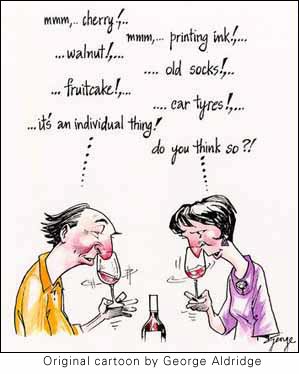 I’ve posted elsewhere on this idea of calibrating your palate to that of a wine critic. I’m not going to repeat that discussion here, but the dilemma is far from simple. Not only is it important to consider whether a wine critic’s description of a wine has meaning for you and whether you trust the critic to get his/her descriptors correct. But the biggest problem with this idea of calibrating your palate is that I have never seen any approach or description of the method that one would use to achieve it, beyond the glib advice to find a critic whose palate matches your own! How do you match palates? What aspects of the wine need to be compared? Are some aspects more important than others? How many of the individual aspects of a wine need to be identified by two tasters in order for a match to be achieved? How many wine critics should you try to compare with yourself?
I rarely see extensive comparisons of tasting notes from wine critics, so how do we even know that their palates are consistently different for accurate calibration to be attempted? Perhaps I shouldn’t be too adamant on this point. There seem to be endless comparisons between wine critic X with Robert Parker or vice versa.
Even so the idea that one wine critic may be more attuned to your tastes than any other can be tested in a rudimentary way by simply recording a tasting note and comparing it with said wine critics. In the interests of time and space I have selected a single wine in order to compare the description of four different wine critics to see what similarities, or differences, exist in the description of a wine. There is no reason why you can’t do this yourself with as many wines as you want.
The wine is Wayne Dutschke’s 2002 St Jakobi’s Shiraz (Barossa Valley).
My tasting note is from our visit to Dutschke Wines on December 13, 2004. I noted that the 2002 St Jakobi Shiraz was a dark cherry, and chocolate just exploded out of that glass! The wine had big rich blackberry flavors, but with a soft and elegant entry and wonderful balance. You didn’t have to wait around for the wine to hit your palate in bits and pieces; it was seamless, wonderfully integrated, with a lengthy finish (2, 2, 4.3, 10.5 = 18.8; 15% alcohol). For those who are counting an 18.8 out of 20 is a 94 on the 100 point sale.
The other tasting notes are:
Vibrant mix of black and red fruits, perfectly integrated vanillin oak and fine, ripe tannins. Elegant style. Rating 92. Drink 2012. James Halliday Wine Companion 2005.
…………..This wine is bang on the money: fruit expressive, laced with coffee oak but not excessively so, full of heart-felt blue and black and red berry fruit, and ripped with choc-mint flavour. If anything it’s a pass too heavy on both the mint and the alcohol-but its great drinking. Drink: 2004-2012. 91. Campbell Mattinson Winefront Monthly Collected Reviews 2002-20005.
…………….Layered and full-bodied, with notes of expresso roast, creosote, blackberries, currants, licorice, and pepper, this rich, full-throttle classic Barossa Shiraz can be consumed now and over the next 10-12 years. 92 points. Robert Parker, Jr.’s The Wine Advocate. Issue 155. (10-25-04).
Ripe and well shaped, with cherry, berry, plum, mineral and licorice that sail on. Just enough juicy acidity, with integrated oak and refined tannins. 94 Harvey Steiman. Wine Spectator October 15, 2005.
Now an initial run though these notes might see some saying that all reviewers find the wine to be excellent, so what is the problem? But this is not about the general assessment, or score, given to the wine this is about the description of the wine from aromas to taste. The description of aromas shows clear similarities and differences. The differences are Mattinson’s mint and alcohol, Parker’s currents, creosote, and pepper, and Steiman’s plum and mineral. Such differences in detection of aromas is not unusual among a group of tasters. Why such differences occur is not completely known. Some of the difference is physiological, that is, some people can smell better than others. But studies have shown that very few of us can smell more than a few aromas.
What about the other aspects of wine, its acidity and tannins? What about balance and integration of the components? Well again there are some similarities and differences. For me the wine is integrated as a whole, while Halliday and Steiman have integrated oak; oak is only a single component albeit an external one that does need to be integrated. In contrast I have an elegant entry, Halliday is more effusive calling the Dutschke an elegant style. These are very significant differences in the use of both integrated and elegant. Balance is only used once!
In truth all five assessments are quite different, although perhaps Steiman and Halliday are somewhat similar. But we come back to the real question. How do you choose one (or more) of these as a calibrator? For me I can only pick my own tasting note as the other four are too different from mine. The naysayers will argue that you can’t base the selection of a calibrator on just one wine. My question to these individuals is how many wines are enough? And what characteristics of the tasting note am I to base my selection on? I have a sneaking suspicion that if you rigorously compare tasting notes of multiple wine critics to your own for a number of wines you will continue to find differences and those differences will not be consistent.
Thursday, February 16, 2006
You are What You Drink and Eat.
 Unhealthy alcohol drinking patterns may go hand-in-hand with unhealthy eating habits, according to a new study by researchers at the National Institute on Alcohol Abuse and Alcoholism (NIAAA), part of the National Institutes of Health (NIH), and the U.S. Department of Agriculture (USDA). Examining diet quality of individuals who drink any kind of alcoholic beverage, researchers found that people who drink the largest quantities of alcohol — even infrequently — have the poorest quality diets. Conversely, people who drink the least amount of alcohol — regardless of drinking frequency — have the best quality diets. A report of the findings appears in the February 15, 2006 issue of the American Journal of Epidemiology.
 More here.
Saturday, February 11, 2006
Wine Scoring – Seems Simple Enough To Me
The February/March 2006 issue of Gourmet Traveller Wine landed in our mail box yesterday. In addition to the magazine was a pocket-sized Tasting Notebook produced in association with Penfolds. Its an interesting little booklet with an introduction by Peter Gago, Penfolds Chief Winemaker and tasting notes on several of the Bin numbered Penfold wines. Gago comments that 2004 has a couple of firsts for Penfolds, one being “the first time that Penfolds has released a white wine in the Bin range”. I had to check that. According to my Rewards of Patience (4th Ed.) Reserve Bin whites were made in 1994 (Bin 94A Chardonnay, released 1997), 1995, (Bin 95A Chardonnay, released 1999), and 1998 (Bin 98A Chardonnay, unreleased as of May 2000). I guess what Peter means is 2004 is the first release of a white wine with a fixed Bin number.
But I digress. The notebook also includes a number of pages where the enthusiastic wine drinker can jot down tasting notes, which seems not unreasonable for a Tasting Notebook. You can record the identity of the Wine, Vintage, Price, Value for Money, Tasted Where, and then wax lyrical on the ethereal pleasures of the bottles’ contents. You can also make note of the food you might have eaten. And you can score the wine, and here is where considerable thought must have gone into this little booklet. Scoring requires a simple tick in one (or perhaps more) of the following four boxes – OUTSTANDING, EXTREMELY GOOD, VERY GOOD, or GOOD.
I’ve been known to sit and stare at various scoring systems and this one was no different. When I have been observed doing this its often been concluded that the visual concentration observed indicates deep, deep thought. But my mental state often depends upon the scoring system under review. Those closest to me know that the glazed expression can sometimes be closely akin to catatonia – I’m there, I’m just not responding.
I responded to the scoring system in the Gourmet Traveller Wine Tasting Notebook. Let’s not beat about the bush, or in this case vine. Wines are made to be scored, they need to be scored. If they could talk, they would tell you how important it is to them to be scored, to be scored by important people, to be scored often, and for the scores to be big, really, really big! Eighty-five is better than any thing less, ninety better still, ninety-five and you have really scored. But 100 is perfect. Still OUTSTANDING seems quite effusive, certainly better than GOOD. Well that is as long its accepted as the best descriptor available, and EXTREMELY GOOD accepted as the next level down. What about if you want to use stupendous, exceptional, incomparable, unrivaled, matchless, or any number of other descriptors. The limit is bounded by the extent of your vocabulary.
No, there are only four verbal descriptors in the Gourmet Traveller Wine Tasting Notebook scoring system, you can’t use more. Why not? That is the problem with verbal descriptors, or any non-numerical scoring system for that matter. Their greatest meaning is most often for the person using the system. And one of the problems with wine critics is that they need to be seen to be different, so there are a lot of unique scoring systems. True, numerical scoring systems are not perfect but there is no ambiguity in a numerical score. But hey, if you find less confusion between two puffs, recommended, three stars and extremely good, versus 18/20, 90/100, or 88/100 then more power to you.
Of course there are those who believe that wines should not be given numerical scores, or perhaps not even judged or compared at all. I find it an interesting thought as I stare, rather more blankly than usual, out my window into the canyon below.
Oh, and one last point. What happens when you taste a wine that is less than GOOD? I guess like most wine critics you don’t make a note of it in the Gourmet Traveller Wine Tasting Notebook.
But I digress. The notebook also includes a number of pages where the enthusiastic wine drinker can jot down tasting notes, which seems not unreasonable for a Tasting Notebook. You can record the identity of the Wine, Vintage, Price, Value for Money, Tasted Where, and then wax lyrical on the ethereal pleasures of the bottles’ contents. You can also make note of the food you might have eaten. And you can score the wine, and here is where considerable thought must have gone into this little booklet. Scoring requires a simple tick in one (or perhaps more) of the following four boxes – OUTSTANDING, EXTREMELY GOOD, VERY GOOD, or GOOD.
I’ve been known to sit and stare at various scoring systems and this one was no different. When I have been observed doing this its often been concluded that the visual concentration observed indicates deep, deep thought. But my mental state often depends upon the scoring system under review. Those closest to me know that the glazed expression can sometimes be closely akin to catatonia – I’m there, I’m just not responding.
I responded to the scoring system in the Gourmet Traveller Wine Tasting Notebook. Let’s not beat about the bush, or in this case vine. Wines are made to be scored, they need to be scored. If they could talk, they would tell you how important it is to them to be scored, to be scored by important people, to be scored often, and for the scores to be big, really, really big! Eighty-five is better than any thing less, ninety better still, ninety-five and you have really scored. But 100 is perfect. Still OUTSTANDING seems quite effusive, certainly better than GOOD. Well that is as long its accepted as the best descriptor available, and EXTREMELY GOOD accepted as the next level down. What about if you want to use stupendous, exceptional, incomparable, unrivaled, matchless, or any number of other descriptors. The limit is bounded by the extent of your vocabulary.
No, there are only four verbal descriptors in the Gourmet Traveller Wine Tasting Notebook scoring system, you can’t use more. Why not? That is the problem with verbal descriptors, or any non-numerical scoring system for that matter. Their greatest meaning is most often for the person using the system. And one of the problems with wine critics is that they need to be seen to be different, so there are a lot of unique scoring systems. True, numerical scoring systems are not perfect but there is no ambiguity in a numerical score. But hey, if you find less confusion between two puffs, recommended, three stars and extremely good, versus 18/20, 90/100, or 88/100 then more power to you.
Of course there are those who believe that wines should not be given numerical scores, or perhaps not even judged or compared at all. I find it an interesting thought as I stare, rather more blankly than usual, out my window into the canyon below.
Oh, and one last point. What happens when you taste a wine that is less than GOOD? I guess like most wine critics you don’t make a note of it in the Gourmet Traveller Wine Tasting Notebook.
Tuesday, February 07, 2006





Monday, February 06, 2006
Port Phillip Estate and Kooyong (Mornington Peninsula)
To get to the Port Phillip Estate cellar door you have to make your way up a long driveway. But first you have to find Port Phillip Estate. That involves more than just a little bit of back and forth along the roads of Mornington Peninsula. After Moorooduc Estate we were not under any illusions about how easy it would be to find another winery. After going the wrong way at least once we finally pulled up outside the cellar door just as a brief rain shower began falling. That made the now necessary visit to the restrooms more of a sprint than a leisurely stroll. But the few moments necessary for relief saw the rain off and allowed a comfortable amble into a very open and airy tasting room that overlooks rows of vines.
Both vineyards are very new with Port Phillip Estate having been established in 1987 and Kooyong even later in 1995. Neither winery seemed greatly excited when I proposed a visit by email but I was at least informed that the Kooyong wines could be tasted at the Port Phillip Estate cellar door. Consequently we only got to taste the wines that were being poured rather than all the wines that are produced by these two wineries. The wines tasted were poured by a young fellow whose family owns a small bottle shop. He told us he wants to get into the wine business and sees his stint at the cellar door as a step in that direction. He was at least attentive and talkative.
First up was the 2004 Port Phillip Estate Pinot Noir ($32AUD). Cherry red with pink edge. Slightly closed, it yielded notes of spice and white pepper. On the palate the wine was soft and supple and well balanced with the flavors carrying well onto the palate. 2, 2, 3.6, 10.0 = 17.6/20, 88/100. Next was the 2001 Port Phillip Estate Shiraz ($20AUD). Cherry red with a pink edge. This had aromas of menthol, oak and red current. In the mouth the wine had a soft entry backed up by nice firm tannins but lacked any real complexity. 2, 2, 3.2, 9.5 = 16.7/20, 84/100. The younger 2003 Port Phillip Estate Shiraz ($32AUD) was a deeper cherry in color with pepper, spice and blackberry aromas. It was soft and supple with pleasant carry of flavors onto the palate, juicy acidity, but marred by a little bitterness to the finish. 2, 2, 3.8, 9.8 = 17.6/20, 88/100.
The only Kooyong wine available for tasting was their 2000 Kooyong Pinot Noir ($37AUD). This is apparently the second vintage, and it was quite impressive. Cherry red in color with a pink edge. Rich, ripe and bold, it had intense spice and smoke aromas. On the palate it was medium weight with firm astringency, nicely balanced and well structured, and with good length to the finish. 2, 2, 4.0, 10.1 = 18.1/20, 90/10
Port Phillip Estate Wines can be obtained from Southern Hemisphere Wine. Kooyong is available through the Australian Premium Wine Collection, although the APWC web site has yet to catch up with that information. We didn’t buy any wines at the cellar door but we did see Glen Green’s Essential Wine Tasting Guide with the Port Phillip Estate logo, and quickly snapped one up.
Both vineyards are very new with Port Phillip Estate having been established in 1987 and Kooyong even later in 1995. Neither winery seemed greatly excited when I proposed a visit by email but I was at least informed that the Kooyong wines could be tasted at the Port Phillip Estate cellar door. Consequently we only got to taste the wines that were being poured rather than all the wines that are produced by these two wineries. The wines tasted were poured by a young fellow whose family owns a small bottle shop. He told us he wants to get into the wine business and sees his stint at the cellar door as a step in that direction. He was at least attentive and talkative.
First up was the 2004 Port Phillip Estate Pinot Noir ($32AUD). Cherry red with pink edge. Slightly closed, it yielded notes of spice and white pepper. On the palate the wine was soft and supple and well balanced with the flavors carrying well onto the palate. 2, 2, 3.6, 10.0 = 17.6/20, 88/100. Next was the 2001 Port Phillip Estate Shiraz ($20AUD). Cherry red with a pink edge. This had aromas of menthol, oak and red current. In the mouth the wine had a soft entry backed up by nice firm tannins but lacked any real complexity. 2, 2, 3.2, 9.5 = 16.7/20, 84/100. The younger 2003 Port Phillip Estate Shiraz ($32AUD) was a deeper cherry in color with pepper, spice and blackberry aromas. It was soft and supple with pleasant carry of flavors onto the palate, juicy acidity, but marred by a little bitterness to the finish. 2, 2, 3.8, 9.8 = 17.6/20, 88/100.
The only Kooyong wine available for tasting was their 2000 Kooyong Pinot Noir ($37AUD). This is apparently the second vintage, and it was quite impressive. Cherry red in color with a pink edge. Rich, ripe and bold, it had intense spice and smoke aromas. On the palate it was medium weight with firm astringency, nicely balanced and well structured, and with good length to the finish. 2, 2, 4.0, 10.1 = 18.1/20, 90/10
Port Phillip Estate Wines can be obtained from Southern Hemisphere Wine. Kooyong is available through the Australian Premium Wine Collection, although the APWC web site has yet to catch up with that information. We didn’t buy any wines at the cellar door but we did see Glen Green’s Essential Wine Tasting Guide with the Port Phillip Estate logo, and quickly snapped one up.
Wednesday, February 01, 2006
Top 100 Wine Blogs
We are pleased! Shiraz - where you are right now - rates 16th and Tasting Notes rates 45th in the Top 100 Wine Blogs. The rating are based on standardized composite logarithmic scores based on multiple relative link popularity rankings from more than a half-dozen top search engines, as well as page rank and web rank scores. As such, they are general quantitative ratings of popularity and do not measure quality of content or frequency of updates, which can be found below. Quality and frequency - it sounds like some sort of measure of sexual adequacy!
Wine Blogging #18
Vintage Wines LTD, San Diego, California.
 My first WBW and I have to praise a wine shop! Good thing I’m used to giving my favorite wine shop plenty of exposure, although it is usually on my other wine blog Tasting Notes.
Why continue to play favorites? Why not branch out and look for another wine shop in San Diego that feels the love? San Diego and surrounding counties are full of wine shops and wine bars doing great things for wine drinkers, just check out the events listed on Local Wine Events.Com. And then check out places like Wine Street , Carlsbad Wine Merchants , 57 Degrees , The Wine Encounter, Bacchus Wine Market & Tasting Room, Wine Sellar & Brasserie, Varietals Wine Merchants - the list goes on and on.
Even with such a large listing Vintage Wines has to be at the top. This wine shop, hidden away in a small mall on Miramar Road, is special to me for several reasons. First, I have along history with them. This goes back to some time in the mid-1980’s when I returned to California after I had returned to Australia; its not as confusing as it sounds, we can talk about it later. At that time I heard that there was this wine shop that had tastings on a Saturday morning. Once I started to attend the tastings I found that they also had a reasonable selection of Australian wines, long before Aussie wine was fashionable in the USA. Second, over the years their selection of Australian wines has grown so that they always have an excellent selection of wines on hand in all prices ranges from Yellow Tail to Torbreck. Third, they offer wine at attractive prices, very attractive prices. Fourth, the staff is knowledgeable, friendly, and diverse in their tastes. Very diverse! Fifth, they have a wide range of wines. American, Australian, French, German, Italian, New Zealand, Spanish, etc. And yes they have shelf talkers, and they will list the points – although for Australian wines you are just as likely to get Halliday’s scores as you are Parker’s.
Sounds like just another good wine shop? Vintage Wines is much more than that. One small example is the email conversations I have had over the last two days with Steve Frederick, the store manager. Yesterday I asked if they would be getting any of the John Duval Entity Shiraz. He replied that he would find out if his distributor is getting any of the wine. Then today I came across the press release confirming the rumors that Paterno Wines would be distributing Two Hands wines. Chasing up that news I rediscovered that Yabby Lake wines are also handled by Paterno. I’d tasted and really liked Yabby Lake on our last visit to Australia and so I fired off an email to Steve about availability. The reply came back with information on estimated pricing, vintages, and availability, and the little added extra that they also have Heathcote Estate Shiraz available – Tod Dexter is winemaker for both Yabby Lake and Heathcote Estate and I’d tasted wines from both vineyards with him last December. Money and wine will soon be changing hands.
Another of the features of Vintage Wines is the variety of wines available for tasting. You can always drop by for a taste from the Wine Bar (except Sunday). Changed every Friday the Bar consists of 5 whites, 6 reds, and 1 dessert wine offered by the taste or glass. The Wine Bar is set up by Bob Bartnett. Bob has been at Vintage for as long as I’ve been going there. Once the owner of a Mustang with the license plate ZINFAN, Bob knows and loves wine, especially Old World. If you are into over-oaked, high alcohol wines don’t ask Bob for recommendations. When Zinfandel was the topic of a Saturday tasting Bob would run it. I pretty soon figured out that we had different palates, but even though I tried I could never get my ordering of the wines to jibe with his. I could almost always come close when John Lindsey, the owner, ran a tasting but Bob could always fool me.
Those semi-structured Saturday tastings that initially drew me to Vintage Wines have long gone. Fortunately they have been replaced by more value orientated tasting schedule that can be done at your leisure. The $2 tasting usually consists of 5 wines under $15/bottle that are considered to provide the best bang for your dollar. The $5 tasting will get you 6 wines based around a varietal, style, or country of origin. Both tastings last from 11AM to 3PM. It is not unusual to find me at a table surrounded by glasses from the $5 tasting as well as few selected tastes from the Wine Bar. If Miranda comes we will often bring some nibbles, as do many of the Saturday regulars.
An event I try not to miss is the monthly Third Thursday tasting. This is a structured event run between 6.30-8.00PM. There are usually 8 top quality wines that are tasted single blind (i.e. you know the identity of the wines but not their order). Votes are taken for 1st, 2nd and 3rd placed wine, and then the identities are revealed. After that discussion and excuses ensue! For the cost of a reasonable bottle of wine (between $40-60) you can compare some outstanding examples of the winemakers art. The folks that attend these tasting can be quite diverse and I have often sat at tables with both novice and expert alike. The discussions can be interesting.
That’s Vintage Wines. If you are ever in San Diego, especially on a Saturday, drop by and spend $7!
No I don’t have a tasting note to go with this WBW commentary. But if you link to Tasting Notes you will find a bunch of notes on $5 and Third Thursday tastings from Vintage Wines.
Vintage Wines LTD, 6904 Miramar Road, Suite 101 San Diego, CA 92121
Web: http://shop.vintagewinessd.com/index.htm,
Tel: (858) 549-2112, Fax: (858) 549-0557, Email: info@vintagewinessd.com
Storefront Hours: Sun & Mon 10AM-6PM, Tues 10AM-7PM, Wed through Fri 10AM-9PM, Sat 10AM-6PM
 My first WBW and I have to praise a wine shop! Good thing I’m used to giving my favorite wine shop plenty of exposure, although it is usually on my other wine blog Tasting Notes.
Why continue to play favorites? Why not branch out and look for another wine shop in San Diego that feels the love? San Diego and surrounding counties are full of wine shops and wine bars doing great things for wine drinkers, just check out the events listed on Local Wine Events.Com. And then check out places like Wine Street , Carlsbad Wine Merchants , 57 Degrees , The Wine Encounter, Bacchus Wine Market & Tasting Room, Wine Sellar & Brasserie, Varietals Wine Merchants - the list goes on and on.
Even with such a large listing Vintage Wines has to be at the top. This wine shop, hidden away in a small mall on Miramar Road, is special to me for several reasons. First, I have along history with them. This goes back to some time in the mid-1980’s when I returned to California after I had returned to Australia; its not as confusing as it sounds, we can talk about it later. At that time I heard that there was this wine shop that had tastings on a Saturday morning. Once I started to attend the tastings I found that they also had a reasonable selection of Australian wines, long before Aussie wine was fashionable in the USA. Second, over the years their selection of Australian wines has grown so that they always have an excellent selection of wines on hand in all prices ranges from Yellow Tail to Torbreck. Third, they offer wine at attractive prices, very attractive prices. Fourth, the staff is knowledgeable, friendly, and diverse in their tastes. Very diverse! Fifth, they have a wide range of wines. American, Australian, French, German, Italian, New Zealand, Spanish, etc. And yes they have shelf talkers, and they will list the points – although for Australian wines you are just as likely to get Halliday’s scores as you are Parker’s.
Sounds like just another good wine shop? Vintage Wines is much more than that. One small example is the email conversations I have had over the last two days with Steve Frederick, the store manager. Yesterday I asked if they would be getting any of the John Duval Entity Shiraz. He replied that he would find out if his distributor is getting any of the wine. Then today I came across the press release confirming the rumors that Paterno Wines would be distributing Two Hands wines. Chasing up that news I rediscovered that Yabby Lake wines are also handled by Paterno. I’d tasted and really liked Yabby Lake on our last visit to Australia and so I fired off an email to Steve about availability. The reply came back with information on estimated pricing, vintages, and availability, and the little added extra that they also have Heathcote Estate Shiraz available – Tod Dexter is winemaker for both Yabby Lake and Heathcote Estate and I’d tasted wines from both vineyards with him last December. Money and wine will soon be changing hands.
Another of the features of Vintage Wines is the variety of wines available for tasting. You can always drop by for a taste from the Wine Bar (except Sunday). Changed every Friday the Bar consists of 5 whites, 6 reds, and 1 dessert wine offered by the taste or glass. The Wine Bar is set up by Bob Bartnett. Bob has been at Vintage for as long as I’ve been going there. Once the owner of a Mustang with the license plate ZINFAN, Bob knows and loves wine, especially Old World. If you are into over-oaked, high alcohol wines don’t ask Bob for recommendations. When Zinfandel was the topic of a Saturday tasting Bob would run it. I pretty soon figured out that we had different palates, but even though I tried I could never get my ordering of the wines to jibe with his. I could almost always come close when John Lindsey, the owner, ran a tasting but Bob could always fool me.
Those semi-structured Saturday tastings that initially drew me to Vintage Wines have long gone. Fortunately they have been replaced by more value orientated tasting schedule that can be done at your leisure. The $2 tasting usually consists of 5 wines under $15/bottle that are considered to provide the best bang for your dollar. The $5 tasting will get you 6 wines based around a varietal, style, or country of origin. Both tastings last from 11AM to 3PM. It is not unusual to find me at a table surrounded by glasses from the $5 tasting as well as few selected tastes from the Wine Bar. If Miranda comes we will often bring some nibbles, as do many of the Saturday regulars.
An event I try not to miss is the monthly Third Thursday tasting. This is a structured event run between 6.30-8.00PM. There are usually 8 top quality wines that are tasted single blind (i.e. you know the identity of the wines but not their order). Votes are taken for 1st, 2nd and 3rd placed wine, and then the identities are revealed. After that discussion and excuses ensue! For the cost of a reasonable bottle of wine (between $40-60) you can compare some outstanding examples of the winemakers art. The folks that attend these tasting can be quite diverse and I have often sat at tables with both novice and expert alike. The discussions can be interesting.
That’s Vintage Wines. If you are ever in San Diego, especially on a Saturday, drop by and spend $7!
No I don’t have a tasting note to go with this WBW commentary. But if you link to Tasting Notes you will find a bunch of notes on $5 and Third Thursday tastings from Vintage Wines.
Vintage Wines LTD, 6904 Miramar Road, Suite 101 San Diego, CA 92121
Web: http://shop.vintagewinessd.com/index.htm,
Tel: (858) 549-2112, Fax: (858) 549-0557, Email: info@vintagewinessd.com
Storefront Hours: Sun & Mon 10AM-6PM, Tues 10AM-7PM, Wed through Fri 10AM-9PM, Sat 10AM-6PM
Monday, January 30, 2006
Wine Pairings
There has been a lot of discussion recently about what pairs with wine, specifically whether cheese is a good match for red wine. I have a pairing that I think goes remarkably well – poodles and wine. No, I haven’t yet done an exhaustive investigation on the subject; although I don’t see why that should matter because all the armchair experts will just come out of their closets and poo-poo the idea anyway.
But the evidence is mounting. Moorooduc Estate (Mornington Peninsula) has two poodles; although they don't feature on the web site. Abercorn (Mudgee) has one. And there must be more in Wine Dogs. The Basic Juice blog has one. And Shiraz has three – we don’t do anything by halves.
There is the beautiful 12 year old Mercy, with a little bit of breakfast on her bottom lip - old age must be setting in! Then there is the lovely white princess Arwen Evenstar (0r Winnie), who just turned two - Happy Birthday Poo!



And finally there is the four year old Strider AKA Aragorn Elessar Son of Arathorn, Heir of Isildur and King of the Reunited Kingdom of the Dúnedain. Called by Gandalf 'the greatest traveller and huntsman in this age of the world', AKA Strides.
There has been a lot of discussion recently about what pairs with wine, specifically whether cheese is a good match for red wine. I have a pairing that I think goes remarkably well – poodles and wine. No, I haven’t yet done an exhaustive investigation on the subject; although I don’t see why that should matter because all the armchair experts will just come out of their closets and poo-poo the idea anyway.
But the evidence is mounting. Moorooduc Estate (Mornington Peninsula) has two poodles; although they don't feature on the web site. Abercorn (Mudgee) has one. And there must be more in Wine Dogs. The Basic Juice blog has one. And Shiraz has three – we don’t do anything by halves.
There is the beautiful 12 year old Mercy, with a little bit of breakfast on her bottom lip - old age must be setting in! Then there is the lovely white princess Arwen Evenstar (0r Winnie), who just turned two - Happy Birthday Poo!
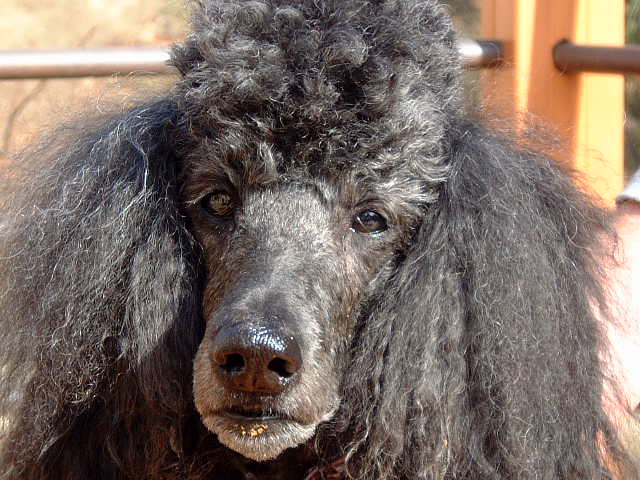
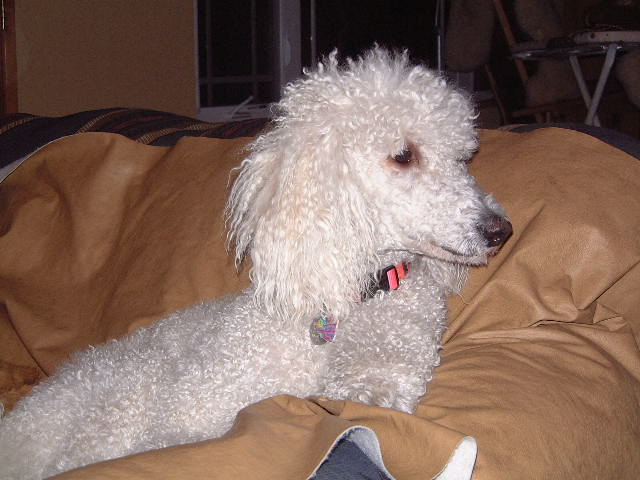
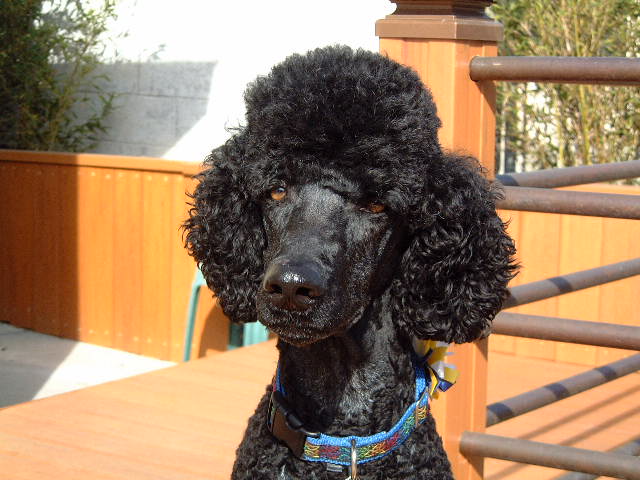
And finally there is the four year old Strider AKA Aragorn Elessar Son of Arathorn, Heir of Isildur and King of the Reunited Kingdom of the Dúnedain. Called by Gandalf 'the greatest traveller and huntsman in this age of the world', AKA Strides.
On the Wild Side at Moorooduc Estate (Mornington Peninsula, Victoria, Australia)
Continuing with our December 2005 visit to Mornington Peninsula and its wineries.
All the hospitality we received at Stonier Wines left us with only a small amount of time to make our 1pm lunch reservation at Jill's at Moorooduc Estate. I’d set up the lunch reservation and some wine tasting with Kate McIntyre, daughter of Moorooduc Estate owners Richard and Jill McIntyre. In one of her emails Kate had written “Give us a call if you have any problems finding us!”
That was, of course, well before we had even boarded the plane to Oz, let alone actually being in the process of motoring down Frankston Road after leaving Stonier. “OK, so we just turn left onto Balnarring Road and then right onto Derril Road.” That sounds simple. And as long as you don’t drive past Derril Road, it is! Once you go past Foxys Road you will be able to figure it – Derril Road is behind you. Have I mentioned the narrow roads yet? Or the undulations that hide oncoming cars? Thought not. How about Derils Road being dirt. No? Oh well, never mind. The drive past Devilbend Reservoir has a calming influence. More importantly Moorooduc Estate is worth the effort.
We actually arrived slightly early and so dropped into the tasting room to see if we could find Kate before heading to Jill’s restaurant for lunch. “Is Kate McIntyre about?” “Oh you must be her American visitors. I think she’s in the main building.” She was indeed, and she wasn’t alone. Samwise and Pedro were with her, and while they turned out to be a little more cautious in their greeting than Kate we were very happy to meet them. Miranda was particularly happy; she hadn’t seen a Poodle for at least two days.
 The main building at Moorooduc Estate is very impressive, certainly the most beautiful of the wineries we visited on the Peninsula. Its rammed earth construction is both rustic and modern, and most certainly spacious. Jill’s, their restaurant, overlooks vineyards and the Moorooduc Valley. My first impression of Moorooduc wines was the 2001 The Moorooduc Pinot Noir (French oak) that I had with lunch. Cherry red in color with an orange tinged edge, my glass gave waves and waves of spicy Pinot Noir notes over stewed quince and an appealing earthy, meaty bouquet. Medium to full bodied it was beautifully soft and supple with a backbone of juicy acidity and very fine tannins supporting a lengthy finish. 2, 2, 4.5, 10.3 = 18.8/20, 94/100. It was a brilliant accompaniment to the excellent food served at Jill’s. Moorrooduc also offers accommodation for those who might want to spend some quality time among the vines and away from everything else.
Similar to many Mornington Peninsula wineries Moorooduc Estate is a relative newcomer. It was founded in 1982. The vineyards total about 12 acres and are in a warmer and more elevated area than Stonier. Production is relatively small, about 2,500 to 3,000 cases per year. What is unique to Moorooduc is that the wines are fermented using yeasts present in the vineyards. Wild yeast fermentation was begun in 1996 at Moorooduc and within five years (2001 vintage) all the Estate wines were being produced using wild yeast fermentation. The yeast strains have not been identified and so it is not known if the same strains are active in the annual fermentations, or indeed if the yeasts are truly wild; they may have originated from commercial yeast used in the earliest vintages. In any case wild fermentation is a clear sign that Richard McIntyre has considerable confidence in his abilities as a winemaker.
Moorooduc Estate makes three levels of wine, all of which will be under screwcap with the 2004 vintage. The Devil Bend wines are made with fruit sourced from viticulturally different parts of Mornington Peninsula. The Estate wines reflect the Moorooduc subregion and include fruit from the Estate’s Derril Road vineyard. The top of the line are the wines labeled The Moorooduc. Sourced from the best of the Derril Road fruit, these wines are made in very limited quantities.
My notes are in the order the wines were tasted. First up was the 2004 Pinot Gris (Screwcap) (French oak). Light straw yellow in color it gave a fresh, yeasty aroma backed up by lemon and anise. Those flavors as well as some herbaceousness carry onto the palate. The feel of the wine in the mouth is soft and round (malolactic?). It’s a fruit driven wine that gives the impression of slight sweetness. There is nice length to the finish. 2, 2, 3.6, 9.8 = 17.4/20, 87/100. 14% alcohol. Next was the 2002 Devils Bend Creek Chardonnay (French oak). Light straw yellow in color, I detected a slight reductive character. Pleasant fruit without great complexity. Appealingly soft in the mouth (from malolactic fermentation), there is just a touch of oak evident. 2, 2, 3.6, 9.8 = 17.4/20, 87/100. 13.5% alcohol. The 2003 Moorooduc Estate Chardonnay (French oak – 35% new) (100% barrel ferment) was light straw in color with opulent aromatics. Its a mouth pleasing wine with no sharp edges, impressive balance and a lengthy finish. 2, 2, 4.1, 10.2 = 18.3/20, 92/100. 13.5% alcohol. Surprisingly I found the 2003 The Moorooduc Chardonnay (French Oak – 40% new) only (very) slightly better than its little sister at this stage of its life. Others will certainly disagree with my assessment. But I found this light straw yellow wine just a little too influenced by oak characters at present. But its quality is clearly evident once the wine hits your mouth. Wonderfully soft and graceful on the palate, beautifully balanced and with great length to the finish, it is a wine that will take 3 to 5 years to show its real class. 2, 2, 4.0, 10.4 = 18.4/20, 92/100.
The first of the red wines tasted was the 2003 Devils Bend Creek Pinot Noir (French oak – 10% or less new oak). Light cherry with pink edge. Very nice spicy Pinot Noir character with notes of stewed quince, strawberry, and just a little nail polish. Medium to full bodied with juicy acidity and excellent presence of flavors on the palate. 2, 2, 3.9, 9.8 = 17.7/20, 88/100. 14% alcohol. The 2003 Moorooduc Estate Pinot Noir (French Oak) is light cherry with pink edge. At this stage more restrained than the Devils Bend Pinot with notes of pepper and sawdust. This wine really comes alive in the mouth with a burst of spiciness. Excellent mouthfeel, nice balance, and great length to the finish mark a very attractive wine. 2, 2, 4.0, 10.0= 18.0, 90/100. 14% alcohol. The top of the line 2003 The Moorooduc Pinot Noir (Screwcap) (French Oak) is light cherry with pink edge in color. Beautiful complex savoury earth notes backed up by slight pepper over spicy Pinot. Simply excellent. Medium to full bodied it is soft and supple in the mouth with excellent presence of flavors on the palate, and juicy acidity to the end of the lengthy finish. 2, 2, 4.4, 10.2 = 18.6/20, 93/100. 14% alcohol.
The 2004 Moorooduc Shiraz (Screwcap) (French Oak) (Not released at time of tasting) was cherry red with pink edge. Pleasantly complex with black pepper turning to a slight herbaceousness. There are also bright dark fruits notes that evolve into attractive jammy characters. Nice mouthfeel with excellent carry of flavors onto the palate. Impressive balance with the juicy acidity marrying well with firm but not overdone astringency. 2, 2, 4.1, 10.1 = 18.2/20, 91/100. 14% alcohol. Next was the 2000 Moorooduc Cabernet Sauvignon (French Oak) (80% Cabernet Sauvignon, rest Merlot and Cabernet Franc). Light cherry red with a faint orange tinge to the edge to indicate some age. The aromas come in waves of spearmint and menthol over cedar. In the mouth its medium bodied but soft, almost Pinot Noir-like, as it caresses the palate. Nice carry of flavors onto the palate. Not great cabernet, but an interesting attempt. 2, 2, 3.8, 9.8 = 17.6/20, 88/100. 13% alcohol. Last was the 2001 Moorooduc Shiraz (French Oak). Cherry red with very faint orange tinge to the edge. Very attractive cool climate pepper and savory notes with just a touch of nail polish. To most Barossa Shiraz drinkers this wine will probably seem thin but for me there was a softness and elegance that was both appealing and distinctive. 2, 2, 4.1, 10.2 = 18.3/20, 92/100. 13.5% alcohol.
It is unlikely that much Moorooduc wine ever finds its way to the USA, the production is simply too small. So as we were leaving I purchased a mixed 6-pack to savor during the rest of our visit downunder. After our goodbyes to Kate, Samwise and Pedro, we headed off in the direction of Port Phillip Estate. I’ve already said that you need a really good map to find wineries in Mornington Peninsula, haven’t I?
Disclaimer: In the interests of full disclosure I have to note that our meal at Jill’s was provided gratis by Kate McIntyre.
Continuing with our December 2005 visit to Mornington Peninsula and its wineries.
All the hospitality we received at Stonier Wines left us with only a small amount of time to make our 1pm lunch reservation at Jill's at Moorooduc Estate. I’d set up the lunch reservation and some wine tasting with Kate McIntyre, daughter of Moorooduc Estate owners Richard and Jill McIntyre. In one of her emails Kate had written “Give us a call if you have any problems finding us!”
That was, of course, well before we had even boarded the plane to Oz, let alone actually being in the process of motoring down Frankston Road after leaving Stonier. “OK, so we just turn left onto Balnarring Road and then right onto Derril Road.” That sounds simple. And as long as you don’t drive past Derril Road, it is! Once you go past Foxys Road you will be able to figure it – Derril Road is behind you. Have I mentioned the narrow roads yet? Or the undulations that hide oncoming cars? Thought not. How about Derils Road being dirt. No? Oh well, never mind. The drive past Devilbend Reservoir has a calming influence. More importantly Moorooduc Estate is worth the effort.
We actually arrived slightly early and so dropped into the tasting room to see if we could find Kate before heading to Jill’s restaurant for lunch. “Is Kate McIntyre about?” “Oh you must be her American visitors. I think she’s in the main building.” She was indeed, and she wasn’t alone. Samwise and Pedro were with her, and while they turned out to be a little more cautious in their greeting than Kate we were very happy to meet them. Miranda was particularly happy; she hadn’t seen a Poodle for at least two days.
 The main building at Moorooduc Estate is very impressive, certainly the most beautiful of the wineries we visited on the Peninsula. Its rammed earth construction is both rustic and modern, and most certainly spacious. Jill’s, their restaurant, overlooks vineyards and the Moorooduc Valley. My first impression of Moorooduc wines was the 2001 The Moorooduc Pinot Noir (French oak) that I had with lunch. Cherry red in color with an orange tinged edge, my glass gave waves and waves of spicy Pinot Noir notes over stewed quince and an appealing earthy, meaty bouquet. Medium to full bodied it was beautifully soft and supple with a backbone of juicy acidity and very fine tannins supporting a lengthy finish. 2, 2, 4.5, 10.3 = 18.8/20, 94/100. It was a brilliant accompaniment to the excellent food served at Jill’s. Moorrooduc also offers accommodation for those who might want to spend some quality time among the vines and away from everything else.
Similar to many Mornington Peninsula wineries Moorooduc Estate is a relative newcomer. It was founded in 1982. The vineyards total about 12 acres and are in a warmer and more elevated area than Stonier. Production is relatively small, about 2,500 to 3,000 cases per year. What is unique to Moorooduc is that the wines are fermented using yeasts present in the vineyards. Wild yeast fermentation was begun in 1996 at Moorooduc and within five years (2001 vintage) all the Estate wines were being produced using wild yeast fermentation. The yeast strains have not been identified and so it is not known if the same strains are active in the annual fermentations, or indeed if the yeasts are truly wild; they may have originated from commercial yeast used in the earliest vintages. In any case wild fermentation is a clear sign that Richard McIntyre has considerable confidence in his abilities as a winemaker.
Moorooduc Estate makes three levels of wine, all of which will be under screwcap with the 2004 vintage. The Devil Bend wines are made with fruit sourced from viticulturally different parts of Mornington Peninsula. The Estate wines reflect the Moorooduc subregion and include fruit from the Estate’s Derril Road vineyard. The top of the line are the wines labeled The Moorooduc. Sourced from the best of the Derril Road fruit, these wines are made in very limited quantities.
My notes are in the order the wines were tasted. First up was the 2004 Pinot Gris (Screwcap) (French oak). Light straw yellow in color it gave a fresh, yeasty aroma backed up by lemon and anise. Those flavors as well as some herbaceousness carry onto the palate. The feel of the wine in the mouth is soft and round (malolactic?). It’s a fruit driven wine that gives the impression of slight sweetness. There is nice length to the finish. 2, 2, 3.6, 9.8 = 17.4/20, 87/100. 14% alcohol. Next was the 2002 Devils Bend Creek Chardonnay (French oak). Light straw yellow in color, I detected a slight reductive character. Pleasant fruit without great complexity. Appealingly soft in the mouth (from malolactic fermentation), there is just a touch of oak evident. 2, 2, 3.6, 9.8 = 17.4/20, 87/100. 13.5% alcohol. The 2003 Moorooduc Estate Chardonnay (French oak – 35% new) (100% barrel ferment) was light straw in color with opulent aromatics. Its a mouth pleasing wine with no sharp edges, impressive balance and a lengthy finish. 2, 2, 4.1, 10.2 = 18.3/20, 92/100. 13.5% alcohol. Surprisingly I found the 2003 The Moorooduc Chardonnay (French Oak – 40% new) only (very) slightly better than its little sister at this stage of its life. Others will certainly disagree with my assessment. But I found this light straw yellow wine just a little too influenced by oak characters at present. But its quality is clearly evident once the wine hits your mouth. Wonderfully soft and graceful on the palate, beautifully balanced and with great length to the finish, it is a wine that will take 3 to 5 years to show its real class. 2, 2, 4.0, 10.4 = 18.4/20, 92/100.
The first of the red wines tasted was the 2003 Devils Bend Creek Pinot Noir (French oak – 10% or less new oak). Light cherry with pink edge. Very nice spicy Pinot Noir character with notes of stewed quince, strawberry, and just a little nail polish. Medium to full bodied with juicy acidity and excellent presence of flavors on the palate. 2, 2, 3.9, 9.8 = 17.7/20, 88/100. 14% alcohol. The 2003 Moorooduc Estate Pinot Noir (French Oak) is light cherry with pink edge. At this stage more restrained than the Devils Bend Pinot with notes of pepper and sawdust. This wine really comes alive in the mouth with a burst of spiciness. Excellent mouthfeel, nice balance, and great length to the finish mark a very attractive wine. 2, 2, 4.0, 10.0= 18.0, 90/100. 14% alcohol. The top of the line 2003 The Moorooduc Pinot Noir (Screwcap) (French Oak) is light cherry with pink edge in color. Beautiful complex savoury earth notes backed up by slight pepper over spicy Pinot. Simply excellent. Medium to full bodied it is soft and supple in the mouth with excellent presence of flavors on the palate, and juicy acidity to the end of the lengthy finish. 2, 2, 4.4, 10.2 = 18.6/20, 93/100. 14% alcohol.
The 2004 Moorooduc Shiraz (Screwcap) (French Oak) (Not released at time of tasting) was cherry red with pink edge. Pleasantly complex with black pepper turning to a slight herbaceousness. There are also bright dark fruits notes that evolve into attractive jammy characters. Nice mouthfeel with excellent carry of flavors onto the palate. Impressive balance with the juicy acidity marrying well with firm but not overdone astringency. 2, 2, 4.1, 10.1 = 18.2/20, 91/100. 14% alcohol. Next was the 2000 Moorooduc Cabernet Sauvignon (French Oak) (80% Cabernet Sauvignon, rest Merlot and Cabernet Franc). Light cherry red with a faint orange tinge to the edge to indicate some age. The aromas come in waves of spearmint and menthol over cedar. In the mouth its medium bodied but soft, almost Pinot Noir-like, as it caresses the palate. Nice carry of flavors onto the palate. Not great cabernet, but an interesting attempt. 2, 2, 3.8, 9.8 = 17.6/20, 88/100. 13% alcohol. Last was the 2001 Moorooduc Shiraz (French Oak). Cherry red with very faint orange tinge to the edge. Very attractive cool climate pepper and savory notes with just a touch of nail polish. To most Barossa Shiraz drinkers this wine will probably seem thin but for me there was a softness and elegance that was both appealing and distinctive. 2, 2, 4.1, 10.2 = 18.3/20, 92/100. 13.5% alcohol.
It is unlikely that much Moorooduc wine ever finds its way to the USA, the production is simply too small. So as we were leaving I purchased a mixed 6-pack to savor during the rest of our visit downunder. After our goodbyes to Kate, Samwise and Pedro, we headed off in the direction of Port Phillip Estate. I’ve already said that you need a really good map to find wineries in Mornington Peninsula, haven’t I?
Disclaimer: In the interests of full disclosure I have to note that our meal at Jill’s was provided gratis by Kate McIntyre.
Tuesday, January 24, 2006
Naked Wine – Not another wine movie!
Wine movies are really going down hill if this little gem is the future.
I quite like the concept of viewers being able to participate in the plot, choose alternate endings and even have friends help solve the mystery. And the prize, a personal wine tasting hosted by the winemaker, could be an interesting experience. As advertising the project is quite innovative, but the soap-opera acting was too much for me.
Wine movies are really going down hill if this little gem is the future.
I quite like the concept of viewers being able to participate in the plot, choose alternate endings and even have friends help solve the mystery. And the prize, a personal wine tasting hosted by the winemaker, could be an interesting experience. As advertising the project is quite innovative, but the soap-opera acting was too much for me.
Monday, January 23, 2006
Oh Those Naughty Scientists, Can’t They Just Let Us Enjoy Life!
Recent articles on a study of how cheese influences sensory assessment of wine have resulted in a flurry of comments on wine boards worldwide. And as I can’t resist the temptation to comment on some of them I will be devoting a future post to the subject. But right now I want to comment on another piece of research that is sure to generate its own share of inspired criticisms.
A study published online in the British Medical Journal (BMJ) on January 20, 2006 has concluded that “Wine buyers made more purchases of healthy food items than people who buy beer.” Why is this important? Well a number of studies have shown differential effects of beer and wine consumption on morbidity and mortality. The resulting hypothesis suggested that components other than ethanol may be responsible. However studies have also found that wine drinkers have a healthier diet than beer or spirit drinkers. This suggests that variation in diet associated with the preferred drink may explain the beneficial effect of wine drinking on health. A complicating factor in many lifestyle studies is that self reporting may influence the study outcome. For example there may be under or over reporting depending upon how study subjects think their answers may be perceived. A group of Danish investigators has attempted to exclude self reporting by comparing the relationship between beer and/or wine purchases against food purchased at the same time. They examined some 3.5 million transactions chosen at random from 98 outlets of two large Danish supermarket chains over a six month period (September 2002 to February 2003). Their results?
“Wine buyers bought more olives, fruit and vegetables, poultry, cooking oil, and low fat cheese, milk, and meat than beer buyers. Beer buyers bought more ready cooked dishes, sugar, cold cuts, chips, pork, butter or margarine, sausages, lamb, and soft drinks than wine buyers.”
Sausages and lamb are favorites of beer drinkers! This has got to be a sham. I drink very little beer but I’ll eat lamb and sausages whenever I can. I’ll even eat lamb sausages. Of course that’s not what the study shows. It simply indicates that those who purchased beer (and presumably consumed it) are more likely to purchase certain food items. And as the investigators are quick to point out the results are by no means conclusive as there are a number of strengths and weaknesses in their study. What they have done is add a little more information to our understanding of what may explain the health effects of alcohol consumption.
The final paragraph of their paper, read from my point of view as a scientist, indicates just how much more work needs to be done before we can explain the health effects of wine. But I’ll bet there are a lot of beer drinkers out there who won’t see it that way.
“Possible explanation of the health benefits of drinking wine.
The additional beneficial effect of drinking wine, rather than other alcoholic drinks, on mortality and morbidity from coronary heart disease and certain cancers may be due to specific substances in wine or to different characteristics of people who drink other types of alcohol. Drinking habits - how much alcohol is ingested, whether alcohol is consumed with food, and which type of alcohol is consumed - probably depend on social and cultural factors, lifestyle, and diet. Wine tends to be drunk with meals, in modest amounts, which may have metabolic advantages; in contrast, spirits are often consumed at times other than mealtime. In Denmark wine drinkers have a higher level of education, higher income, better psychological functioning, and better subjective health than people who do not drink wine. Similar results have been found in a Californian population: people who prefer wine tend to be educated, healthy, lean, young or middle aged women with a moderate alcohol intake, whereas those who prefer beer tend to be less educated, healthy young men with a higher alcohol intake. Thus, the influence of type of alcoholic drink on mortality could be due to insufficient adjustment for lifestyle factors such as diet, drinking patterns, smoking, physical activity, education, or income.” Food buying habits of people who buy wine or beer: cross sectional Study. Ditte Johansen, Karina Friis, Erik Skovenborg, Morten Grønbæk BMJ, doi:10.1136/bmj.38694.568981.80 (published 20 January 2006).
Recent articles on a study of how cheese influences sensory assessment of wine have resulted in a flurry of comments on wine boards worldwide. And as I can’t resist the temptation to comment on some of them I will be devoting a future post to the subject. But right now I want to comment on another piece of research that is sure to generate its own share of inspired criticisms.
A study published online in the British Medical Journal (BMJ) on January 20, 2006 has concluded that “Wine buyers made more purchases of healthy food items than people who buy beer.” Why is this important? Well a number of studies have shown differential effects of beer and wine consumption on morbidity and mortality. The resulting hypothesis suggested that components other than ethanol may be responsible. However studies have also found that wine drinkers have a healthier diet than beer or spirit drinkers. This suggests that variation in diet associated with the preferred drink may explain the beneficial effect of wine drinking on health. A complicating factor in many lifestyle studies is that self reporting may influence the study outcome. For example there may be under or over reporting depending upon how study subjects think their answers may be perceived. A group of Danish investigators has attempted to exclude self reporting by comparing the relationship between beer and/or wine purchases against food purchased at the same time. They examined some 3.5 million transactions chosen at random from 98 outlets of two large Danish supermarket chains over a six month period (September 2002 to February 2003). Their results?
“Wine buyers bought more olives, fruit and vegetables, poultry, cooking oil, and low fat cheese, milk, and meat than beer buyers. Beer buyers bought more ready cooked dishes, sugar, cold cuts, chips, pork, butter or margarine, sausages, lamb, and soft drinks than wine buyers.”
Sausages and lamb are favorites of beer drinkers! This has got to be a sham. I drink very little beer but I’ll eat lamb and sausages whenever I can. I’ll even eat lamb sausages. Of course that’s not what the study shows. It simply indicates that those who purchased beer (and presumably consumed it) are more likely to purchase certain food items. And as the investigators are quick to point out the results are by no means conclusive as there are a number of strengths and weaknesses in their study. What they have done is add a little more information to our understanding of what may explain the health effects of alcohol consumption.
The final paragraph of their paper, read from my point of view as a scientist, indicates just how much more work needs to be done before we can explain the health effects of wine. But I’ll bet there are a lot of beer drinkers out there who won’t see it that way.
“Possible explanation of the health benefits of drinking wine.
The additional beneficial effect of drinking wine, rather than other alcoholic drinks, on mortality and morbidity from coronary heart disease and certain cancers may be due to specific substances in wine or to different characteristics of people who drink other types of alcohol. Drinking habits - how much alcohol is ingested, whether alcohol is consumed with food, and which type of alcohol is consumed - probably depend on social and cultural factors, lifestyle, and diet. Wine tends to be drunk with meals, in modest amounts, which may have metabolic advantages; in contrast, spirits are often consumed at times other than mealtime. In Denmark wine drinkers have a higher level of education, higher income, better psychological functioning, and better subjective health than people who do not drink wine. Similar results have been found in a Californian population: people who prefer wine tend to be educated, healthy, lean, young or middle aged women with a moderate alcohol intake, whereas those who prefer beer tend to be less educated, healthy young men with a higher alcohol intake. Thus, the influence of type of alcoholic drink on mortality could be due to insufficient adjustment for lifestyle factors such as diet, drinking patterns, smoking, physical activity, education, or income.” Food buying habits of people who buy wine or beer: cross sectional Study. Ditte Johansen, Karina Friis, Erik Skovenborg, Morten Grønbæk BMJ, doi:10.1136/bmj.38694.568981.80 (published 20 January 2006).
Saturday, January 21, 2006
Big Gun Burgundy from 2002 and 2003
First Third Thursday Tasting for 2006 at Vintage Wines of San Diego. Held on January 19th, 2006 6:30pm.
These tastings are conducted using a single blind format with the wines poured several hours before. My tasting notes are in the order the wines were served
1) 2002 Charlopin, Cote de Nuits ($NA USD)
Light cherry red with a faint tinge of orange/brown (lightest colored wine in the group). Nice clean Pinot Noir character, with spices and just a touch of ripe banana. A light bodied, pleasant wine with nice balance across the palate, finishing with considerable acidity. 2, 2, 4.2, 9.6 = 17.8/20, 89/100.
2) 2002 Guy Dufouleur, Nuits St Georges Clos des Perrieres ($44.99USD)
Light cherry with a faint tinge of orange/brown. Initially closed with only faint note of spices, opening to dried earth, leather, and ripe banana. Light body (almost thin) with sharp acidity and mouth drying tannins. Leather and rotten apple flavors on the palate. 2, 2, 3.8, 9.6 = 17.4/20, 87.
3) 2003 Louis Jadot, Gevrey Chambertin Les Petite Chapelle ($61.99USD)
Light cherry red with pink edge. Smells of earth, dusty oak, violets and spice. Additional aromas of pepper, smoke and tea developed during the tasting. Medium weight with excellent balance and very firm tannins. Very appealing. 2, 2, 4.0, 10.3 = 18.3/20, 92/100.
4) 2002 Joseph Roty, Gevrey Chambertin Les Fontenys ($77.99USD)
Light cherry red with pink edge. Very open with excellent ripe Pinot characters. Soft entry with great presence of flavors on the palate; although the occasional hint of a vegetal character was a bit worrying.. Very well balanced with attractive juicy acidity and excellent length to the finish. 2, 2, 4.2, 10.4 = 18.4/20, 92/100.
5) 2003 Louis Jadot, Latricieres-Chambertin ($129.99USD)
Light cherry fed with pink edge. Slightly closed with spices and pepper and then dried tea leaves. Medium weight. Soft and supple with excellent balance and nice length to the finish. 2, 2, 4.1, 10.3 = 18.4/, 92/100.
6) 2003 Frederic Esmonin, Chambertin Clos de Beze ($89.99USD)
Light cherry red with a faint tinge of orange/brown to the edge. Nice Pinot Noir aromas. Very earthy and spicy. Medium weight with a soft and supple entry and firm tannins. Beautifully balanced with wonderful mouthfeel. Excellent carry of flavors onto the palate. Although the aromas tended to close down with time, this is a very, very nice wine. 2, 2, 4.2, 19.5 = 18.7/20, 94/100.
7) 2002 Xavier Liger-Belair, Clos Vougeot ($89.99USD)
Light cherry red with pink edge. Slightly closed, giving up smells of dusty oak, earth and mushrooms. Medium weight with a super soft (elegant) caress on the palate backed up by attractive juicy acidity. Nicely structured, well balance wine. 2, 2, 3.9, 10.1 = 18.0/20, 90/100.
8) 2002 Xavier Liger-Belair, Richebourg ($174.99USD)
Light cherry red with faint brownish tinge to the edge. Graphite, licorice and ripe banana turning to spices. Medium weight with soft entry followed by moth drying astringency and bright acidity. Well balanced with nice expression of flavors across the palate. 2, 2, 4.0, 10.2 = 18.2/20, 91/100.
9) 2003 Faiveley, Corton Clos des Corton ($119.99USD)
Dark cherry red with red edge, clearly the most extracted color of allthe wines. Uncharacteristic of Pinot Noir with rich, deep aromas of cocoa, plumb and smoke turning to fruit cake and coconut. This is powerful stuff. Full bodied with overwhelming astringency on the palate and nice bright acidity just struggling to the surface on a finish that fades. Almost too aggressive to assess, and will need decades to soften. 2, 2, 4.2, 9.6 = 17.8/20, 89/100.
Before the identities were revealed votes for the top three wines were taken. The top scoring wine was the 2003 Louis Jadot, Latricieres-Chambertin, followed by the 2002 Joseph Roty, Gevrey Chambertin Les Fontenys, and then came the 2002 Xavier Liger-Belair, Clos Vougeot. I scored the 2003 Frederic Esmonin, Chambertin Clos de Beze as the top wine followed by the 2003 Louis Jadot, Latricieres-Chambertin and then the 2002 Joseph Roty, Gevrey Chambertin Les Fontenys.
After a couple of hours of nursing the wines (and stealing pours from glasses at seats that were unoccupied) the Esmonin began to shut down. So I may have been a bit too generous in scoring it, but it has a wonderful mouthfeel that completely seduced me. I thought it the surprise of the night. Well at least a pleasant surprise, the real surprise was the Faiveley. I’ve never had one before and I’m certainly only ever likely to taste them in the future under this format as I’m pretty sure they have more longevity than I do. The one staff member at Vintage Wines who has experience with more mature examples is of the opinion that you really shouldn’t look at the wine for between one to decades.
Given my recent experiences its reasonable to ask how these wines compare with Pinot from the Mornington Peninsula of Victoria, Australia. Once I’ve put up the notes on all those wines you will probably be able to decide for yourself. And it would certainly be instructive to taste them side-by-side because the differences should be obvious. The Aussies tend to be more forward and appealing in their spicy aromas but usually lack the depth and complexity of the Burgundies on the palate. I’d certainly prefer the Aussies (something like The Moorooduc) with a few years of bottle age, but they are unlikely to last the distance of decades. Although, as we will see Yabby Lake might be something to wait on.
First Third Thursday Tasting for 2006 at Vintage Wines of San Diego. Held on January 19th, 2006 6:30pm.
These tastings are conducted using a single blind format with the wines poured several hours before. My tasting notes are in the order the wines were served
1) 2002 Charlopin, Cote de Nuits ($NA USD)
Light cherry red with a faint tinge of orange/brown (lightest colored wine in the group). Nice clean Pinot Noir character, with spices and just a touch of ripe banana. A light bodied, pleasant wine with nice balance across the palate, finishing with considerable acidity. 2, 2, 4.2, 9.6 = 17.8/20, 89/100.
2) 2002 Guy Dufouleur, Nuits St Georges Clos des Perrieres ($44.99USD)
Light cherry with a faint tinge of orange/brown. Initially closed with only faint note of spices, opening to dried earth, leather, and ripe banana. Light body (almost thin) with sharp acidity and mouth drying tannins. Leather and rotten apple flavors on the palate. 2, 2, 3.8, 9.6 = 17.4/20, 87.
3) 2003 Louis Jadot, Gevrey Chambertin Les Petite Chapelle ($61.99USD)
Light cherry red with pink edge. Smells of earth, dusty oak, violets and spice. Additional aromas of pepper, smoke and tea developed during the tasting. Medium weight with excellent balance and very firm tannins. Very appealing. 2, 2, 4.0, 10.3 = 18.3/20, 92/100.
4) 2002 Joseph Roty, Gevrey Chambertin Les Fontenys ($77.99USD)
Light cherry red with pink edge. Very open with excellent ripe Pinot characters. Soft entry with great presence of flavors on the palate; although the occasional hint of a vegetal character was a bit worrying.. Very well balanced with attractive juicy acidity and excellent length to the finish. 2, 2, 4.2, 10.4 = 18.4/20, 92/100.
5) 2003 Louis Jadot, Latricieres-Chambertin ($129.99USD)
Light cherry fed with pink edge. Slightly closed with spices and pepper and then dried tea leaves. Medium weight. Soft and supple with excellent balance and nice length to the finish. 2, 2, 4.1, 10.3 = 18.4/, 92/100.
6) 2003 Frederic Esmonin, Chambertin Clos de Beze ($89.99USD)
Light cherry red with a faint tinge of orange/brown to the edge. Nice Pinot Noir aromas. Very earthy and spicy. Medium weight with a soft and supple entry and firm tannins. Beautifully balanced with wonderful mouthfeel. Excellent carry of flavors onto the palate. Although the aromas tended to close down with time, this is a very, very nice wine. 2, 2, 4.2, 19.5 = 18.7/20, 94/100.
7) 2002 Xavier Liger-Belair, Clos Vougeot ($89.99USD)
Light cherry red with pink edge. Slightly closed, giving up smells of dusty oak, earth and mushrooms. Medium weight with a super soft (elegant) caress on the palate backed up by attractive juicy acidity. Nicely structured, well balance wine. 2, 2, 3.9, 10.1 = 18.0/20, 90/100.
8) 2002 Xavier Liger-Belair, Richebourg ($174.99USD)
Light cherry red with faint brownish tinge to the edge. Graphite, licorice and ripe banana turning to spices. Medium weight with soft entry followed by moth drying astringency and bright acidity. Well balanced with nice expression of flavors across the palate. 2, 2, 4.0, 10.2 = 18.2/20, 91/100.
9) 2003 Faiveley, Corton Clos des Corton ($119.99USD)
Dark cherry red with red edge, clearly the most extracted color of allthe wines. Uncharacteristic of Pinot Noir with rich, deep aromas of cocoa, plumb and smoke turning to fruit cake and coconut. This is powerful stuff. Full bodied with overwhelming astringency on the palate and nice bright acidity just struggling to the surface on a finish that fades. Almost too aggressive to assess, and will need decades to soften. 2, 2, 4.2, 9.6 = 17.8/20, 89/100.
Before the identities were revealed votes for the top three wines were taken. The top scoring wine was the 2003 Louis Jadot, Latricieres-Chambertin, followed by the 2002 Joseph Roty, Gevrey Chambertin Les Fontenys, and then came the 2002 Xavier Liger-Belair, Clos Vougeot. I scored the 2003 Frederic Esmonin, Chambertin Clos de Beze as the top wine followed by the 2003 Louis Jadot, Latricieres-Chambertin and then the 2002 Joseph Roty, Gevrey Chambertin Les Fontenys.
After a couple of hours of nursing the wines (and stealing pours from glasses at seats that were unoccupied) the Esmonin began to shut down. So I may have been a bit too generous in scoring it, but it has a wonderful mouthfeel that completely seduced me. I thought it the surprise of the night. Well at least a pleasant surprise, the real surprise was the Faiveley. I’ve never had one before and I’m certainly only ever likely to taste them in the future under this format as I’m pretty sure they have more longevity than I do. The one staff member at Vintage Wines who has experience with more mature examples is of the opinion that you really shouldn’t look at the wine for between one to decades.
Given my recent experiences its reasonable to ask how these wines compare with Pinot from the Mornington Peninsula of Victoria, Australia. Once I’ve put up the notes on all those wines you will probably be able to decide for yourself. And it would certainly be instructive to taste them side-by-side because the differences should be obvious. The Aussies tend to be more forward and appealing in their spicy aromas but usually lack the depth and complexity of the Burgundies on the palate. I’d certainly prefer the Aussies (something like The Moorooduc) with a few years of bottle age, but they are unlikely to last the distance of decades. Although, as we will see Yabby Lake might be something to wait on.
Subscribe to:
Posts (Atom)