Wednesday, August 03, 2005

Langton’s Classification of Australian Wine Limited-Edition Guide
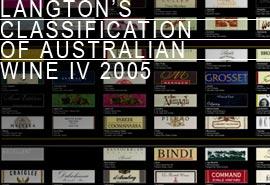
As has been noted by a number of WineBlogs the wine auction house of Langton’s has updated their Classification of Australian Wine. Reviewed every five years the 2005 Classification comprises 101 wines: 11 Exceptional, 22 Outstanding, 34 Excellent and 34 Distinguished. This an increase of 12 from the 89 wines listed in the 2000 Classification, with 67 wines of the 2000 Classification included in the 2005 Classification. The criteria used for selection have not been clearly enunciated by Langton’s but a wine must have 10 vintages to be considered for inclusion. Other criteria include bidding activity, price realizations and volume of wine sold for all wines and vintages sold by Langton’s. Importantly the classification is not based on tastings or show results or even the pronouncements of wine critics or writers.

With a five year cycle interest in the Classification really only peaks when a new classification is announced. This time Langton’s has teamed up with Range Rover and Gourmet Traveller WINE to release the classification as a limited-edition guide book with the August/September 2005 issue of GT WINE. The booklet contains notes on all 101 wines together with the top vintages for each wine. A very useful little guide.

But Langton’s also has other wine lists – Cult and Emerging. The wines in these lists are on the Langton’s website but not in the limited-edition booklet. Revision of these two lists does not appear to have a time scale, but Langton’s note “A number of wines included in the emerging category are wines that missed the cut in 2000 for Langton’s Classification III.” So can we expect these two lists to be updated now that the 2005 Classification is out? Almost certainly, particularly as Andrew Caillard MW Director of Langton’s Fine Wine Auctions has a piece in the GT WINE entitled “Class Acts”. Here he talks about new cult and emerging Aussie wine. Cult wine of the moment? Glaetzer Amon-Ra Shiraz closely followed by the Kalleske Greenock Shiraz. Other cults include the Two Hands Ares, Henry’s Drive Reserve Shiraz, Shrivington’s Cabernet and Shiraz, and the Mitolo GAM among others.

The emerging category comprises mostly wines from the Margate River of Western Australia, the Barossa Valley and Coonawarra regions of South Australia and the Victorian areas of Heathcote and Beechworth. In Caillard’s opinion the emerging wine scene is not easily defined, although regional provenance is important. This means Shiraz from the Barossa and Cabernet from Coonawarra and Western Australia. Interestingly Caillard thinks that the next step in the appeal of Barossa Shiraz will be subregional wines. With the number of single-vineyard Shiraz wines currently being produced this is almost a sure bet.
Trying To Be In The 13%
From the Sydney Morning Herald, August 4th, 2005.

The blog-tracking site Technorati counted more than 14.2 million blogs last month, compared with 7.8 million in March. That's 80,000 new weblogs being created every day, said Dave Sifry, the company's chief executive. But only about half of all blogs are active - updated in the past three months - and just 13 per cent are updated every week.

More from the Technorati Blog. And a bit from BBC News.

What they don’t focus on is why 87% are not active weekly. My own excuse is that my real job keeps me too busy to post daily. But I think I can keep in the 13%!

Monday, August 01, 2005

Need a Book on Wine?
Last Friday Miranda and I visited the University of California at Davis. As a graduate of the Veterinary School she was keen to show me her old stomping grounds. As a wine geek I was keen to see one of the premier enology schools in the USA. After visiting the Vet School we didn’t have time visit all the other places we would have liked, but we did get to the main book store. There I was confronted with the largest array of books on wine and winemaking I have ever seen. It simply was not possible to purchase all the books I wanted, but I did get a number that I’ll comment on over the next few weeks. Meanwhile why don’t you peruse their shelves online. I’ll bet you can find something of interest.

Wednesday, July 27, 2005

Beer Fights Back
Wineblogs have been alive with the news that Gallup have found 39% of American drinkers said they drink wine most often, while only 36% said they drink beer most often.

Robin Abcarian of the LA Times writes “Is our country, in other words, on some ineffable road to effete?” Probably!

Can beer fight back? Well in Australia beer has no desire to lose its froth. Its an advertising war in which the first salvo is the Very Big Ad. Lampooning QANTAS and British Airways ads on a scale fit for Lord of The Rings the Carlton Draught ad comes from Foster's Australia.

The Fosters Group recently purchased SouthCorp which is the largest Australian-owned wine producer. So keep a lookout for an even bigger wine ad, maybe for something from Lindemans, Wolf Blass, Penfolds, Rosemount, or Wynns Coonawarra Estate! Perhaps aimed at the Chinese? Afterall there are a lot of beer drinkers to convert in China, and if that doesn't work there is always the Very Big Ad. My God its big!

Wednesday, July 20, 2005

A Little Humor Helps The Wine Go Down
When you sample wine for its flavor, you are supposed to suck a small amount past your teeth and let it dance on your tongue. Rrrrrright.

Our first wine was a California chardonnay. Our teacher poured some into our glasses, pardon me, stemware. I sniffed, swirled and examined. Then I put the wine into my mouth and let it dance. Sort of a samba. Someone asked what we should pair with this wine. One wisecracking female student suggested Brad Pitt. MORE->

This is the first time I've seen anything from Larry Johnston but I hope I see more of his writing style. Clearly he doesn't need to drink Bordeaux First Growths to have fun with wine.
Google Earth
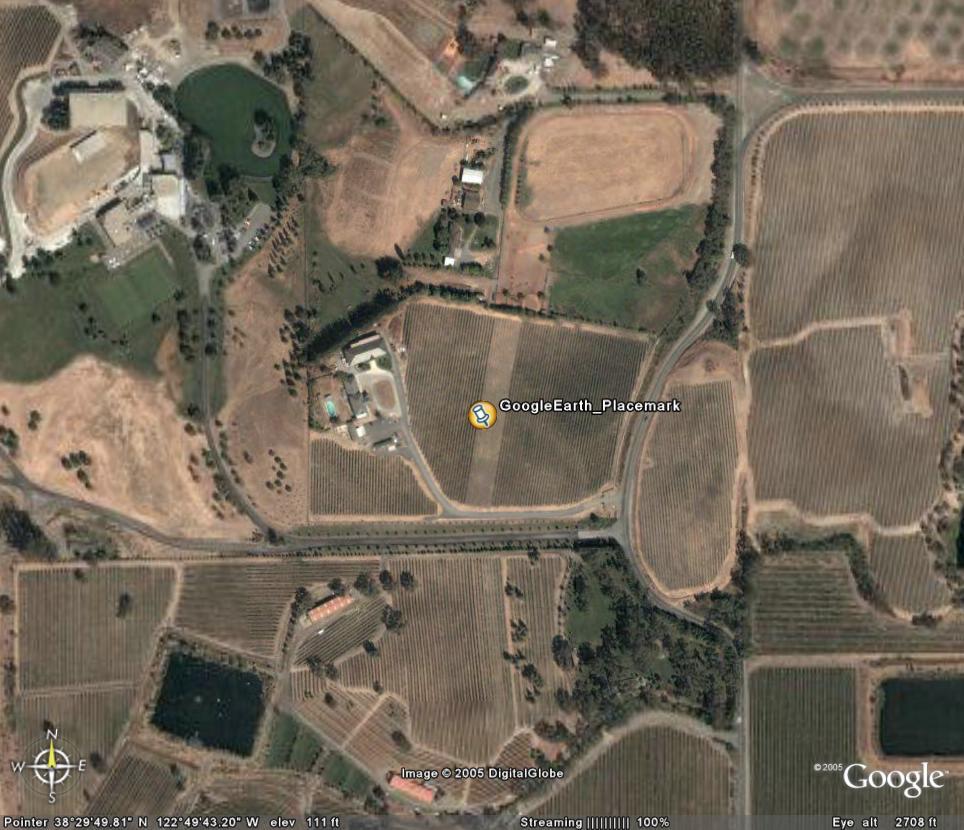
Want to see your favorite vineyard from above? Find out where the nearest wine shops are to your home? Or just want to check out if there are vineyards in the Hunter Valley. You need Google Earth!

The blurb says Google Earth streams the world over wired and wireless networks enabling users to virtually go anywhere on the planet and see places in photographic detail. This is not like any map you have ever seen. This is a 3D model of the real world, based on real satellite images combined with maps, guides to restaurants, hotels, entertainment, businesses and more. You can zoom from space to street level instantly and then pan or jump from place to place, city to city, even country to country.

Get Google Earth. Put the world in perspective.

This really does put the world in your hands!
Australia’s Wine Stamps
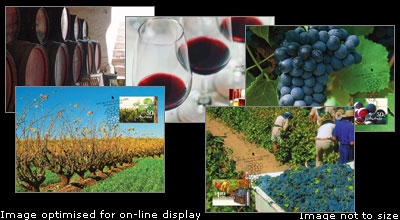
Australia Post has released five stamps depicting various aspects of wine production and consumption. The stamps contain photographic quality images of a vineyard or ripe grapes on the two paired 50 cents stamps, harvesting and wine casks on the two paired $1.00 stamps, and red and white wine in wineglasses on the $1.45 stamp. A variety of different Australia Post products containing the wine stamps have been produced including booklets of stamps, a First Day Cover, and Maximum Cards. The latter is my choice to collect as the image on each card continues the theme depicted in the accompanying stamp.

Tuesday, July 19, 2005

Tasting Notes Update
I have added a few more tasting notes for 2003 Australian Shiraz to the Tasting Notes wine blog. Check them out.

I am desperately trying to catch up with all the tasting notes that need to be posted. I'll keep updates coming.
The Strengths of Australia’s Greatest Red – Shiraz
In the July 5th issue of The Age Jeni Port explores some of the features of Ausie Shiraz. It is not a particularly in-depth piece as it fails to cover all the regions that produce distinctive Shiraz in Australia. It is also limited in the number of wines that are chosen as representative of each region. But it’s a start if you are looking for a little information on major regional characteristics.

The Jelly Belly Wine Bar
Wine X Magazine can be pretty provocative and also downright irreverent when it comes to wine snobbishness. Their latest foray into the world of wine fun is to combine different Jelly Belly Beans to simulate the flavors of various varietals/styles of wine – The Jelly Belly Wine Bar.

Fun way to chew your Jelly Bellys although for oaked Syrah you need eleven different beans. And if you want to make it a French-Syrah you add a bit of dirt, Jelly Belly dirt that is. In fact whether its red or white any French varietal seems to require a little bit of dirt, even French Alsace riesling.

Friday, July 15, 2005

At Last Some Sound Advice on Decanting To Aerate Wine
I started reading this article by Janet Fletcher in the San Francisco Chronicle with little enthusiasm as it looked like the same old same old.

Many wine professionals also say that decanting softens the tannins in red wine, achieving in a few hours what might take years to transpire in a cellar. Barolo and Barbaresco -- the big, brawny Nebbiolo-based wines of Italy's Piedmont region -- are almost always decanted, ostensibly to mellow the tannins and release the bottle bouquet.

But then came this. According to UC Davis Enology Professor Roger Boulton, there is absolutely no evidence that decanting produces any change in wine tannins, at least over a matter of days. Tasters may perceive that the tannins have softened, but laboratory tests show otherwise.

So that is another academic to claim that there is no science to support the argument that decanting softens tannins.

And then came this. Nor does oxygen play the role that many wine professionals think.

"If (a wine) seems a little closed in, the very best thing you can do is give it some oxygen," says Ronn Wiegand, publisher of the newsletter Restaurant Wine, articulating a belief echoed frequently by his colleagues.


But Boulton says oxygen has nothing to do with the aromas that emerge when wine is poured into a decanter or glass. The same aromatic bloom happens in a nitrogen environment, with no oxygen present.

Like a soda that releases some of its carbon dioxide when opened but retains some bubbles in the drink, bottled wine holds many of its aromatic compounds in solution with some proportion of them clustered in the headspace. When the cork is pulled and the wine poured into a container with considerably more headspace -- a decanter or a glass -- those aromas in solution, good smells and bad ones, have somewhere to go.

Some compounds volatilize more quickly than others; stinky sulfides and acetic acid are among the first to blow off, which is why the initial perfume may not be a wine's best. On the other hand, the esters responsible for the fruity aromas in many white wines also evaporate early, so decanting a Sauvignon Blanc or Pinot Gris may diminish its attributes.

Depending on the age of the wine and the aromatic compounds it contains, this release of aromas into the headspace might continue for two to three hours. But for the typical 10-year-old wine, says Boulton, an hour of breathing time should do it; after that, the wine is probably losing more good aromas than bad ones. And no matter how long the taster waits, a wine with the undesirable aromas of cork taint or brettanomyces, a spoilage yeast, will never lose them.

Nor does one need a decanter to unleash the aromas in a bottle of wine. "You and I can pour the wine from the bottle into the glass and do the same thing," says Boulton. "It's only if you're a sommelier that your role in the world is to pour it into a decanter."

Yes! (fist pump). Great stuff, could not agree more with his interpretation. But just to be sure I’m still working on an approach that will allow me to compare decanted and undecanted wine from the same bottle to see how much aeration does change a wine.

Final note: Interesting that “enjoyed the last glass more than the first” raises its ugly head in this article. I’ve seen this comment many times as a justification for decanting or aeration. I’ll bet there is no science to back up this claim. And if you think about the number of variables involved in comparing the first and last glass of any bottle you might come to realize that the comparison is truly meaningless.

Thursday, July 14, 2005

No Rooster for Me
I don't ever remember buying or drinking any wines from Gallo, but I may have. However after this I most certainly will be avoiding them in the future. I could never enjoy any of their wines knowing they do this sort of thing. I'm even worried about just mentioning their name in this post.

Wednesday, July 13, 2005


A Very Good Year
There is a scene in the fictional movie Sideways in which Maya, the female lead, defines her character through her thoughts on wine. She says “I like to think about the life of wine, how it’s a living thing. I like to think about what was going on the year the grapes were growing……..what the weather was like. I think about all those people who tended and picked the grapes, and if its an old wine, how some of them must be dead by now……..”. It’s a moving personalization of one individual’s intimacy with the life of wine. It is also a rare display of appreciation because the majority of wine lovers drink wine for the sensory and hedonistic pleasures it provides. Very few think about what it took to get the wine into the bottle they are pouring and enjoying.

This is not true of Mike Weiss, or perhaps more correctly his wife Carole Rafferty who asked “Did you ever think about all that goes into a bottle of wine?” From that simple question came a multipart series in the San Francisco Chronicle and then a book by Weiss. Entitled “A Very Good Year” this rather extraordinary volume traces the life of a California wine from vine to table. The wine is the 2002 Ferrari-Carano Fumé Blanc and for those interested in a general overview of the aspects of vineyard care and winemaking that produced this wine there is sufficient detail scattered among the 280 or so pages to hold one’s interest. And it is useful knowledge for those wanting to lean about how a wine is made, but “A Very Good Year” is more than about making wine.

Fermenting along with the wine are a number of other stories. Unintended as they may be it is the contrasts that draw you into this book and keep you reading page after page. There is, of course, The Story. It can make or break a wine and the Caranos have their story. More than just a family with wealth from Reno gaming looking to own a bit of Sonoma, there is a passion to succeed, to produce quality wine. Flip the gaming token and you have their Mexican vineyard workers laboring with their own desire to succeed for their families a distant border away. Weiss’s depiction of the lives of the vineyard workers and their families is the most vivid story behind California wine. And even then he has probably only scratched the surface.

The making of the 2002 Ferrari-Carano Fumé Blanc is also about underlying personality clashes, a protective winery owner criticized for his favoritism, a wine maker with an almost paranoid approach to his craft that is not shared by the junior staff, and a marketing maven with a monster ego. There is even a Deep Cork to provide the odd anonymous insight or two. And, perhaps ironically, there is also human birth, disease and death during the span of vine budding to cork pulling. “A Very Good Year” is very compelling reading for those who want to read about the lives that make a bottle of wine.

The only thing missing in “A Very Good Year” are some of the photographs that must have been snapped by the photographers that Weiss mentions several times in the text.


A Very Good Year: The Journey of a California Wine from Vine to Table by Mike Weiss (Gotham Books, 2005, 288 pages, $26.00USD Hardcover).

Disclosure: A complimentary copy of the book was supplied to me by Gotham Books.
Yellow Tail 7th Wine Brand in USA Restaurants
Restaurant Wine, a bimonthly journal on wine for the hospitality and wine industries, has released its listing of the Top 100 brands of wine sold in restaurants in the USA in 2004, ranked according to their estimated sales volume. The top 25 are in this news release. Number 7 on the list is Yellow Tail! Five other Aussie wines also made the listing, although they are not listed in the top 25.

It is interesting just how accepted Yellow Tail has become in the US. On the recent July 4th holiday I had a couple of people who have relatively good palates and drink wine every day tell me what great deals they get on Yellow Tail. I'm not a fan of the wines, but if you enjoy them drink up. Then be adventurous and spend a few $’s more on another wine, eventually you will get into a price/quality range where you will see why Yellow Tail is the lower rung on the ladder of wine experiences.

Monday, July 11, 2005

Shiraz Has A New Skin
As a temporary fix I've put Shiraz into a new skin. My old skin seems not to be available any more. In any case this new skin does not appear to have the formatting problem that has bugged Shiraz for the last few weeks. But don't get used to it because I intend to move as soon as I get time to put some ideas together for a more comprehensive wine blog.
Shiraz is Down at Present
If you have scrolled down this far then you will have realized that Shiraz has a formatting issue. Blogger does not seem to want to help me solve this problem. Its not my doing as I have just found that one of my other blogs (that I post to less frequently) has a similar formatting problem. So until I can resolve this issue I doubt that I will be putting up new posts on any regular basis. There are a few topics that I do wish to cover and I will be doing those posts in the next week or so. Meanwhile I will be looking for an alternative host for my blogging activities.

Thursday, June 23, 2005

Aussie Wines Online Launches International Australian Wine Home Delivery Service
The following is a PRWEB Press Release.
Offering a ‘delivered to your door’ service around the world, a small Australian wine exporter has not only made great tasting Boutique Australian wines available online but offers delivery direct to the customer’s door. And business is booming.

Sydney, Australia (PRWEB) June 22, 2005 -- Aussie Wines Online, a small Australian wine exporter in Sydney, has now made accessible online to wine drinkers outside Australia, the lesser known yet excellent quality Australian wines from independent and boutique Australian Wineries. And made it easy and convenient by delivering direct to the customer’s door, around the world.

“Australian boutique Wineries produce some terrific wines and they are Australia’s best kept secret” says Wayne Moore, Director and founder of Aussie Wines Online. “These wines are lovingly produced by independent winery owners who take great pride in their product. Each wine shows individual characteristics of the soil and growing region, giving more taste and variety than bulk wines”.

Australian wines are becoming increasingly popular but as there are hundreds of Wineries with growing regions scattered across Australia, the choice can be overwhelming and confusing. This company has eliminated the guess work and presents a select range of recommended boutique Australian red and white wines to order online, in popular varieties and blends. The customer also has the option to mix a case to their own taste from the available wines. The wine selection changes regularly to give plenty of variety and the export prices are affordable as quality boutique wines offer exceptional value.

The website has a distinct Aussie flavor including the company’s appealing ‘blue roo’ Aussie kangaroo logo with its unique wine delivery method. The site is easy to use and shows a clear picture and description of each wine with more detailed information including growing region and serving suggestions if desired. It’s also informative with additional tips for storing and serving wine plus some basic ‘wine speak’ information for the novice or those who always wanted to know more but were too embarrassed to ask.

Boutique Aussie wines - real flavor, real wine by real people. Visit
www.aussiewinestoyourdoor.com and get the Taste of Australia delivered to your door. It’s that easy.

For additional information, jpgs and promotional material, contact Ms Lindsay Lewis, Marketing Director, Aussie Wines Online. Phone Australia +612 9460 8050

Background information: Aussie Wines Online Pty Ltd (
www.aussiewinestoyourdoor.com) is an independent Australian wine exporter supplying trade and private customers outside Australia and specializes in wines from independent and boutique Australian wineries. AussieWinesToYourDoor.com website was launched April, 2005.

It all sounds very impressive until you go to the website and find that currently there are only seven wines for sale.

Wednesday, June 22, 2005

There's a syrah for every wine drinker
This is what Roger Rutan has written for The Register-Guard of Eugene, Oregon, USA. As much as I love Shiraz/Syrah I doubt that it suits all palates. More to the point I very seriously doubt that the wines listed by Rutan will satisy "every wine drinker". I may be getting a little ahead of myself because I have not had the pleasure of tasting the wines mentioned in the piece by Rutan but that is simply because my local wine shop simply does not carry any of them! Rather poor selection on the part of the wine shop you might say, especially when Rutan gives six examples of "premium quality syrah wines". I guess it all dependes on your definition of premium quality. Shiraz/Syrah/Petite Sirah in the range of $15 to $21USD per bottle is not really touching the price range of premium. Double it and you might be getting a bit closer to reality.

But if you are limited to paying below $20USD for a bottle of Shiraz/Syrah then you might like to look to Australia for St Hallett Faith from the Barossa Valley, Kangarilla Road from McLaren Vale, RockBare from McLaren Vale, Jim Barry Lodge Hill from Clare Valley, or the Green Point Shiraz from Victoria.

Tuesday, June 21, 2005

Wine and Sex
If any clever wine makers have read this little piece of information they are probably already thinking of making wines that have the aroma of grapefruit. And I’m sure there will be hoards of wine loving women who will buy the wines. I’m not sure if drinking such wines has the same effect as having grapefruit smeared on your body, but then who said you have to drink it!

One the other side of the coin I’m not too sure if there will be very many who will be making wines that smell of lavender and pumpkin pie, or doughnut and black licorice. But there are plenty of wines that already smell of licorice. I wonder if that is why……..

Wednesday, June 15, 2005

Sparkling Shiraz
Question of the Day on my Wine Lovers Calendar is When was the first sparkling shiraz made in Australia? Answer. 1890! Wonder what it was, and if there is any left?

Additional information provided is that it is an Australian specialty, some 70 wineries make a sparkler and that Peter Rumball winery makes only Sparkling Shiraz.

All interesting stuff. BUT if you go to Peter Rumball's web site he has some history of sparkling shiraz. A rose style was made in 1881 called Sparkling Burgundy by the Victorian Champage Company. But Rumball's site directs you to The Wilson Vineyard at Polish Hill and this Classic Clipping where you can find. There can be little doubt that Edmond Mazure deserves the honour of being the creator of the Australian sparkling burgundy style. One other acknowledgment is due, and that is to Ernest Whittington of the Adelaide Observer.

From Whittingtons 1898 report: This year he (Mazure) intends making about 50,000 gallons of principally the celebrated St. Henri claret. He is also hopeful of turning out about 2,000 dozen of his famous sparkling Burgundy. Last year Auldana produced 1,500 dozen of this brand... .. A feature of the new cellars connected with the vineyard is a tunnel which is driven under the Magill Hill to a distance of 50 feet and in which the temperature has never been known to exceed 600. This cool retreat is utilized for storing "Sparkling Burgundy" and other wines in course of maturing.

Most references to Auldana quote 1895 as the year that sparkling wine production commenced at Auldana, although that date more correctly would apply to the extension works of the cellars. But clearly, Mazure was making sparkling wine before 1895. To have the Sparkling Cup available in mid 1894, would suggest that the wine was put down in 1893. Given that the facilities for sparkling wine production were in place then, and the above hint that Sparkling Burgundy needed some maturation, we can reasonably assume that the wine that Whittington tasted in 1895, was put down in '93.

The critical question arises as to whether Mazure's early wines more closely approximated the lighter bodied French wines, or whether the now-familiar "Keatsian" shiraz-based style was produced right from the onset.

On the evidence available it would appear that the wines were big from the start. At Auldana, Mazure worked with a young Hurtle Walker. Hurtle's son Norm later joined his father making sparkling wines at the Romalo Cellars. Norm Walket is still involved in the wine industry, and is in no doubt that the style of sparkling burgundy produced at Romalo was always "big and gutsy". "Most of the base wine for those sparkling burgundies was shiraz that came from A. P. Birks in Clare, and their wines were always big, so big that sometimes they had to be broken down first."

Fascinating stuff! Sparkling Burgundy is one thing, but 1898 Auldana Cellars St Henri Claret. Now that's a wine I'd like to try!