......Auckland is better! Just about fell off my seat when I read this. The human resources consultancy firm Mercer has conducted a survey on over 270 cities worldwide. Link.
39 key quality of living determinants were used , grouped in the following categories:
Political and social environment (political stability, crime, law enforcement, etc)
Economic environment (currency exchange regulations, banking services, etc)
Socio-cultural environment ( censorship, limitations on personal freedom, etc)
Health and sanitation (medical supplies and services, infectious diseases, sewage, waste disposal, air pollution, etc)
Schools and education (standard and availability of international schools, etc)
Public services and transportation (electricity, water, public transport, traffic congestion, etc)
Recreation (restaurants, theatres, cinemas, sports and leisure, etc)
Consumer goods (availability of food/daily consumption items, cars, etc)
Housing (housing, household appliances, furniture, maintenance services, etc)
Natural environment (climate, record of natural disasters)
Auckland came in as the fifth best city in the world, behind Zurich, Geneva, Vancouver and Vienna. Sydney ranks ninth on the list, ahead of Melbourne at 17, Perth at 21, Brisbane at 31 and Adelaide at 32.
At least in terms of a tourist visit Miranda and I would not rank Auckland so highly - only city where we have been subject to crime in the last 8 years - car break-in. The city itself falls down in terms of architecture and planning - the harbor area is not the equal of Sydney. And its not a cheap palce to live. And the display in the Museum on volcanoes wiped out Auckland multiple time each hour! Seemed almost as bad as earthquakes in California. (Link to Age article.)
Showing posts with label Travel. Show all posts
Showing posts with label Travel. Show all posts
Tuesday, April 03, 2007

Sunday, January 14, 2007
Nelson Interlude
The Nelson wine region, located on the western side of the northern end of the South Island of New Zealand, is home to some twenty-three boutique wineries which occupy two major geographical regions. The Waimea plains are made up of alluvial loams; Waimea means “river gardens” in Maori. The plains are bounded by rolling valleys and hills so that a V-shape is formed as the plains broaden toward the ocean. To the west of Nelson, the Moutere Hills are more clay and gravel in composition.
This is a cool climate wine region, protected from rain by mountains to the west. Rich in horticulture, seafood and artists, the region was first home to winemaking when German winemakers arrived in 1843. By 1845 they had left for the more appealing hills of South Australia. It was not until the 1970s that vineyards again began to make their presence felt.
We arrived into the region by car from Blenheim, the heart of Marlborough wine country, after a short flight from Auckland. It did seem a little like a retreat to be driving away from the flat vineyards of Marlborough through Renwick to Havelock, the Green Shell Mussel Capital of the World, and then through the Rai Valley and on into Nelson. But we were on a mission. We had planned to meet up with Max Marroitt, an expatriate Aussie, who was working over the summer at Neudorf. Max planned to meet us at Greenhough Vineyard at midday to taste through some of their wines before moving on to Neudorf to sample their wares.
Greenhough (green-hoff) Vineyard and Winery
Both vineyard and winery are located on an elevated south-easterly corner of the Waimea Plains, a broad plateau known as Burke's Bank. When we arrived at Greenhough Max was already inside talking with Andrew Greenhough. A Master’s degree in Art History seems an unlikely start to viticulture but that is how Andrew began his wine adventure. Quietly spoken, he let’s the wines do all the talking.
Sauvignon Blanc 2006 (screwcap) (13.5% alcohol)
Light straw in color with muted notes of citrus and tropical fruits. A riper style, lacking herbaceousness. Very crisp acidity is the center piece of this well balanced, very well made wine. Should drink well till 2008. 2, 2, 3.8, 9.8 = 17.6/20, 88/100.
Hope Vineyard Chardonnay 2004 (screwcap) (14.0% alcohol)
A wine made using French oak (13% new) and malolactic fermentation it has an excellent nutty character with just a hint of oak. Medium weight on the palate, this is a vibrant wine with excellent mouthfeel and carry of flavors and a lengthy finish. Drink 2006-10 2, 2, 4.0, 10.0 = 18.0/20, 90/100.
Hope Vineyard Chardonnay 2005 (screwcap) (13.5% alcohol)
Made with more new oak (25%) this wine shows its youth and is revealing very little at present, just some citrus, and lime flavors. Tightly wound, it will need time to open, but the balance and structure are there, and the acidity adds appealing crispness. Drink 2006-12. 2, 2, 3.8, 9.8 = 17.6/20, 88/100.
Hope Vineyard Pinot Noir 2004 (screwcap) (14.0% alcohol)
Matured in 35% new French oak this wine is light cherry in color, and with very typical spicy notes of Pinot Noir together with flavors of red fruits and ripe lychees. There is almost a touch of sweetness on the palate, and the flavors carry extremely well providing great length to this delightfully balanced wine. Drink 2006-2010. 2, 2, 4.1, 10.3 = 18.4/20, 92/100.
Hope Vineyard Pinot Noir 2005 (screwcap) (14.0% alcohol)
The yields were considerably lower, and the flavors more concentrated in 2005 and it shows in this wine. It lacks the overt spicy notes of the 2004. Instead there are deeply seated fruit and savory flavors with a touch of pepper rising just above the surface of this densely packaged, classy wine. The mouthfeel is soft and silky with prominent, vibrant acidity that carries across the palate and will need time to integrate. But thus is an excellently structured wine that will reward patience. Drink 2008-2015. 2, 2, 4.3, 10.4 = 18.7/20, 94/100.
As we were leaving we purchased a bottle of the Gewürztraminer that Miranda and I had with dinner at the Plaza Indian in Blenhiem later in the week.
Gewürztraminer 2006 (screwcap) (13.5% alcohol)
Light straw yellow in color this is a wine that is full of flavor with muted spices flooded by aromas of apricot, nectarine and white peach. The flavors carry well onto a rich palate and are enhanced by crisp acidity. There is a little lingering sweetness to the finish, but it is not cloying. A very well balanced and palate pleasing wine. Drink 2006-2010. 2, 2, 3.9, 10.0 = 17.9/20, 89/100.
Neudorf
The Neudorf Vineyards are among the oldest in the Nelson region with planting having begun in 1978. The vineyards constitute either those on the north-facing slope overlooking a branch of the Moutere Valley, or on the Waimea plains south of Nelson.
Nelson Chardonnay 2005 (screwcap) (14.0% alcohol)
Light straw in color with aromas of smoky oak, citrus and peach, barrel fermented (25% new oak) with indigenous yeasts this Chardonnay is less complex than the Greenhough, but still nicely structured. It needs a little time for the oak to settle but it has the acidity to carry aging. Drink 2008-2014. 2, 2, 3.7, 9.8 = 17.5/20, 87/100.
Moutere Pinot Noir 2004 (screwcap) (14.5% alcohol)
Indigenous yeast fermented and matured in French Oak barrels (40% new) for eleven months, this is a richly aromatic, riper style of Pinot Noir with a stalky character. Soft and silky in texture with a beautiful carry of flavors onto the palate, nice balance and good supporting acidity. Drink 2006-2011. 2, 2, 3.9, 9.7 = 17.6/20, 88/100.
Nelson Pinot Noir 2004 (screwcap) (13.5% alcohol)
Also fermented with indigenous yeasts and then matured for eight months in French barriques (25% new), this is an unusually scented wine, giving little spiciness but instead the smell of yeasty dough. More mouthfilling that the Moutere, it opens on the palate to reveal spice flavors more typical of Pinot Noir. However the acidity is a little harsh and not well integrated at present. Needs time. Drink 2008-2011. 2, 2, 3.3, 9.4 = 16.7/20, 84/100.
Later in the evening, courtesy of the excellent hospitality of Max, we sampled even more wines including a few more New Zealanders. One, the 2004 Felton Road Pinot Noir left the examples tasted earlier in the day in its wake. But we would taste even better Pinot in the days to come.
The next evening we opened a bottle of Neudorf Moutere Riesling. It was a wine some liked and others were less enamored by. The fact that the bottle remained unfinished after two days seemed to indicate the verdict of the jury.
Moutere Riesling 2005 (screwcap) (11.0% alcohol) $28NZD)
Light straw yellow in color the initial aromas were of sweet, ripe grapes, followed by honey, with a hint of apricot and peach, and a touch of petrichor (minerality). Mouthfilling, the initial sweetness was cut short by pronounced green apple acidity that overwhelmed the palate, and did not allow the fruit flavors to show off their highlights. Otherwise a well made wine with excellent persistence to its finish. Drink 2007-2013. 2, 2, 3.7, 9.5 = 17.2/20, 86/100.
This is a cool climate wine region, protected from rain by mountains to the west. Rich in horticulture, seafood and artists, the region was first home to winemaking when German winemakers arrived in 1843. By 1845 they had left for the more appealing hills of South Australia. It was not until the 1970s that vineyards again began to make their presence felt.
We arrived into the region by car from Blenheim, the heart of Marlborough wine country, after a short flight from Auckland. It did seem a little like a retreat to be driving away from the flat vineyards of Marlborough through Renwick to Havelock, the Green Shell Mussel Capital of the World, and then through the Rai Valley and on into Nelson. But we were on a mission. We had planned to meet up with Max Marroitt, an expatriate Aussie, who was working over the summer at Neudorf. Max planned to meet us at Greenhough Vineyard at midday to taste through some of their wines before moving on to Neudorf to sample their wares.
Greenhough (green-hoff) Vineyard and Winery
Both vineyard and winery are located on an elevated south-easterly corner of the Waimea Plains, a broad plateau known as Burke's Bank. When we arrived at Greenhough Max was already inside talking with Andrew Greenhough. A Master’s degree in Art History seems an unlikely start to viticulture but that is how Andrew began his wine adventure. Quietly spoken, he let’s the wines do all the talking.
Sauvignon Blanc 2006 (screwcap) (13.5% alcohol)
Light straw in color with muted notes of citrus and tropical fruits. A riper style, lacking herbaceousness. Very crisp acidity is the center piece of this well balanced, very well made wine. Should drink well till 2008. 2, 2, 3.8, 9.8 = 17.6/20, 88/100.
Hope Vineyard Chardonnay 2004 (screwcap) (14.0% alcohol)
A wine made using French oak (13% new) and malolactic fermentation it has an excellent nutty character with just a hint of oak. Medium weight on the palate, this is a vibrant wine with excellent mouthfeel and carry of flavors and a lengthy finish. Drink 2006-10 2, 2, 4.0, 10.0 = 18.0/20, 90/100.
Hope Vineyard Chardonnay 2005 (screwcap) (13.5% alcohol)
Made with more new oak (25%) this wine shows its youth and is revealing very little at present, just some citrus, and lime flavors. Tightly wound, it will need time to open, but the balance and structure are there, and the acidity adds appealing crispness. Drink 2006-12. 2, 2, 3.8, 9.8 = 17.6/20, 88/100.
Hope Vineyard Pinot Noir 2004 (screwcap) (14.0% alcohol)
Matured in 35% new French oak this wine is light cherry in color, and with very typical spicy notes of Pinot Noir together with flavors of red fruits and ripe lychees. There is almost a touch of sweetness on the palate, and the flavors carry extremely well providing great length to this delightfully balanced wine. Drink 2006-2010. 2, 2, 4.1, 10.3 = 18.4/20, 92/100.
Hope Vineyard Pinot Noir 2005 (screwcap) (14.0% alcohol)
The yields were considerably lower, and the flavors more concentrated in 2005 and it shows in this wine. It lacks the overt spicy notes of the 2004. Instead there are deeply seated fruit and savory flavors with a touch of pepper rising just above the surface of this densely packaged, classy wine. The mouthfeel is soft and silky with prominent, vibrant acidity that carries across the palate and will need time to integrate. But thus is an excellently structured wine that will reward patience. Drink 2008-2015. 2, 2, 4.3, 10.4 = 18.7/20, 94/100.
As we were leaving we purchased a bottle of the Gewürztraminer that Miranda and I had with dinner at the Plaza Indian in Blenhiem later in the week.
Gewürztraminer 2006 (screwcap) (13.5% alcohol)
Light straw yellow in color this is a wine that is full of flavor with muted spices flooded by aromas of apricot, nectarine and white peach. The flavors carry well onto a rich palate and are enhanced by crisp acidity. There is a little lingering sweetness to the finish, but it is not cloying. A very well balanced and palate pleasing wine. Drink 2006-2010. 2, 2, 3.9, 10.0 = 17.9/20, 89/100.
Neudorf
The Neudorf Vineyards are among the oldest in the Nelson region with planting having begun in 1978. The vineyards constitute either those on the north-facing slope overlooking a branch of the Moutere Valley, or on the Waimea plains south of Nelson.
Nelson Chardonnay 2005 (screwcap) (14.0% alcohol)
Light straw in color with aromas of smoky oak, citrus and peach, barrel fermented (25% new oak) with indigenous yeasts this Chardonnay is less complex than the Greenhough, but still nicely structured. It needs a little time for the oak to settle but it has the acidity to carry aging. Drink 2008-2014. 2, 2, 3.7, 9.8 = 17.5/20, 87/100.
Moutere Pinot Noir 2004 (screwcap) (14.5% alcohol)
Indigenous yeast fermented and matured in French Oak barrels (40% new) for eleven months, this is a richly aromatic, riper style of Pinot Noir with a stalky character. Soft and silky in texture with a beautiful carry of flavors onto the palate, nice balance and good supporting acidity. Drink 2006-2011. 2, 2, 3.9, 9.7 = 17.6/20, 88/100.
Nelson Pinot Noir 2004 (screwcap) (13.5% alcohol)
Also fermented with indigenous yeasts and then matured for eight months in French barriques (25% new), this is an unusually scented wine, giving little spiciness but instead the smell of yeasty dough. More mouthfilling that the Moutere, it opens on the palate to reveal spice flavors more typical of Pinot Noir. However the acidity is a little harsh and not well integrated at present. Needs time. Drink 2008-2011. 2, 2, 3.3, 9.4 = 16.7/20, 84/100.
Later in the evening, courtesy of the excellent hospitality of Max, we sampled even more wines including a few more New Zealanders. One, the 2004 Felton Road Pinot Noir left the examples tasted earlier in the day in its wake. But we would taste even better Pinot in the days to come.
The next evening we opened a bottle of Neudorf Moutere Riesling. It was a wine some liked and others were less enamored by. The fact that the bottle remained unfinished after two days seemed to indicate the verdict of the jury.
Moutere Riesling 2005 (screwcap) (11.0% alcohol) $28NZD)
Light straw yellow in color the initial aromas were of sweet, ripe grapes, followed by honey, with a hint of apricot and peach, and a touch of petrichor (minerality). Mouthfilling, the initial sweetness was cut short by pronounced green apple acidity that overwhelmed the palate, and did not allow the fruit flavors to show off their highlights. Otherwise a well made wine with excellent persistence to its finish. Drink 2007-2013. 2, 2, 3.7, 9.5 = 17.2/20, 86/100.
Saturday, January 06, 2007
Waiheke: Island of Wine. Yeah Right
I’m not sure if there has been a Tui billboard that argues against the pundits when it comes to Waiheke Island wines. And having tasted less than a dozen perhaps I shouldn’t cast doubts either, but judging from the lack of criticism of my stance from others in different wine regions of New Zealand I think there is support for the construct. Sour grapes? Perhaps, but that depends if you think the grapes are being used to make wine or in the mouths of others.
Vineyards on Waiheke Island have a very short history, going back only as far as 1978 when vines were planted at Goldwater Estate. Today there are some 26 individual vineyards, many with cellar doors. However if you want to taste wine on Waiheke go on a weekend, go later in the summer than we did, and call ahead for an appointment; see the web site for details. Only 10 vineyards/cellar doors were open when we visited and a number of them closed by 4pm. So don’t linger in the villages or over the scenery, as we did, because it will severely cut down on your time with wine.
Waiheke Island is best reached by ferry from The Ferry Building in Auckland (a Link stop on Customs St will get you close). The trip takes about 35 minutes and if you are feeling lucky you can leave the organization of island transport until you the reach the ferry terminal on the island. I had emailed both hire car companies the night before about the possibility of reservations and they were ready for us as walked up to their booths. Pity I didn’t have my California Drivers’ License with me. Fortunately Ngaire, my cousin, and her husband Chris had flown in from Australia at 1 am that morning. Chris looked awake enough to sign up as our chauffer.
The first order of business was to find the Waiheke Wine Centre. Touted as having all available Waiheke wines, as well as tastings of wines and local olive oils, it seemed like the ideal first port of call. Wine centers with official sounding names are big in New Zealand. We had visited the New Zealand Winemakers Centre in Auckland thinking that it was something put together by New Zealand winemakers. But it was just a privately run wine shop. It was the same with the Waiheke Wine Centre. Just a simple bottle shop, but with an impressive selection of wines. We spent a good half an hour just looking before we decided to ask what was on the tasting bench. The line-up was of Waiheke Island wines, 3 wines for $15NZD. That seemed a little steep, even if it did come with local olive oils and dukkah. There was the Passage Rock 2006 Rose and 2006 Viognier, and the Obsidian Weeping Sands 2005 Merlot/Cabernet. We were allowed to sit out the back of the shop, on a very, very small balcony with an ocean view, while we tasted our wines. I didn’t make any notes because, well I was simply not moved to do so. The wines were ordinary at best. The others kept asking me what I thought, did the wines seem to be lacking in flavor, and did I think that there was enough there in terms of structure? At least the olive oils seemed attractive. Maybe we should go and have lunch?
Miranda had figured out where she wanted to go, Te Whau. But we didn’t have a reservation for what has been described as "One of the Best Restaurants in the World for Wine Lovers" by the Wine Spectator. If we couldn’t get in we could at least get a few pictures of the magnificent views back towards Auckland. As soon as we walked in the door we were asked if we had a reservation. No? Well, sorry but we are fully booked. All we can give you is the next hour. No problem, we can eat lunch in an hour. And we did. The food was impressive, the service attentive and the views the best I have had from any vineyard restaurant. I had the Lemon Pepper Roasted Rump of Lamb with fennel and capsicum pickle, and lemongrass puree and a glass of the 2004 Te Whau The Point. The other wine tasted (by Chris) was the 2005 Te Whau Chardonnay. Both wines were clear improvements over our earlier tasting and as we snapped a few final pictures outside the restaurant I held high hopes for the next winery on the list, Stonyridge.
Stonyridge makes the flagship wine of Waiheke. Its a Bordeaux blend called Larose that is sold largely en primeur. A cult wine, among a stable of expensive wines, none of which is less that $55NZD/bottle. Is this reputation deserved? A PDF on the web site notes that the 1994 and 1996 Larose produced record sales at auction in New Zealand in February 2003, “which makes this one of the best investments anyone can make!” An interesting claim to make on a web site!
The Larose was not on the tasting list but many of the stable were, and we could pick any three for the princely sum of $30NZD! We chose the 2004 Row 10 Chardonnay ($65NZD), 2004 Luna Negra – Hill Side Malbec ($75NZD) and the 2004 Pilgrim, a Syrah, Grenache, Mouvedre blend ($90NZD). A second label, Fallen Angel, made from grapes sourced off Waiheke was also available for tasting at a more reasonable $10NZD for three wines. Here we picked the 2006 Marlborough Sauvignon Blanc ($26NZD), 2005 Central Otago Pinot Noir ($59NZD) and the 2004 Gisbourne Semillon/Gewurztraminer dessert wine ($36NZD). It may have been the almost gale force winds that forced us to fiercely protect our glasses (how do they keep leaves, let alone berries on the vines here?), or the entertaining conversations with another table about the wind, New Zealand beating Australia at rugby, and anyone beating England at cricket, but I was again unmoved by the wines. No, that is not quite true. The Sauvignon Blanc was quite a passable example and the Semillon/Gewurztraminer blend a pleasant little sticky. The Stonyridge wines, although presenting some attractive flavors, attacked the palate from all angles. Balance and structure seemed to have been carried off by the wind. The rest of our time on the island was spent exploring the scenery and trying to get lost on the narrow, sometimes poorly marked, roads.
That evening, back in Auckland we opened a bottle of Penninsula Estate Zeno Syrah 2002 ($35.95NZD) that I had purchased from Accent on Wine in Parnell. Initially muted with white pepper over a little mint and spice it developed mocha, earthy, and dusty oak notes. Almost medium weight on the palate, it presented the mouth with inky, earthy, lengthy flavors mixed with graphite and surrounded by firm astringency and overt acidity. Again, there was that angularity and lack of balance. With time things may come together. (2, 2, 3.5, 9.0 = 16.5/20, 83/100. 13.3% alcohol). The one interesting observation was that the aromas of the Zeno did evolve over several hours; trying, perhaps in vain, to become more Old than New World. A similar event occurred the following evening where a bottle of the 2004 Passage Rock Syrah ($80NZD at Accent on Wine) faced off against the 2004 Lagier Meredith Syrah (Mt Veeder, California). The Passage Rock, although suffering the fate of sinking to the bottom or near the bottom among a group of eight wines, did evolve some interesting flavors over several hours. (Note: Link - Scroll down to see tasting notes by Max Marriott on the wines from the evening.)
Am I being too hard on Waiheke Island wines? Given our New Zealand wine experiences, especially those of the following days? No. The Waiheke Island wines that we tried simply do not warrant consideration at the prices being asked. Limited production and the idea of Bordeaux style wine is not a recipe that will lead to success in the wine world of the 21st century. There may be wineries on Waiheke that let the wine speak of the vineyards, I hope there are.
Vineyards on Waiheke Island have a very short history, going back only as far as 1978 when vines were planted at Goldwater Estate. Today there are some 26 individual vineyards, many with cellar doors. However if you want to taste wine on Waiheke go on a weekend, go later in the summer than we did, and call ahead for an appointment; see the web site for details. Only 10 vineyards/cellar doors were open when we visited and a number of them closed by 4pm. So don’t linger in the villages or over the scenery, as we did, because it will severely cut down on your time with wine.
Waiheke Island is best reached by ferry from The Ferry Building in Auckland (a Link stop on Customs St will get you close). The trip takes about 35 minutes and if you are feeling lucky you can leave the organization of island transport until you the reach the ferry terminal on the island. I had emailed both hire car companies the night before about the possibility of reservations and they were ready for us as walked up to their booths. Pity I didn’t have my California Drivers’ License with me. Fortunately Ngaire, my cousin, and her husband Chris had flown in from Australia at 1 am that morning. Chris looked awake enough to sign up as our chauffer.
The first order of business was to find the Waiheke Wine Centre. Touted as having all available Waiheke wines, as well as tastings of wines and local olive oils, it seemed like the ideal first port of call. Wine centers with official sounding names are big in New Zealand. We had visited the New Zealand Winemakers Centre in Auckland thinking that it was something put together by New Zealand winemakers. But it was just a privately run wine shop. It was the same with the Waiheke Wine Centre. Just a simple bottle shop, but with an impressive selection of wines. We spent a good half an hour just looking before we decided to ask what was on the tasting bench. The line-up was of Waiheke Island wines, 3 wines for $15NZD. That seemed a little steep, even if it did come with local olive oils and dukkah. There was the Passage Rock 2006 Rose and 2006 Viognier, and the Obsidian Weeping Sands 2005 Merlot/Cabernet. We were allowed to sit out the back of the shop, on a very, very small balcony with an ocean view, while we tasted our wines. I didn’t make any notes because, well I was simply not moved to do so. The wines were ordinary at best. The others kept asking me what I thought, did the wines seem to be lacking in flavor, and did I think that there was enough there in terms of structure? At least the olive oils seemed attractive. Maybe we should go and have lunch?
Miranda had figured out where she wanted to go, Te Whau. But we didn’t have a reservation for what has been described as "One of the Best Restaurants in the World for Wine Lovers" by the Wine Spectator. If we couldn’t get in we could at least get a few pictures of the magnificent views back towards Auckland. As soon as we walked in the door we were asked if we had a reservation. No? Well, sorry but we are fully booked. All we can give you is the next hour. No problem, we can eat lunch in an hour. And we did. The food was impressive, the service attentive and the views the best I have had from any vineyard restaurant. I had the Lemon Pepper Roasted Rump of Lamb with fennel and capsicum pickle, and lemongrass puree and a glass of the 2004 Te Whau The Point. The other wine tasted (by Chris) was the 2005 Te Whau Chardonnay. Both wines were clear improvements over our earlier tasting and as we snapped a few final pictures outside the restaurant I held high hopes for the next winery on the list, Stonyridge.
Stonyridge makes the flagship wine of Waiheke. Its a Bordeaux blend called Larose that is sold largely en primeur. A cult wine, among a stable of expensive wines, none of which is less that $55NZD/bottle. Is this reputation deserved? A PDF on the web site notes that the 1994 and 1996 Larose produced record sales at auction in New Zealand in February 2003, “which makes this one of the best investments anyone can make!” An interesting claim to make on a web site!
The Larose was not on the tasting list but many of the stable were, and we could pick any three for the princely sum of $30NZD! We chose the 2004 Row 10 Chardonnay ($65NZD), 2004 Luna Negra – Hill Side Malbec ($75NZD) and the 2004 Pilgrim, a Syrah, Grenache, Mouvedre blend ($90NZD). A second label, Fallen Angel, made from grapes sourced off Waiheke was also available for tasting at a more reasonable $10NZD for three wines. Here we picked the 2006 Marlborough Sauvignon Blanc ($26NZD), 2005 Central Otago Pinot Noir ($59NZD) and the 2004 Gisbourne Semillon/Gewurztraminer dessert wine ($36NZD). It may have been the almost gale force winds that forced us to fiercely protect our glasses (how do they keep leaves, let alone berries on the vines here?), or the entertaining conversations with another table about the wind, New Zealand beating Australia at rugby, and anyone beating England at cricket, but I was again unmoved by the wines. No, that is not quite true. The Sauvignon Blanc was quite a passable example and the Semillon/Gewurztraminer blend a pleasant little sticky. The Stonyridge wines, although presenting some attractive flavors, attacked the palate from all angles. Balance and structure seemed to have been carried off by the wind. The rest of our time on the island was spent exploring the scenery and trying to get lost on the narrow, sometimes poorly marked, roads.
That evening, back in Auckland we opened a bottle of Penninsula Estate Zeno Syrah 2002 ($35.95NZD) that I had purchased from Accent on Wine in Parnell. Initially muted with white pepper over a little mint and spice it developed mocha, earthy, and dusty oak notes. Almost medium weight on the palate, it presented the mouth with inky, earthy, lengthy flavors mixed with graphite and surrounded by firm astringency and overt acidity. Again, there was that angularity and lack of balance. With time things may come together. (2, 2, 3.5, 9.0 = 16.5/20, 83/100. 13.3% alcohol). The one interesting observation was that the aromas of the Zeno did evolve over several hours; trying, perhaps in vain, to become more Old than New World. A similar event occurred the following evening where a bottle of the 2004 Passage Rock Syrah ($80NZD at Accent on Wine) faced off against the 2004 Lagier Meredith Syrah (Mt Veeder, California). The Passage Rock, although suffering the fate of sinking to the bottom or near the bottom among a group of eight wines, did evolve some interesting flavors over several hours. (Note: Link - Scroll down to see tasting notes by Max Marriott on the wines from the evening.)
Am I being too hard on Waiheke Island wines? Given our New Zealand wine experiences, especially those of the following days? No. The Waiheke Island wines that we tried simply do not warrant consideration at the prices being asked. Limited production and the idea of Bordeaux style wine is not a recipe that will lead to success in the wine world of the 21st century. There may be wineries on Waiheke that let the wine speak of the vineyards, I hope there are.
Tuesday, January 02, 2007
New Zealand in Review
Over a coming series of posts I will be reviewing the wineries we visited in New Zealand this past December and providing tasting notes on many of the wines consumed during our trip. The posts will be based on the chronological order that we visited the wine regions. This means Waiheke Island will be first followed by Nelson, Marlborough, Hawke’s Bay and finally Martinborough.
Why won’t there be any reviews for wineries in the Auckland region other than Waiheke Island? Its quite simple really. I was in Auckland to talk at a conference and as I did not know the final program for the 4-5 days of the conference I had decided that it would be foolish to set up appointments with any wineries. It would be much better to simply fly into Auckland early, very early as it turned out, on Sunday the 3rd of December. We could then avoid jetlag by spending the day registering for the meeting and perusing the program to figure out what presentations I should attend and whom I might need to catch up with. I could then give my talk on the Monday afternoon, do my extra little bits at the conference, and then we would be free to indulge in our vacation. Conferences can be a significant misuse of time when the vast majority of the subjects under discussion do not involve your own, so it was fortunate that it only took Sunday and Monday to do all that I needed to do.
Thus on Tuesday we hired a car with the expectation that we would be visiting the sights of Auckland, Hobbiton, and, yes, some vineyards. As I have reported in a previous post our hire car experience in Auckland was short, not sweet, and having just received the credit card bill, fortunately not as expensive as I was dreading. Without our own transport, any trips outside of Auckland had to involve tour buses of one description or another. An organized trip to Waitomo and Tumu Tumu TOObing was an outstanding way to spend a day. Sadly, on the Waitomo trip we were told that Hobbiton was no longer as pristine as seen in cinemas. It may well have been imagined by JRR Tolkien, and brought to the silver screen by Peter Jackson, but all that remains now are facades of the movie set. Sad but true. We thought our time would be better spent elsewhere.
After spending six days in Auckland Miranda and I came to realize that it does not rate highly on our list of cities of international appeal. We roomed on the 11the floor of the Quest on Eden, overlooking some very ordinary high-rise buildings, Auckland Harbor, dockyards and rail lines; it was not a pretty vista. Additionally, the architecture of the central business district (CBD) of Auckland is uninspiring to say the least. I hesitate to use the word blighted because there is plenty of hustle and bustle on the streets during the day, but one does get the sense of a city that needs a thorough makeover.
Renewal is taking place in some areas. The Auckland Museum is obviously getting more than just some spit and polish. Hop on the free Link bus to Parnell and you are in boutique city. The wine is expensive there but the coffee is good! Back on the harbor, on Quay Street, you can also find restaurants. We dined at the Harborside on our second night. Go futher afield and you can stroll Ponsonby Road for more restaurants. We had a passable meal at Leonardo’s. And I’m sure if you really work at it you can find better. We had to go to Waiheke Island for our best meal in the Auckland area. More on that later.
Why won’t there be any reviews for wineries in the Auckland region other than Waiheke Island? Its quite simple really. I was in Auckland to talk at a conference and as I did not know the final program for the 4-5 days of the conference I had decided that it would be foolish to set up appointments with any wineries. It would be much better to simply fly into Auckland early, very early as it turned out, on Sunday the 3rd of December. We could then avoid jetlag by spending the day registering for the meeting and perusing the program to figure out what presentations I should attend and whom I might need to catch up with. I could then give my talk on the Monday afternoon, do my extra little bits at the conference, and then we would be free to indulge in our vacation. Conferences can be a significant misuse of time when the vast majority of the subjects under discussion do not involve your own, so it was fortunate that it only took Sunday and Monday to do all that I needed to do.
Thus on Tuesday we hired a car with the expectation that we would be visiting the sights of Auckland, Hobbiton, and, yes, some vineyards. As I have reported in a previous post our hire car experience in Auckland was short, not sweet, and having just received the credit card bill, fortunately not as expensive as I was dreading. Without our own transport, any trips outside of Auckland had to involve tour buses of one description or another. An organized trip to Waitomo and Tumu Tumu TOObing was an outstanding way to spend a day. Sadly, on the Waitomo trip we were told that Hobbiton was no longer as pristine as seen in cinemas. It may well have been imagined by JRR Tolkien, and brought to the silver screen by Peter Jackson, but all that remains now are facades of the movie set. Sad but true. We thought our time would be better spent elsewhere.
After spending six days in Auckland Miranda and I came to realize that it does not rate highly on our list of cities of international appeal. We roomed on the 11the floor of the Quest on Eden, overlooking some very ordinary high-rise buildings, Auckland Harbor, dockyards and rail lines; it was not a pretty vista. Additionally, the architecture of the central business district (CBD) of Auckland is uninspiring to say the least. I hesitate to use the word blighted because there is plenty of hustle and bustle on the streets during the day, but one does get the sense of a city that needs a thorough makeover.
Renewal is taking place in some areas. The Auckland Museum is obviously getting more than just some spit and polish. Hop on the free Link bus to Parnell and you are in boutique city. The wine is expensive there but the coffee is good! Back on the harbor, on Quay Street, you can also find restaurants. We dined at the Harborside on our second night. Go futher afield and you can stroll Ponsonby Road for more restaurants. We had a passable meal at Leonardo’s. And I’m sure if you really work at it you can find better. We had to go to Waiheke Island for our best meal in the Auckland area. More on that later.
Friday, December 29, 2006
Its all the same wine. Yeah Right!
We didn’t know it, but when we flew into Auckland, New Zealand on December 3rd a storm was brewing. Perhaps fermenting, or batch fermenting, might be a better choice of words. It was, of course, the furor over the awarding of accolades to an early batch of the 2006 Wither Hills Sauvignon Blanc. There might not have been anything wrong if the 2,228 cases of this early batch, called BR315, had been appropriately labeled, but they were not. They were no different in bottled form than the total production of more than 100,000 cases!
However New Zealand wine writer Michael Cooper had determined that a store bought sample of the wine tasted different to that supplied for competition. After further tasting (in which Mr Cooper preferred the competition sample 5 of 6 times, while other wine judges Kay Morganty, could not identify a difference, and Sam Kim, favored the store bought sample 5 of 6 times) the wine magazine Cuisine sent bottles of the wine to the Institute of Environmental Science and Research where it was discovered that the store bought and competition samples differed in their content of alcohol, sugar and acidity. Wither Hills winemaker and director Brent Marris described the competition sample as made to “best represent” the vintage, and that there was no attempt to mislead critics or the public.
On Saturday (December 2nd) while we were somewhere between packing our bags and flying the Pacific the wine lost its five star rating from Cuisine. Case closed? Not quite. On Sunday (December 3rd) Wither Hills took out full page newspaper ads defending their wine. On Monday Michael Cooper revealed his role to the media and the tasting done by himself and the two other judges. When Cuisine did not offer an explanation for its action of removing the five star rating and Cooper was told that this would not occur anytime soon, he decided to get the information to the buying public. By Thursday Brent Marris has resigned as chief judge of the Air New Zealand awards and Wither Hills had returned all medals awarded to the wine. On the same day we traveled out of Auckland to Waitomo, on the way passing the Tui billboard that is the title of this post. When a beer company puts up a billboard that implies a criticism of wine in general you know that they smell blood in the water.
On Friday (December 8th) Brent Marris stated on a radio show that he was following standard wine industry practice by bottling a wine that had been harvested earlier than later bottlings. New Zealand Winegrowers’ chairman Stuart Smith suggested that Mr Marris “review his position”. On Saturday the New Zealand Weekend Herald ran a synopsis on the preceding week’s events. But more scathing was a lengthy piece by Chris Barton entitled “Sour Grapes” which showed that the wine industry was divided over the role that wine shows/judging play. That may not seem like news, but the Wither Hills incident brought the divisions within the industry more clearly into focus for the public. The question that remains is whether the industry will address the concerns raised.
On December 14th and again on the 16th Lion Nathan, the owners of Wither Hills, placed a total of $4 million in discounts in the daily New Zealand newspapers. The discount was in the form of 800,000 vouchers, each good for a $5 discount on a bottle of the 2006 Wither Hills Sauvignon Blanc. Brent Marris stated that the discount was Lion Nathan’s idea, “It had nothing to do with me.” You have to wonder if Lion Nathan will ante up any money for PR classes for Mr Marris, or if he’s cost them too much already? It seems a costly exercise for him to be seen and heard, instead of making wine. But then it was the winemaking that started the whole thing in the first place.
Is all this just fermentation in a wine glass? Several individuals I talked with were of the impression that Brent Marris continued to do more damage as the weeks progressed and he would have done better to state the facts as they were and not try to defend them. His attitude definitely made things worse for himself and New Zealand wine. Wither Hills was not on our list of wineries to visit but during some of our discussions I joked that we should visit and ask to taste both versions of the wine. That was greeted with laughter, but also nods of approval. Hmmm, the knives did seem to be out! In the end the decision was made for us. While tasting at Fromm Winery in Marlborough one of our party asked the cellar door staff if they could recommend any other Sauvignon Blanc wines. The answer came back, without hesitation, Wither Hills. Even though they were having problems, their wine was still one of the best.
The Wither Hills winery/cellar door is Napa Valley come to New Zealand, or at least Marlborough. Its big and bold and you can visit the barrel room or the top floors to view the vineyards. The cellar door staff are friendly, fairly knowledgeable, and unlike other wineries Wither Hills offers two vintages of its wines for comparative tasting. There is no doubt that the 2006 Sauvignon Blanc is an excellent wine, much more fruit forward and refreshing than the somewhat softer, less aggressive 2005. We left impressed, and realized that we had not asked to taste a sample of the BR315. Then someone suggested that maybe that was what we had tasted!
However New Zealand wine writer Michael Cooper had determined that a store bought sample of the wine tasted different to that supplied for competition. After further tasting (in which Mr Cooper preferred the competition sample 5 of 6 times, while other wine judges Kay Morganty, could not identify a difference, and Sam Kim, favored the store bought sample 5 of 6 times) the wine magazine Cuisine sent bottles of the wine to the Institute of Environmental Science and Research where it was discovered that the store bought and competition samples differed in their content of alcohol, sugar and acidity. Wither Hills winemaker and director Brent Marris described the competition sample as made to “best represent” the vintage, and that there was no attempt to mislead critics or the public.
On Saturday (December 2nd) while we were somewhere between packing our bags and flying the Pacific the wine lost its five star rating from Cuisine. Case closed? Not quite. On Sunday (December 3rd) Wither Hills took out full page newspaper ads defending their wine. On Monday Michael Cooper revealed his role to the media and the tasting done by himself and the two other judges. When Cuisine did not offer an explanation for its action of removing the five star rating and Cooper was told that this would not occur anytime soon, he decided to get the information to the buying public. By Thursday Brent Marris has resigned as chief judge of the Air New Zealand awards and Wither Hills had returned all medals awarded to the wine. On the same day we traveled out of Auckland to Waitomo, on the way passing the Tui billboard that is the title of this post. When a beer company puts up a billboard that implies a criticism of wine in general you know that they smell blood in the water.
On Friday (December 8th) Brent Marris stated on a radio show that he was following standard wine industry practice by bottling a wine that had been harvested earlier than later bottlings. New Zealand Winegrowers’ chairman Stuart Smith suggested that Mr Marris “review his position”. On Saturday the New Zealand Weekend Herald ran a synopsis on the preceding week’s events. But more scathing was a lengthy piece by Chris Barton entitled “Sour Grapes” which showed that the wine industry was divided over the role that wine shows/judging play. That may not seem like news, but the Wither Hills incident brought the divisions within the industry more clearly into focus for the public. The question that remains is whether the industry will address the concerns raised.
On December 14th and again on the 16th Lion Nathan, the owners of Wither Hills, placed a total of $4 million in discounts in the daily New Zealand newspapers. The discount was in the form of 800,000 vouchers, each good for a $5 discount on a bottle of the 2006 Wither Hills Sauvignon Blanc. Brent Marris stated that the discount was Lion Nathan’s idea, “It had nothing to do with me.” You have to wonder if Lion Nathan will ante up any money for PR classes for Mr Marris, or if he’s cost them too much already? It seems a costly exercise for him to be seen and heard, instead of making wine. But then it was the winemaking that started the whole thing in the first place.
Is all this just fermentation in a wine glass? Several individuals I talked with were of the impression that Brent Marris continued to do more damage as the weeks progressed and he would have done better to state the facts as they were and not try to defend them. His attitude definitely made things worse for himself and New Zealand wine. Wither Hills was not on our list of wineries to visit but during some of our discussions I joked that we should visit and ask to taste both versions of the wine. That was greeted with laughter, but also nods of approval. Hmmm, the knives did seem to be out! In the end the decision was made for us. While tasting at Fromm Winery in Marlborough one of our party asked the cellar door staff if they could recommend any other Sauvignon Blanc wines. The answer came back, without hesitation, Wither Hills. Even though they were having problems, their wine was still one of the best.
The Wither Hills winery/cellar door is Napa Valley come to New Zealand, or at least Marlborough. Its big and bold and you can visit the barrel room or the top floors to view the vineyards. The cellar door staff are friendly, fairly knowledgeable, and unlike other wineries Wither Hills offers two vintages of its wines for comparative tasting. There is no doubt that the 2006 Sauvignon Blanc is an excellent wine, much more fruit forward and refreshing than the somewhat softer, less aggressive 2005. We left impressed, and realized that we had not asked to taste a sample of the BR315. Then someone suggested that maybe that was what we had tasted!
Tuesday, December 19, 2006
New Zealand - Further Impressions
We are getting toward the end of our New Zealand trip, and having found excellent accommodation in Martinborough, with free wireless internet access, I thought I should post again. At least that is my excuse for the paucity of entries into this blog.
Navigating to and from Napier
After arriving in Wellington Miranda and I drove by car to Napier and the Hawkes Bay wine region. We had a little detour to Martinborough in the Wairarapa region, which resulted in our present accommodation, but more on that later. The trip to Napier is pleasant if you enjoy driving country roads, I mean Highways. Its more interesting if you come into Napier through the Gimblett gravels wine country. Napier, after being destroyed by earthquake in 1931, was rebuilt mostly in the Art Deco style. If architecture is your thing, go for it. We found it just a little too out of the way for trips to wine country, and arriving at rush hour made us realize that there are more people than sheep in some places in New Zealand. We pulled up our tent pegs and moved on to Havelock North.
A Few from Hawkes Bay
We got through quite a few wines on our first day in Hawkes Bay, but only two wineries. Outstanding hospitality from Nicholas Buck at Te Mata saw us in the vineyards, winery and tasting room for over 3 hours. Their Elston Chardonnay (2005) is pretty special, as is the Bullnose Syrah (2005). The Coleraine (from barrel) looked good as well. A quality line up in all respects.
The other visit was to Sileni where Grant Edmonds had lined up 18 wines. While Miranda looked after the owners’ toy Poodle I faced the task undaunted. My pick would be the 2004 Semillon (The Circle), with the 2005 EV Chardonnay, 2004 Merlot, 2004 Merlot (The Triangle) and the 2004 EV Pourriture worth trying as well.
I was on my own for the second day, which started at Stonecroft. After all the hype I was not as impressed by their Syrah as I was hoping. The 2004 Young Vines was all pepper, while the 2004 Serine was more approachable but will need time. Unfortunately Alan Limmer had “gone fishing” and his son, who was serving the wines, while very friendly was not a wine drinker. He wasn’t great at giving directions either when I asked about Unison, but fortunately I did find the winery. And it was worth it. I’m not a big Rosé drinker but their 2006 Rosé is excellent, as was most of their small line-up. The stand out wine was the 2005 Syrah. The best I tasted in the region, seek it out. Next was Te Awa where I preferred the 2002 Boundary. Trinity Hill did not excite me. I scribbled my tasting notes on their sheet of printed tasting notes, and its around here somewhere. Last was Vidal, which is in Hastings. The friendly young lady serving grabbed me a pour of the 2004 Soler Syrah from the restaurant, and it was worth it.
My most lasting impression about Hawkes Bay Syrah is the diversity of the wines. Admittedly I tasted across two vintages (2004 and 2005) but even so the differences are pronounced. The 2004 wines go from peppery (almost under-ripe) wines to over ripe wines, and even though the 2005s appear to have more depth, they ranged from a peppery style to something that approached Cabernet in its flavor profile. And all this from a handful of wineries in one region! You gotta love it.
Wine and the Big Picture in New Zealand
When in New Zealand, and especially Havelock North, you have to go to the movies, right? Well, you are on vacation. Havelock North has Cinema Gold, and Cinema Gold will sell you a glass of wine while you wait for your movie to begin screening. You can then take your wine with you into the theatre. Better still make it a whole bottle and store it in the pull out receptacle provided between the seats. Saluté!
Buring, a name alive and well in Martinborough
Arriving in Martinborough on a Sunday evening is not the best choice as many of the vineyards are only open on the weekends (or by appointment). We missed Margrain and Escarpment because we could just not quite hook up with Strat Canning or Larry McKenna at mutually agreeable times, but the unexpected should always be expected in wine country. On Monday, while I was busy sticking my nose into a tasting glass at Schubert Miranda was busy quizzing the server, Robert Hunter, about education of winemakers in Martinborough and learning that one was a UC Davis graduate. And not just any UC Davis graduate but the great nephew of an icon of the Australian wine industry, Leo Buring. The presence of another Cal Aggie graduate within spitting distance was enough for Miranda to drag me kicking and screaming (Yeah, right!) to Oak House and the once barn now winery that is the home of Buring wines. Chris Buring has worked as a winemaker in Martinborough since 1989 and started Burings of Martinborough in 2002. Lacking his own vineyards, he buys his fruit from local growers and was kind enough to show us his 2004 and 2005 Pinot Noir and then some blended barrel samples from 2006 of fruit from old and new vine Pinot Noir. Enthusiastic and technically proficient would be inadequate descriptors of Chris’s approach to his craft. And his Pinot certainly fits the bill. I just hope that the bottles of 2004 and the gift of a single bottle of the yet to be released 2005 make it back to San Diego unscathed by baggage handlers and customs officials.
For me this trip was capped by a discussion about Pinot with Chis Buring and his mention that the 2005 TerraVin Hillside Selection is an excellent Pinot Noir that he has purchased for his own cellar. Maybe I am beginning to understand New Zealand Pinot!
A Pinot you can Live In
We had originally planned to stay in Wellington and drive out to Martinbouorgh and the wineries. But Wellington is one busy city and a good 90 minutes from Martinborough; looks much closer when you view New Zealand as a whole! So on our way through to Napier we stopped to check out accommodation, and found Pinot Villas. If you come to Martinborough and you need a place to stay, look no further. It’s the best accommodation we have had on our trip, and the cost is extremely reasonable. Plus the internet is free! And if you get really lucky Millie will wink and wag her tail at you.
Navigating to and from Napier
After arriving in Wellington Miranda and I drove by car to Napier and the Hawkes Bay wine region. We had a little detour to Martinborough in the Wairarapa region, which resulted in our present accommodation, but more on that later. The trip to Napier is pleasant if you enjoy driving country roads, I mean Highways. Its more interesting if you come into Napier through the Gimblett gravels wine country. Napier, after being destroyed by earthquake in 1931, was rebuilt mostly in the Art Deco style. If architecture is your thing, go for it. We found it just a little too out of the way for trips to wine country, and arriving at rush hour made us realize that there are more people than sheep in some places in New Zealand. We pulled up our tent pegs and moved on to Havelock North.
A Few from Hawkes Bay
We got through quite a few wines on our first day in Hawkes Bay, but only two wineries. Outstanding hospitality from Nicholas Buck at Te Mata saw us in the vineyards, winery and tasting room for over 3 hours. Their Elston Chardonnay (2005) is pretty special, as is the Bullnose Syrah (2005). The Coleraine (from barrel) looked good as well. A quality line up in all respects.
The other visit was to Sileni where Grant Edmonds had lined up 18 wines. While Miranda looked after the owners’ toy Poodle I faced the task undaunted. My pick would be the 2004 Semillon (The Circle), with the 2005 EV Chardonnay, 2004 Merlot, 2004 Merlot (The Triangle) and the 2004 EV Pourriture worth trying as well.
I was on my own for the second day, which started at Stonecroft. After all the hype I was not as impressed by their Syrah as I was hoping. The 2004 Young Vines was all pepper, while the 2004 Serine was more approachable but will need time. Unfortunately Alan Limmer had “gone fishing” and his son, who was serving the wines, while very friendly was not a wine drinker. He wasn’t great at giving directions either when I asked about Unison, but fortunately I did find the winery. And it was worth it. I’m not a big Rosé drinker but their 2006 Rosé is excellent, as was most of their small line-up. The stand out wine was the 2005 Syrah. The best I tasted in the region, seek it out. Next was Te Awa where I preferred the 2002 Boundary. Trinity Hill did not excite me. I scribbled my tasting notes on their sheet of printed tasting notes, and its around here somewhere. Last was Vidal, which is in Hastings. The friendly young lady serving grabbed me a pour of the 2004 Soler Syrah from the restaurant, and it was worth it.
My most lasting impression about Hawkes Bay Syrah is the diversity of the wines. Admittedly I tasted across two vintages (2004 and 2005) but even so the differences are pronounced. The 2004 wines go from peppery (almost under-ripe) wines to over ripe wines, and even though the 2005s appear to have more depth, they ranged from a peppery style to something that approached Cabernet in its flavor profile. And all this from a handful of wineries in one region! You gotta love it.
Wine and the Big Picture in New Zealand
When in New Zealand, and especially Havelock North, you have to go to the movies, right? Well, you are on vacation. Havelock North has Cinema Gold, and Cinema Gold will sell you a glass of wine while you wait for your movie to begin screening. You can then take your wine with you into the theatre. Better still make it a whole bottle and store it in the pull out receptacle provided between the seats. Saluté!
Buring, a name alive and well in Martinborough
Arriving in Martinborough on a Sunday evening is not the best choice as many of the vineyards are only open on the weekends (or by appointment). We missed Margrain and Escarpment because we could just not quite hook up with Strat Canning or Larry McKenna at mutually agreeable times, but the unexpected should always be expected in wine country. On Monday, while I was busy sticking my nose into a tasting glass at Schubert Miranda was busy quizzing the server, Robert Hunter, about education of winemakers in Martinborough and learning that one was a UC Davis graduate. And not just any UC Davis graduate but the great nephew of an icon of the Australian wine industry, Leo Buring. The presence of another Cal Aggie graduate within spitting distance was enough for Miranda to drag me kicking and screaming (Yeah, right!) to Oak House and the once barn now winery that is the home of Buring wines. Chris Buring has worked as a winemaker in Martinborough since 1989 and started Burings of Martinborough in 2002. Lacking his own vineyards, he buys his fruit from local growers and was kind enough to show us his 2004 and 2005 Pinot Noir and then some blended barrel samples from 2006 of fruit from old and new vine Pinot Noir. Enthusiastic and technically proficient would be inadequate descriptors of Chris’s approach to his craft. And his Pinot certainly fits the bill. I just hope that the bottles of 2004 and the gift of a single bottle of the yet to be released 2005 make it back to San Diego unscathed by baggage handlers and customs officials.
For me this trip was capped by a discussion about Pinot with Chis Buring and his mention that the 2005 TerraVin Hillside Selection is an excellent Pinot Noir that he has purchased for his own cellar. Maybe I am beginning to understand New Zealand Pinot!
A Pinot you can Live In
We had originally planned to stay in Wellington and drive out to Martinbouorgh and the wineries. But Wellington is one busy city and a good 90 minutes from Martinborough; looks much closer when you view New Zealand as a whole! So on our way through to Napier we stopped to check out accommodation, and found Pinot Villas. If you come to Martinborough and you need a place to stay, look no further. It’s the best accommodation we have had on our trip, and the cost is extremely reasonable. Plus the internet is free! And if you get really lucky Millie will wink and wag her tail at you.
Tuesday, December 12, 2006
New Zealand - Some Impressions
We have been in New Zealand for almost 10 days, long enough to form some opinions. And while my views may contrast with those of longer experience, its often first impressions that form the most lasting memories; I’m certain not to forget some of the experiences we have had so far.
Auckland and Waiheke Island
Our plans to visit some of the wineries around Auckland were dashed when we found our hire car had been broken into, about five hours after we signed the hire agreement, and it would take a week to fix. Did we want another car? Is crime a problem? Well, yes it is worse in the city. Then, seeing as how the deductible meant that we were already responsible for an unknown repair cost, we would use public transport for the rest of our stay. That was not entirely true. A few days later, when relatives arrived from Australia, we took the ferry across to Waiheke Island and hired a car so we could visit some of wineries and view some of the scenery.
I apologize to those who view Waiheke Island as a serious wine destination, but it seems little more that a tourist trap to me. If you wish to visit the wineries on the island, be warned that many require prior appointment. And tasting the wines can be expensive. We stopped at the Waiheke Island Wine Centre and had to hand over $15 to sample three wines. At Stonyridge Vineyard it cost a further $30 to taste 3 of their wines. While we didn’t taste widely among the wineries, what we did taste was far from impressive, and more remote in terms of value. The noted Passage Rock Syrah from 2004 cost me $80NZD at Accent on Wine in Parnell. At an informal offline, which included the 2004 Lagier Meredith Syrah (Mt Veeder, California), the Passage Rock sank to the bottom, or very near the bottom, of the 8 wines consumed on the night. I should have taken the hint when the store attendant at Accent on Wine said that most New Zealand reds were 2 to 3 time over priced! The one bright spot? Te Whau. Excellent food and the wine is quite good. I had The Point, but also try the Chardonnay.
Its Quite Restrained
This seems to be the chorus line among winemakers/cellar staff in Nelson and Marlborough. Do they know that this means austere, or severe on the palate? And its not really a term for acidic white wines. However some of my teeth have taken to aching but we haven’t had THAT many wines, and I can only think of one that really upset the apple cart in terms of acidity.
Nelson
I planned on visiting only two wineries in this region at the north-western end of the South Island, and that is what we did. And if you don’t go out and chase down some of Andrew Greenhough’s (Green–hoff) Pinot Noir, especially the 2005, then I don’t know why you are reading this. Purity, density, complexity – its all there. Get some of the 2004 to drink while you wait for the ’05 to really strut its stuff.
The Max and Simon Show
Most posters and lurkers on the Auswine and Starwine forums will know Maximus, but I doubt that many will know his friend Simon. Both work in the wine industry, Max in Nelson and Simon in Marlborough. Max was very helpful getting us into the two wineries in Nelson, and in putting on an outstanding picnic-style late lunch offline with some really excellent wines including some great wines for Options. Thanks Max. Now if we can just teach you to throw a tennis ball!
Simon turned out to be the king of options players. While I was still trying to decide whether the first wine was from the Old World or New World, Simon already had country and grape! This guy is really quick off the mark, and so correct that either he has tremendous knowledge and an excellent palate, or x-ray vision. I know the answer.
Marlborough
We visited a total of eleven wineries in the Marlborough region. More than I had planned. And while we missed a couple that I wanted to see, we visited others that turned out to be very pleasant surprises. I hope to write more about some of these wineries at a future date, but for now I just wanted to mention two.
The first is TerraVin. I don’t know how widespread the reputation is of this winery, but if they continue to make wines of the quality that we tasted then their future is assured. Without a doubt the best Pinot Noir I have tasted. I’d love to put these wines in a blind tasting up against some really big names, maybe even from that place in France, begins with a B or something. The 2004 Hillside Selection was going all oldie worldie on me just before I tipped out my glass to taste the “J”. Oh yeah, sure, you made this in Marlborough, New Zealand. Its 85% Cabernet! Bordeaux blend, sure. But its bloody impressive. Still, THE wine was the 2005 Hillside Selection Pinot. If I can convince you to get just one bottle of wine, this is it. OK, get the ordinary Pinot, but make it the 2005. The yields were low, the flavors concentrated, and these wines have a mouthfeel that really is sex in a glass.
The next winery to blow my horn, so to speak, was Te Whare Ra. Don’t ask me to pronounce it, but in the native dialect Wh has an f sound. What is so special about this place? Well, they are a young husband and wife team making quality white wines, and a very nice Pinot as well. But it’s the whites that will spellbind you. The 2006 Riesling was delicate and yet filled the mouth with flavor and finished with lively acidity. It was the best example I tasted in Nelson and Marlborough. Their Gewurztraminer is also excellent as is their Noble Riesling. And a little thing called the Toru might not set your world on fire, but it will certainly make a warm summer evening pleasant.
Tomorrow we are bound by ferry to Wellington for a day of rest before its off to Hawkes Bay and big reds. Can anyone say restrained?
Auckland and Waiheke Island
Our plans to visit some of the wineries around Auckland were dashed when we found our hire car had been broken into, about five hours after we signed the hire agreement, and it would take a week to fix. Did we want another car? Is crime a problem? Well, yes it is worse in the city. Then, seeing as how the deductible meant that we were already responsible for an unknown repair cost, we would use public transport for the rest of our stay. That was not entirely true. A few days later, when relatives arrived from Australia, we took the ferry across to Waiheke Island and hired a car so we could visit some of wineries and view some of the scenery.
I apologize to those who view Waiheke Island as a serious wine destination, but it seems little more that a tourist trap to me. If you wish to visit the wineries on the island, be warned that many require prior appointment. And tasting the wines can be expensive. We stopped at the Waiheke Island Wine Centre and had to hand over $15 to sample three wines. At Stonyridge Vineyard it cost a further $30 to taste 3 of their wines. While we didn’t taste widely among the wineries, what we did taste was far from impressive, and more remote in terms of value. The noted Passage Rock Syrah from 2004 cost me $80NZD at Accent on Wine in Parnell. At an informal offline, which included the 2004 Lagier Meredith Syrah (Mt Veeder, California), the Passage Rock sank to the bottom, or very near the bottom, of the 8 wines consumed on the night. I should have taken the hint when the store attendant at Accent on Wine said that most New Zealand reds were 2 to 3 time over priced! The one bright spot? Te Whau. Excellent food and the wine is quite good. I had The Point, but also try the Chardonnay.
Its Quite Restrained
This seems to be the chorus line among winemakers/cellar staff in Nelson and Marlborough. Do they know that this means austere, or severe on the palate? And its not really a term for acidic white wines. However some of my teeth have taken to aching but we haven’t had THAT many wines, and I can only think of one that really upset the apple cart in terms of acidity.
Nelson
I planned on visiting only two wineries in this region at the north-western end of the South Island, and that is what we did. And if you don’t go out and chase down some of Andrew Greenhough’s (Green–hoff) Pinot Noir, especially the 2005, then I don’t know why you are reading this. Purity, density, complexity – its all there. Get some of the 2004 to drink while you wait for the ’05 to really strut its stuff.
The Max and Simon Show
Most posters and lurkers on the Auswine and Starwine forums will know Maximus, but I doubt that many will know his friend Simon. Both work in the wine industry, Max in Nelson and Simon in Marlborough. Max was very helpful getting us into the two wineries in Nelson, and in putting on an outstanding picnic-style late lunch offline with some really excellent wines including some great wines for Options. Thanks Max. Now if we can just teach you to throw a tennis ball!
Simon turned out to be the king of options players. While I was still trying to decide whether the first wine was from the Old World or New World, Simon already had country and grape! This guy is really quick off the mark, and so correct that either he has tremendous knowledge and an excellent palate, or x-ray vision. I know the answer.
Marlborough
We visited a total of eleven wineries in the Marlborough region. More than I had planned. And while we missed a couple that I wanted to see, we visited others that turned out to be very pleasant surprises. I hope to write more about some of these wineries at a future date, but for now I just wanted to mention two.
The first is TerraVin. I don’t know how widespread the reputation is of this winery, but if they continue to make wines of the quality that we tasted then their future is assured. Without a doubt the best Pinot Noir I have tasted. I’d love to put these wines in a blind tasting up against some really big names, maybe even from that place in France, begins with a B or something. The 2004 Hillside Selection was going all oldie worldie on me just before I tipped out my glass to taste the “J”. Oh yeah, sure, you made this in Marlborough, New Zealand. Its 85% Cabernet! Bordeaux blend, sure. But its bloody impressive. Still, THE wine was the 2005 Hillside Selection Pinot. If I can convince you to get just one bottle of wine, this is it. OK, get the ordinary Pinot, but make it the 2005. The yields were low, the flavors concentrated, and these wines have a mouthfeel that really is sex in a glass.
The next winery to blow my horn, so to speak, was Te Whare Ra. Don’t ask me to pronounce it, but in the native dialect Wh has an f sound. What is so special about this place? Well, they are a young husband and wife team making quality white wines, and a very nice Pinot as well. But it’s the whites that will spellbind you. The 2006 Riesling was delicate and yet filled the mouth with flavor and finished with lively acidity. It was the best example I tasted in Nelson and Marlborough. Their Gewurztraminer is also excellent as is their Noble Riesling. And a little thing called the Toru might not set your world on fire, but it will certainly make a warm summer evening pleasant.
Tomorrow we are bound by ferry to Wellington for a day of rest before its off to Hawkes Bay and big reds. Can anyone say restrained?
Thursday, November 30, 2006
Shiraz is New Zealand Bound
 Its time for our annual trip downunder. This time we will be visiting Aotearoa, or the land of the long white cloud, also known as New Zealand. It’s the home of Sauvignon Blanc and more recently Pinot Noir. And while we will taste some of those wines, I’m looking for the new kids on the block, like Syrah which has been making serious inroads. Also a Cloudy Bay Chardonnay I tasted recently has made me hanker to taste more of New Zealand’s attempts at what is arguably one of the world’s most popular white wines, but not a wine that has brought New Zealand fame, at least not according to Robert Whitley.
Whitley wrote yesterday in an article the San Diego Union Tribune But I digress. As I was saying, I was on my way to New Zealand to judge the International Chardonnay Challenge in Gisborne. I can't believe I just used chardonnay and New Zealand in the same sentence. Oh, my! What is the wine world coming to?
As a judge of the ICC, and presumably a guest of his New Zealand hosts, Whitley really didn't need to pick on NZ chardonnay, after all the article was on the globalization of wine. You don't really win points with your hosts by that sort of attitude. Although I guess he doesn't care now as the event was held last month.
The article also suggested (to me) that NZ doesn't make good chardonnay but what ones I may find I can expect to taste pretty much the same as chardonnay from anywhere else. However from the (admitted limited) experience I have of NZ chardonnay they have more acidity than most Napa chards; making them much more refreshing and lively to drink. If they were more widely available in the USA, I could see them occupying space in my cellar. So while we are in NZ I'm certainly interested in seeking out chardonnays and finding out what winemakers see as the future of this variety in New Zealand.
We will be visiting wineries in four regions. Auckland, at the top of the North Island, then down to the top of the South Island to Marlborough and Nelson. This will be followed by a trip back to the North Island to the east coast and Hawkes Bay, and finally down to the bottom of the North Island to the Martinborough region near Wellington.
We won’t be visiting large number of vineyards. In fact I have tried to be quite selective, picking out 6 or 7 wineries in each region from among the recommendations made to me by members of various Australian wine forums. Although its late in the year and close to the holiday season many of the wineries I have contacted have been generous with their time. Replies from others have just listed information on the hours of operation of their cellar door, and so I imagine they want me to sample their wines as do other members of the public, and that is fine. All will get honest, critical reviews. But its obvious that the wineries that have offered to host us for a more intimate discussion of their operation will get more of my attention. Of course that could be good or bad!
The problem is what to do with the seven that have not replied. Are they so disinterested in the consumer that they don’t care to reply, just poor correspondents, too busy to reply, or has their email service gone down and they can’t reply? If they have a cellar door, should I make an attempt to belly up to the bar? If I come across their wines in our travels, should I buy them to taste? Maybe I’ll end up being too busy writing about all the excellent wines from the other wineries to care?
Friday, August 11, 2006
Wine Odyssey – a year of wine, food and travel
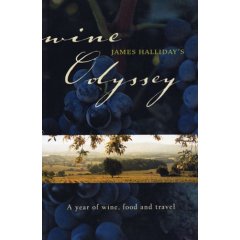 There are not many individuals who live the vinous existence enjoyed by Australia’s James Halliday. That is why I was pleased to find his Wine Odyssey – a year of wine, food and travel. Written in a diary-like format, the book chronicles Halliday’s experiences in the world of wine for 2002. And when I say world, I mean that Halliday does get about. He is more than just an acknowledged expert on Australian wines, his expertise as a critic, judge and just plain wine expert is sought in the New World and Old World alike.
Halliday describes himself as a workaholic in the first sentence of the Prologue, by the end of the book that is more than believable. I was convinced the first time we learn that it is not uncommon for his wife to meet him at Melbourne airport with fresh clothes so that he can jet off to judge yet another Wine Show, or speak at a wine symposium. All of this is done against the backdrop of consulting for Coldstream Hills Winery (which Halliday and his wife Suzanne sold to Southcorp in 1996), tasting through thousands of Australian wines for his annual Wine Companion and selecting the annual Top 100 wines for the Weekend Australian. And these are just a few of the regular events that occupy his time during the year.
A diary should be a personal account of the life of the writer, even if it is only a slice of that life, as is the case with Halliday’s Odyssey. While this book does document Halliday’s life on an almost daily basis it is not cluttered with the personal detritus that some writers might be tempted to include, and some readers may be expecting! Instead it is well tempered with vinous experiences that the wine aficionado will appreciate. The most telling, at least for me, is a reminiscence of a visit, with his wife Suzanne, to France in the early 1980’s. At La Pyramide (a restaurant) in Vienne he seeks out wines of his birth year. One is a 1938 Romanée-Conti. I’ll let Halliday tell of the experience.
“As Louis, the venerable sommelier, teased the cork out of the bottle with his splayed fingers, a sixth sense warned me that something extraordinary was about to happen. As I smelt the wine he poured for my approval, Suzanne said, ‘Why are you crying?’ My first reaction was to indignantly deny that I was doing any such thing, but then I realized that tears were indeed trickling down my cheeks. It was an entirely involuntary reaction to the sheer perfection of the wine.”
If that little anecdote does not give some insight into the love that Halliday has for the liquid that he has devoted his life to, then I clearly don’t have the measure of the man.
For the less emotional, but still voyeuristic, purists there is the description of the purchase and consumption of a double magnum of 1865 Chateau Lafite, as well as 77 vintages of Chateau Latour from 1920 to 2000. Another highlight are the photographs that add visual detail to many of Halliday's exploits, all snapped by the author. There is much to recommend this excellent little book, I mean diary.
Wine Odyssey: A year of wine, food and travel (Paperback) by James Halliday, 304 pages, HarperCollinsPublishers PTY Limited (May 1, 2004). $20.95USD
Subscribe to:
Posts (Atom)