New Zealand is not a producer of quality wine, well at least according to Robert Parker, Jr. It’s a bold statement, even if it does come from one considered to be the dominant exponent of wine swirling, sniffing, slurping, spitting and scoring. But what is Parker’s assertion based upon? What is his experience with New Zealand wine? Only one way to really find out and that is to surf across to eRobertParker.com and explore his wine data base to see what New Zealand wines he has tasted.
Of the 20 countries listed in the database New Zealand ranks 12th, ahead of Greece (58 wines), Japan (48 wines), Ukraine (7 wines), Algeria (2 wines), Morocco (2 wines), Hungary (1 wine), Israel (1 wine), and Lebanon (1 wine). There are 191 wine reviews listed for New Zealand, but that number is deceptive because it represents the number of wines recommended; there may well have been several fold more than 191 tasted. What is a recommended wine? Usually it scores 85 or above on the 100 point scale. In the case of the 191 wines this is correct as 34 were rated between 90-95 and 155 between 80-89. However none of the wines had scores below 85; there were 2 wines where the score was not recorded.
Thirty-four wines scored 90-95 points, or outstanding. What Robert Parker, Jr describes as a “wine of exceptional complexity and character.” But no wines were rated as extraordinary, that is scored greater than 95 points. These are wines of “profound and complex character displaying all the attributes expected of a classic wine of its variety.” Does that say anything about the overall quality of New Zealand wine as assessed by The Wine Advocate? Its difficult to judge given that there is no indication of the total number of wines tasted. Parker usually recommends around 30% of Australian wines, and if that was the case for New Zealand then he may have tasted as many as 636 wines. But as he seems not to favor New Zealand wine all that much the percentage of recommended wines may be lower, let’s say its 10%. That would put the quantity of tasted wines closer to 1200. Seems like quite a sizeable number! How does it compare with the total number of wines produced in New Zealand? Michael Cooper, in his 2007 Buyer’s Guide to New Zealand Wines, notes that there are some 550 wineries producing a total of 3,000 wines, and he tasted and rated 2,740 for his annual review. But Parker’s reviews are not from a single year, nor are they from just a few vintages, they span 1990 to 2004. The greatest number of wines recommended was for the 1999 vintage with 40 wines, followed by 2002 (38 wines), 2001 (23 wines), 1998 (20 wines), 2003 (19 wines), 2000 (11 wines), 2004 (10 wines), 1991 (6 wines), 1996 (5 wines), 1997 (4 wines), 1990 (2 wines) and one wine for each vintage between 1992-1995. Do they represent an adequate sampling of the wines of New Zealand? Well, a decade ago there were 200 wineries and 1,000 wines. So finding less than 10 wines to recommend from any vintage in the early to mid-mid-1990s suggests that a small number of wines were tasted or that Parker was finding very little to recommend! Lets look at two of the years where he scored the most wines and see if there has been improvement in the scores with time. In 1999 he recommended 40 wines, 36 of which were in the 80-89 point range. In 2002 he recommended 38 wines and 26 were in the 80-89 point group. Over that short period more wines have made it into the Outstanding group and more red wines have been recommended than in 1999; 15 as opposed to 6. But these are small numbers and without knowing the actual number of wines tasted its hard to draw any firm conclusions.
Let’s look at the 191 wines a few other ways. Where have they come from? Has Parker at least found wines to recommend in the major wine growing regions? Marlborough is the big winner with 106 wines recommended, followed by Hawkes Bay (24 wines), Wairarapa (16 wines), Otago (7 wines), Nelson (6 wines), South Island (1 wine), Waiheke Island (1 wine), and then Unclassified (30 wines). These numbers are not all that inconsistent with wine production if you consider the regions in terms of the most recent percentage of national production; Marlborough (47.7%), Hawke’s Bay (20.0%), Gisborne (8.3%), Otago (5.5%), Canterbury (4.1%), Wairarapa (3.4%), Nelson, (3.2%), Auckland (incl. Waiheke Isl) (2.4%), Waikato/Bay of Plenty (0.6%). Perhaps Gisborne has missed out, but then one might argue that if you don’t make the list that may be a good thing!
What about varieties? Clearly Sauvignon Blanc, with 79 wines, is the favorite but most wineries have at least one and sometimes multiple SBs. Next comes Pinot Noir (30 wines), followed by Chardonnay (27 wines). Nothing too unexpected there, but it is interesting to note that Parker’s critique of New Zealand wine scolds these three varietals, the three that he has recommended the most. I find that just a little odd.
Next came Riesling (25 wines), over half (14 wines) coming from Marlborough. Then came Proprietary Blends (17 wines) of which three were white (Selaks Ice Wine). The other red varietals, apart from Pinot Noir, were Cabernet Sauvignon (4 wines), Syrah (3 wines), Cabernet Franc (2 wines), and Merlot (2 wines). Single examples of Pinot Gris and Viognier also made the list.
It just does not seem all that impressive an experience, does it? The numbers just don’t support an extensive experience of New Zealand wine at The Wine Advocate. And its difficult to argue otherwise because if that is the case then the last time that Ata Rangi made decent Pinot was 1995-6, Felton Road 1997, and Martinborough Vineyard and Villa Maria only got it right in 2000. And Cloudy Bay only ever made Sauvignon Blanc worth recommending in 1990? No, Parker’s recommendations hint at a lack of exposure to the wines of New Zealand.
What about other reviewers? How does the Wine Spectator see New Zealand wine? In 2006 they rated 184 wines. None of the wines received scores between 95-100, 20% scored between 90-94, 56%, between 85-89, 18% between 80-84, and 6% found their way into the 50-79 point group. By comparison 862 Australian wines were rated with 1% in the 95-100 point group and 26% received 90-94 points, 61%, between 85-89, 10% between 80-84, and 2% found their way into the 50-79 point group. Those percentages seen very similar and certainly a lot better than Argentina with 18% in the 50-79 point group.
Now somewhere at the back of the room I can hear a murmur complaining “All this is just about Parker and points. Who cares?” Well the take home message is quite simple. When you think of New Zealand wine, what comes to mind?
“Not Robert Parker!”
“Sauvignon Blanc.”
“Yes, and Pinot Noir.”
Correct, and isn’t it interesting that New Zealand wine has established an international standing, particularly for Sauvignon Blanc, without the help of the lawyer from Maryland! If they can be left alone long enough maybe we’ll get other wines that speak of New Zealand - Pinot Noir and Syrah and Riesling, and…….
Showing posts with label wine. Show all posts
Showing posts with label wine. Show all posts
Wednesday, March 14, 2007

Thursday, March 01, 2007
How to Win Friends and Influence People
Come on New Zealand own up, just what did you do to Robert Parker, Jr.? It must have been something out of the ordinary to deserve this.
New Zealand
The cool-climate wines of New Zealand have long been popular with wine critics. But to me, the pinot noirs are often too vegetal and green, the sauvignon blancs reminiscent of cat pee, and the chardonnays grotesquely over-oaked. This is a country of young wine producers where everything remains a work in progress, but for now the prices of these wines do not translate to quality in the bottle. Robert parker, Business Week online, February 7th, 2007.
Let me see if I can picture it. Ah yes, the images are forming readily in my mind as I write. Parker, on his way from his last encounter with big bruising Barossa Shiraz decides to stop off in New Zealand for a little R&R. The international port of call would have to be Auckland, and someone (we are never likely to know whom) decides to take the all seeing, all knowing master critic of Bordeaux to Waiheke Island to taste New Zealand Bordeaux. That, of course, would be the first mistake. But then, with Parker’s penchant for paying his own way, insult is heaped upon insult as he finds himself paying outrageous sums of money (OK, so its only NZ $s) just for a taste of what seems to be barely above vin ordinaire. Two wrongs don’t make a right, and as our critic wings his way eastward, back to the safety of fortress America, his fingers flash across the keyboard of his laptop. “The cool climate wines of New Zealand………..
New Zealand
The cool-climate wines of New Zealand have long been popular with wine critics. But to me, the pinot noirs are often too vegetal and green, the sauvignon blancs reminiscent of cat pee, and the chardonnays grotesquely over-oaked. This is a country of young wine producers where everything remains a work in progress, but for now the prices of these wines do not translate to quality in the bottle. Robert parker, Business Week online, February 7th, 2007.
Let me see if I can picture it. Ah yes, the images are forming readily in my mind as I write. Parker, on his way from his last encounter with big bruising Barossa Shiraz decides to stop off in New Zealand for a little R&R. The international port of call would have to be Auckland, and someone (we are never likely to know whom) decides to take the all seeing, all knowing master critic of Bordeaux to Waiheke Island to taste New Zealand Bordeaux. That, of course, would be the first mistake. But then, with Parker’s penchant for paying his own way, insult is heaped upon insult as he finds himself paying outrageous sums of money (OK, so its only NZ $s) just for a taste of what seems to be barely above vin ordinaire. Two wrongs don’t make a right, and as our critic wings his way eastward, back to the safety of fortress America, his fingers flash across the keyboard of his laptop. “The cool climate wines of New Zealand………..
Friday, August 11, 2006
Wine Odyssey – a year of wine, food and travel
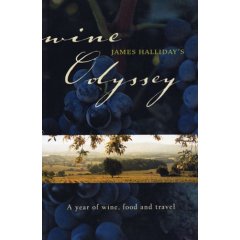 There are not many individuals who live the vinous existence enjoyed by Australia’s James Halliday. That is why I was pleased to find his Wine Odyssey – a year of wine, food and travel. Written in a diary-like format, the book chronicles Halliday’s experiences in the world of wine for 2002. And when I say world, I mean that Halliday does get about. He is more than just an acknowledged expert on Australian wines, his expertise as a critic, judge and just plain wine expert is sought in the New World and Old World alike.
Halliday describes himself as a workaholic in the first sentence of the Prologue, by the end of the book that is more than believable. I was convinced the first time we learn that it is not uncommon for his wife to meet him at Melbourne airport with fresh clothes so that he can jet off to judge yet another Wine Show, or speak at a wine symposium. All of this is done against the backdrop of consulting for Coldstream Hills Winery (which Halliday and his wife Suzanne sold to Southcorp in 1996), tasting through thousands of Australian wines for his annual Wine Companion and selecting the annual Top 100 wines for the Weekend Australian. And these are just a few of the regular events that occupy his time during the year.
A diary should be a personal account of the life of the writer, even if it is only a slice of that life, as is the case with Halliday’s Odyssey. While this book does document Halliday’s life on an almost daily basis it is not cluttered with the personal detritus that some writers might be tempted to include, and some readers may be expecting! Instead it is well tempered with vinous experiences that the wine aficionado will appreciate. The most telling, at least for me, is a reminiscence of a visit, with his wife Suzanne, to France in the early 1980’s. At La Pyramide (a restaurant) in Vienne he seeks out wines of his birth year. One is a 1938 Romanée-Conti. I’ll let Halliday tell of the experience.
“As Louis, the venerable sommelier, teased the cork out of the bottle with his splayed fingers, a sixth sense warned me that something extraordinary was about to happen. As I smelt the wine he poured for my approval, Suzanne said, ‘Why are you crying?’ My first reaction was to indignantly deny that I was doing any such thing, but then I realized that tears were indeed trickling down my cheeks. It was an entirely involuntary reaction to the sheer perfection of the wine.”
If that little anecdote does not give some insight into the love that Halliday has for the liquid that he has devoted his life to, then I clearly don’t have the measure of the man.
For the less emotional, but still voyeuristic, purists there is the description of the purchase and consumption of a double magnum of 1865 Chateau Lafite, as well as 77 vintages of Chateau Latour from 1920 to 2000. Another highlight are the photographs that add visual detail to many of Halliday's exploits, all snapped by the author. There is much to recommend this excellent little book, I mean diary.
Wine Odyssey: A year of wine, food and travel (Paperback) by James Halliday, 304 pages, HarperCollinsPublishers PTY Limited (May 1, 2004). $20.95USD
Subscribe to:
Posts (Atom)