Many who search out the pinnacle of wine perfection chase the myth in wines given a perfect score, 100 points! On the other end of the scale are the wines that never seem to be talked about, those that fall below the cutoff score that signifies a recommended wine, below 84-85 points for Robert Parker or 75 points for Wine Spectator. But the true bottom of the wine barrel is 50 points in the 100 points scoring system. A wine scores 50 points just for being liquid in a bottle.
Do 50 point wines exist? It is difficult to get any definitive numbers because non-recommended wines are rarely described in any detail by wine critics. Why? Well in the case of Robert Parker they make up some 65-75% of the wines he tastes. Recording the tasting notes, or even just the scores, for those wines would consume a significant amount of space in any publication, hardcopy or otherwise. This is a blessing for winemakers because the wine buying public never learns that certain wines have achieved non-recommended status. Of course it is possible that a wine does not receive a recommended score because it was not submitted for review, which leaves the wine buying public even further in the dark about the quality of a winery’s portfolio.
Enter the enthusiastic amateur wine critic or, as we are known these days, the wine blogger. Wine bloggers, it seems, will drink pretty much everything and then they will blog about it. Why? Well most of us are not occupied in the wine trade full-time. Wine is our passion, not our mistress; although there may be some to whom it is a passionate mistress. Wine bloggers are willing to experience the spectrum of wine and comment on the knowledge gleaned to the world of cyberspace. We are an information conduit to the masses yearning to gather bits and bytes of wine knowledge at the click of a Google enquiry.
And if you Google Graeme Miller Wines you will find a 50 point wine courtesy of a wine blogger. Cam Wheeler of Appellation Australia gave 50 points to the 2005 Graeme Miller Wines (Yarra Valley) Rosé. According to what is fast becoming legend Cam tasted the wine at the Victorian Winemaker Exhibition 2006. He commented at the tasting that he thought the wine had a problem but was told (by the winery owners) that the wine was sound; no additional bottles were opened to confirm the quality of the wine. Cam posted his, rather apologetic, tasting note on his blog; how else do you write a 50 point score? Several months later he received a short, terse email threatening legal action if the tasting note was not removed! Further emails have passed back and forth between Cam and the winery and their content can be found here. Needless to say Cam has not removed the tasting note.
What does all this say about wine bloggers and their critiques of wines? Should we be like the Parkers' and Wine Spectators' of this world and not describe those wines that fall below a certain score? Hardly. As Cam notes on his blog the wine in question was tasted by others and found wanting, severely wanting. The consensus seems to be that its not a wine that should be recommended. It will be interesting to see what the established critics make of this wine. If no recommended scores appear then Cam will have done us a service by putting a score out there for us to see. And that is one thing that wine bloggers should do, assume the role of the long abdicated consumer advocate, and talk about the wines that should not be recommended.
Still, I’m intrigued about this 50 pointer. I don’t know that I have ever had one. Well maybe some of the stuff from around the Great Lakes that is made from the native American grapes, or perhaps from Virginia. But no, some of those may be 60-70 pointers. Fifty points is in a class of its own. I have a feeling that sales of this wine might just increase with all the internet discussion. Will they export? 50 points, there is a real marketing gimmick there, especially if they can get Robert Parker to agree with Cam’s score.
Wednesday, July 19, 2006

Tuesday, July 18, 2006
Mudgee – How to blog a wine region
Most blogs start with little more than the support of the individual brave enough to take on the job of attempting to post regularly on a subject of their choosing. With luck the blog might garner some attention and like minded readers may post a few comments. Or you may never ever raise a ripple in the sea of cybercurrents that carry the majority of flotsam and jetsam of the blogosphere. Sound familiar? Then imagine the possibilities if your blog was linked with a major media outlet like The Sydney Morning Herald. Picture a grander vision of having such a blog talk about the wine region that is home to your winery.
Such is the luck of Mudgee, located on the Central Tablelands of NSW and part of the newly renamed "Central NSW" Region. Apparently their tourism campaign, targeting the patrons of art house cinemas, caught the attention of Rob Woodburn whose blog, Lost in Transit, featured the town and surrounding wine region in a post on June 28. A travel blog on the online site of a Sydney newspaper, how could it not draw attention? Fifty-six comments later and you have what seems to be the discovery of an Australian wine region, somewhat to the detriment of the better known nearby Hunter Valley.
In truth Mudgee has been in the wine business for quite a while but like its better known cousin, the Hunter Valley, it has lagged behind the growth of other wine regions of Australia. And there is good reason for this. The quality of wine is not really competitive; there are exceptions. But having visited the region several times over the last couple of decades I have not been impressed. Yes, there has been growth, and our visit in December 2003 revealed some surprises like Abercorn but I enjoyed Mudgee more as a weekend retreat than as a major wine region. Maybe I’ll be proved wrong in years to come but not in the near future. Still there must be something in the air or on the cyberwaves because another post just hit the surf, or is that the "Nest in the Hills".
Such is the luck of Mudgee, located on the Central Tablelands of NSW and part of the newly renamed "Central NSW" Region. Apparently their tourism campaign, targeting the patrons of art house cinemas, caught the attention of Rob Woodburn whose blog, Lost in Transit, featured the town and surrounding wine region in a post on June 28. A travel blog on the online site of a Sydney newspaper, how could it not draw attention? Fifty-six comments later and you have what seems to be the discovery of an Australian wine region, somewhat to the detriment of the better known nearby Hunter Valley.
In truth Mudgee has been in the wine business for quite a while but like its better known cousin, the Hunter Valley, it has lagged behind the growth of other wine regions of Australia. And there is good reason for this. The quality of wine is not really competitive; there are exceptions. But having visited the region several times over the last couple of decades I have not been impressed. Yes, there has been growth, and our visit in December 2003 revealed some surprises like Abercorn but I enjoyed Mudgee more as a weekend retreat than as a major wine region. Maybe I’ll be proved wrong in years to come but not in the near future. Still there must be something in the air or on the cyberwaves because another post just hit the surf, or is that the "Nest in the Hills".
Monday, July 17, 2006
French Lose the World Cup but Win the Wine Cup
We all know which country won the World Cup but according to Australian wine makers it seems that the French are still on top in the wine business. The Australian news media outlet The Age asked leading members of the Australian wine industry (winemaker Chester Osborn, of d'Arenberg Wines; marketer Rob Geddes of WineStream; wine company CEO Darren De Bortoli; and winery owner Bruce Tyrrell of Tyrrell's Wines) who stands in the way of Australia achieving world dominion. Their answers might surprise you; they knocked me off my feet!
The greatest threat was generally considered to be Spain, although Italy got a half vote. A surprise to me, I would have said the USA given the potential that the US has to compete with the Australian products.
The quiet achiever was all over the place with New Zealand, France, Italy and Germany getting nods. My bias would be a toss up between New Zealand and Germany but that may change after we visit NZ in December.
The most admired player? Again a big spread with France, Australia, New Zealand and Argentina getting gongs. My gong would be for France if I was a whole lot more affluent. Otherwise I’ll stick with Oz with a little bit of Germany thrown in for the necessary sweet white.
It was for the most innovative player that things got just plain strange. France two, Australia and New Zealand one each. You climb the ladder like Oz has, with innovation as one of your major players, only to lose out to the guy who has fallen in front of goal ten seconds before full time! Excuse me for confusing Europeans, but this is just too weird because these comments are coming from Australian wine experts.
But the clincher was the score for the most aggressive player. The French got two clear points, the South Africans one and the last point split by Australia and France.
By my count that makes France the clear winner with 6 and half points. One has to wonder if the Australian wine industry really has its eye on the ball. The South Americans might not have done all that much in World Cup but watch them when it comes to competing in wine.
The greatest threat was generally considered to be Spain, although Italy got a half vote. A surprise to me, I would have said the USA given the potential that the US has to compete with the Australian products.
The quiet achiever was all over the place with New Zealand, France, Italy and Germany getting nods. My bias would be a toss up between New Zealand and Germany but that may change after we visit NZ in December.
The most admired player? Again a big spread with France, Australia, New Zealand and Argentina getting gongs. My gong would be for France if I was a whole lot more affluent. Otherwise I’ll stick with Oz with a little bit of Germany thrown in for the necessary sweet white.
It was for the most innovative player that things got just plain strange. France two, Australia and New Zealand one each. You climb the ladder like Oz has, with innovation as one of your major players, only to lose out to the guy who has fallen in front of goal ten seconds before full time! Excuse me for confusing Europeans, but this is just too weird because these comments are coming from Australian wine experts.
But the clincher was the score for the most aggressive player. The French got two clear points, the South Africans one and the last point split by Australia and France.
By my count that makes France the clear winner with 6 and half points. One has to wonder if the Australian wine industry really has its eye on the ball. The South Americans might not have done all that much in World Cup but watch them when it comes to competing in wine.
Thursday, June 29, 2006
We Love Shiraz
I think everyone who visits this site knows that, but I'm not talking about this site. Shiraz has competition? No not really. But I have found a new web site, based in the USA, that is "dedicated to everyone who enjoys Shiraz and the great wine from Australia". It is early days yet for WeLoveShiraz.com, but as one goal is "to catalog 100% of all Australian wine producers and get many of them to be contributing writers" expectations are high.
I guess I better add it to the links so we can keep an eye on it and its companion website!
I guess I better add it to the links so we can keep an eye on it and its companion website!
Wednesday, June 21, 2006
Desperately Seeking Funding, The World Cup and a little Bordeaux
No I’m not seeking funding for my eBlogs. I’m just doing my impersonation of a scientist trying to convince his peers that his research is more worthy of receiving federal funds that some 80 percent of the other research grant applications that are reviewed by the National Institutes of Health (NIH). Well, at least that’s my excuse for not posting so frequently on wine these days. With funding levels being reduced for the first time in the history of the NIH there is a serious concern that medical research in the USA will begin to fall behind the rest of the world. The news may not be that bad, but its pretty obvious that while the current administration is not adverse to spending money to kill people, they are loathe to support the sciences in any meaningful way. And if they say they are, ask them to show you the NIH budget figures after they have been adjusted for inflation. And if they start talking about their AIDS initiatives, make sure they tell you just how much is going to faith based groups. Oh well, maybe I’ll just tell my lab staff to start praying before each experiment!
Speaking of going down on one’s knees, I wonder how much prayer is being offered up in the hope that Australia's Socceroos go through to the Group of 16 in the World Cup? Probably not as much as in Croatia! Unfortunately I’ll be working on my research application during the game tomorrow but I’ll be opening up a bottle of Aussie Shiraz to watch the replay later that evening. It will be a really good bottle if we go through.
And speaking of good bottles, I’ve finally put up some notes on a tasting of 2003 Bordeaux from this past April. I have still to catch up on the March Chardonnay tasting (I was unable to attend the Pinot Noir tasting in May). But I will attend the 2001 Brunello di Montalcino tasting tomorrow night. Its lucky that the soccer replay is not until 11pm! Watch for notes on the Brunellos, oh around November! Sad isn’t it?
Speaking of going down on one’s knees, I wonder how much prayer is being offered up in the hope that Australia's Socceroos go through to the Group of 16 in the World Cup? Probably not as much as in Croatia! Unfortunately I’ll be working on my research application during the game tomorrow but I’ll be opening up a bottle of Aussie Shiraz to watch the replay later that evening. It will be a really good bottle if we go through.
And speaking of good bottles, I’ve finally put up some notes on a tasting of 2003 Bordeaux from this past April. I have still to catch up on the March Chardonnay tasting (I was unable to attend the Pinot Noir tasting in May). But I will attend the 2001 Brunello di Montalcino tasting tomorrow night. Its lucky that the soccer replay is not until 11pm! Watch for notes on the Brunellos, oh around November! Sad isn’t it?
Friday, June 16, 2006
But can you drink 5-8 glasses a day?
WATER into wine? Why bother when in Sydney next week you can buy a bottle of 2003 chardonnay or a 2002 shiraz-cabernet for less than many leading brands of bottled water.
That's the reality of the 900 million-litre wine glut sloshing across Australia, which has created a boom in the "cleanskin" market. MORE->
That's the reality of the 900 million-litre wine glut sloshing across Australia, which has created a boom in the "cleanskin" market. MORE->
Tuesday, June 13, 2006
Grape grower 'plotted to bomb winery'
(From The Age, by Steve Butcher, June 14, 2006)
 THE downturn in the grape market had a potentially disastrous outcome when a company director allegedly planned to bomb a winery over lost income.
Steve Bergamin, 23, is accused of planning to blame terrorists for his plot to bomb the Gapsted winery, between Myrtleford and Bright in north-east Victoria.
He allegedly told an associate he wanted the winery "levelled … lock, stock and barrel".
A detective told a bail hearing in Melbourne Magistrates Court yesterday that Bergamin was angered by a cut in grape prices and said the winery "had to go".
"I want it to look like terrorists have done it," he allegedly said. MORE->
There are terroirists, and then there are terrorists, and then there are those who are just plain idiots!
 THE downturn in the grape market had a potentially disastrous outcome when a company director allegedly planned to bomb a winery over lost income.
Steve Bergamin, 23, is accused of planning to blame terrorists for his plot to bomb the Gapsted winery, between Myrtleford and Bright in north-east Victoria.
He allegedly told an associate he wanted the winery "levelled … lock, stock and barrel".
A detective told a bail hearing in Melbourne Magistrates Court yesterday that Bergamin was angered by a cut in grape prices and said the winery "had to go".
"I want it to look like terrorists have done it," he allegedly said. MORE->
There are terroirists, and then there are terrorists, and then there are those who are just plain idiots!
Sunday, June 11, 2006
Aussie wines take French to the cleaners
NEARLY a billion bottles of French and Italian wine are to be turned into disinfectant and bio-fuels because no one is prepared to buy and drink them. And the reason?
British drinkers would rather buy Australian. Says Annabel Crabb (London) in the June 11 edition of The Age.
And if you look at what has been happening in Ireland since 1990 you can see how the French and Italians have been suffering while Australia has risen to the top in case sales and market share in 2004.
British drinkers would rather buy Australian. Says Annabel Crabb (London) in the June 11 edition of The Age.
And if you look at what has been happening in Ireland since 1990 you can see how the French and Italians have been suffering while Australia has risen to the top in case sales and market share in 2004.
Saturday, June 03, 2006
The Irish Wine Buff
As expected the Guinness in Ireland was smooth and creamy, and came in pint glasses. The wine experience was a little different. I took four bottles of 2002 Australian Shiraz as well a 375 ml bottle of Seppelt’s DP 59 Rare Rutherglen Tokay to share among relatives and friends. The reception these wines received was interesting. Friends from England were quite willing to taste the wines and express an opinion. But my wife’s Irish cousins seemed more interested in the alcohol content than the taste of the wines. Initially I put this down to a lack of experience with wine, after all alcohol is not the only component that goes to make a balanced and structurally sound wine.
However! Toward the end of our week among the green hills and stone ruins of southwest Ireland I was asked to purchase wine for a birthday party. And this was not just any birthday party; it was the reason for being in Ireland. The wine selection would have to rise to the occasion but there was only one bottle of Aussie Shiraz left. Having seen what wines were being sold in the supermarkets I was keen to find a specialist wine store. But this is Ireland. The land of Guinness. Small villages with narrow streets. And peat-smoke filled pubs! Quality wine is it, ya say? Hmmm, let me tink now. Fortunately some of the other Americans who were visiting for the party, and were staying in GarryKennedy, had seen a wine shop, The Wine Buff, in nearby Nenagh.
A brief glance around the shelves of The Wine Buff and I knew that I wasn’t going to be buying any New World Wines. But the owner Alexis Kelly was very accommodating once she knew I liked Syrah. And she opened a couple of bottles of other wines for us to taste as well. In the end we came away with a six-pack of wines that turned out to be quite popular among the party goers. Maybe I’ll post on them in the future.
But what of the Irish and the alcohol content of wine? To try and learn more I chased down the web site for The Wine Buff because Alexis had said in passing that The Wine Buff was looking at Australia. And there it was, Update from Australia. And there it was again, the concern over high alcohol content. This time the comments were a little more informative. The alcohol level was clearly a concern but so was the heavy extraction and lack of freshness. With comments like “At this stage I have tasted about two hundred wines and there were only about six wines, maximum, that I felt like drinking” it looks like The Wine Buff won’t be a big importer of Australian wines .The price of the wines downunder also appeared to be a concern. I can understand this. The six wines we purchased from The Wine Buff were all under $20USD and only one was not good value.
And then there is Muck and Merlot! Published in 2004 this little book was written by Tom Doorley, reputedly “one of Ireland’s best-known commentators on food and wine”. My copy came from the Tall Stories book store in Kilkenny and as I leafed through a few chapters late at night in the Willowbrook B&B I began to realize that Mr Doorley was perhaps one of the reasons why the Irish look for the alcohol level before they taste. Muck and Merlot has a chapter entitled Wine Whine which covers the usual suspects but it also goes after “cult wines that are over-extracted and over-alcoholic”. Now there is nothing wrong with that notion, in fact it may well hold more than a grain of truth. Its just that the paragraph begins with quite a crippling comment on Penfold’s Grange. Red flag to an Australian! But the same paragraph also contains the comment “Whole swathes of the world’s wines are now too alcoholic for their own good, but do we hear serious objections? Not nearly enough of them.” Later in the same chapter are comments on the mafia and dead bodies in the irrigation channels of (Riverina) Australia. Well in truth there are a lot of Australians of Italian heritage there, so I suppose……
Back to some real facts about Ireland and those high alcohol Australian wines. Tom, my man, do you realize that Ireland is the sixth largest market for Australian wines? And that between the years 2002/3 and 2004/5 the volume of Australian wine sold increased by 46.5%? Someone in Ireland loves a little bit more alcohol in their wines!
However! Toward the end of our week among the green hills and stone ruins of southwest Ireland I was asked to purchase wine for a birthday party. And this was not just any birthday party; it was the reason for being in Ireland. The wine selection would have to rise to the occasion but there was only one bottle of Aussie Shiraz left. Having seen what wines were being sold in the supermarkets I was keen to find a specialist wine store. But this is Ireland. The land of Guinness. Small villages with narrow streets. And peat-smoke filled pubs! Quality wine is it, ya say? Hmmm, let me tink now. Fortunately some of the other Americans who were visiting for the party, and were staying in GarryKennedy, had seen a wine shop, The Wine Buff, in nearby Nenagh.
A brief glance around the shelves of The Wine Buff and I knew that I wasn’t going to be buying any New World Wines. But the owner Alexis Kelly was very accommodating once she knew I liked Syrah. And she opened a couple of bottles of other wines for us to taste as well. In the end we came away with a six-pack of wines that turned out to be quite popular among the party goers. Maybe I’ll post on them in the future.
But what of the Irish and the alcohol content of wine? To try and learn more I chased down the web site for The Wine Buff because Alexis had said in passing that The Wine Buff was looking at Australia. And there it was, Update from Australia. And there it was again, the concern over high alcohol content. This time the comments were a little more informative. The alcohol level was clearly a concern but so was the heavy extraction and lack of freshness. With comments like “At this stage I have tasted about two hundred wines and there were only about six wines, maximum, that I felt like drinking” it looks like The Wine Buff won’t be a big importer of Australian wines .The price of the wines downunder also appeared to be a concern. I can understand this. The six wines we purchased from The Wine Buff were all under $20USD and only one was not good value.
And then there is Muck and Merlot! Published in 2004 this little book was written by Tom Doorley, reputedly “one of Ireland’s best-known commentators on food and wine”. My copy came from the Tall Stories book store in Kilkenny and as I leafed through a few chapters late at night in the Willowbrook B&B I began to realize that Mr Doorley was perhaps one of the reasons why the Irish look for the alcohol level before they taste. Muck and Merlot has a chapter entitled Wine Whine which covers the usual suspects but it also goes after “cult wines that are over-extracted and over-alcoholic”. Now there is nothing wrong with that notion, in fact it may well hold more than a grain of truth. Its just that the paragraph begins with quite a crippling comment on Penfold’s Grange. Red flag to an Australian! But the same paragraph also contains the comment “Whole swathes of the world’s wines are now too alcoholic for their own good, but do we hear serious objections? Not nearly enough of them.” Later in the same chapter are comments on the mafia and dead bodies in the irrigation channels of (Riverina) Australia. Well in truth there are a lot of Australians of Italian heritage there, so I suppose……
Back to some real facts about Ireland and those high alcohol Australian wines. Tom, my man, do you realize that Ireland is the sixth largest market for Australian wines? And that between the years 2002/3 and 2004/5 the volume of Australian wine sold increased by 46.5%? Someone in Ireland loves a little bit more alcohol in their wines!
Wednesday, May 17, 2006
Ginger Man Country
Not that it will disturb the status quo too much but service is about to be  disrupted. We are off to Ireland for what I hope will be ten Guinness filled days. We may try to hunt down some wines as well, but when you are on the trail of The Ginger Man it is pubs that you need to frequent. We will be in Dublin for only a night or two and we’ll have to visit the bar where the Guinness is the best in Dublin. Of course a real Ginger Man does not go past McDaids, nor would he pass up a night in the Shelbourne Hotel. Unfortunately the latter is under rennovation. Then it will be off to Willowbrook, Garrykennedy and Lough Derg. Garrykennedy has ten buildings with two pubs, sounds about the right ratio. And there will be a few other excursions as well - at least that is what I am told!
For those few souls who don't know about The Ginger Man I recommend this site.
 disrupted. We are off to Ireland for what I hope will be ten Guinness filled days. We may try to hunt down some wines as well, but when you are on the trail of The Ginger Man it is pubs that you need to frequent. We will be in Dublin for only a night or two and we’ll have to visit the bar where the Guinness is the best in Dublin. Of course a real Ginger Man does not go past McDaids, nor would he pass up a night in the Shelbourne Hotel. Unfortunately the latter is under rennovation. Then it will be off to Willowbrook, Garrykennedy and Lough Derg. Garrykennedy has ten buildings with two pubs, sounds about the right ratio. And there will be a few other excursions as well - at least that is what I am told!
For those few souls who don't know about The Ginger Man I recommend this site.
Thursday, May 11, 2006
Campbell’s Latest
THE WINE FRONT The latest edition of Winefront (March-April) has been released in PDF format. This edition includes articles on Brokenwood Graveyard, Screwcaps, Best Value Reds, Penfolds Supers, Pinot Gris, By Farr, ILR Semillon, New Zealand pinot and more. There is also a stack of reviews plus the new Mucho Yummo Wino section. You need to be a subscriber so why not check out Winefront now.
Wednesday, May 10, 2006
Placing Wine Reviewing In Context
 I was looking forward to a tasting of 2003 Bordeaux reds a few weeks ago. As usual the tasting was accompanied by tasting notes from several noted critics and as always happens some of the people in attendance placed great emphasis on the content of the notes and/or the scores for the individual wines. Because the tasting was done single blind the inevitable happens, people taste the wines and then try to identify them based on how their tasting notes compare with the provided tasting notes. It never works; at least I’ve never seen anyone successfully identify the wines using that approach.
One thing that does not happen at these tastings is complaints about the use of single blind as the method of assessing the wines. True, some individuals are clearly quite new to wine tasting and require an explanation of how the evening will progress but I’ve never heard any raised voices complaining that the identity of the wines is not laid out before them. This is in contrast to many professional critics, including Robert Parker, Jr and James Halliday, who taste many wines unblinded. The argument used is that a wine label should not influence the true professional, although I challenge them to prove that point, or at the very least to point to peer reviewed scientific literature that proves that visual clues do not influence decision making.
Another argument that is used in support of non-blinded wine reviewing is that its important to know the identity of the wine so that you can more easily place the wine in context. In other words by knowing the identity of the wine (e.g. variety, vintage, producer, region) you are better able to judge it. I always have a difficult time with this idea of drinking and/or reviewing wines "in context", particularly if you are blinded to the identity of the wines and then when you learn of the identity you reassess the wines to put them "in context", and especially if that reassessment means that wines are re-graded. Let's put this in perspective! What "in context" means to me is drinking/reviewing wine within your own field of reference/experience. The problem with this is that is exactly where bias comes in. I appreciate that it is difficult to avoid bias. Simply looking at a row of wine glasses and seeing that the wines are red as opposed to white has already begun a thought process that could include bias, and the influence of bias can increase as more information is gathered (e.g. smell, taste etc). But the serious bias comes in when notes and scores/grades/stars are added after a wine has been identified following a blind tasting. I believe serious basis is there from the beginning if the identity of the wine is known during the tasting (if you don't believe the latter I'd love to see the data that proves me wrong.)
To make this short just a couple of examples of why I believe "in context" creates problems.
1) Placing a young wine in the context of previous vintages: Essentially vintage comparison and its done all the time. The most recent vintage of wine X is compared to some previous vintage with regard to some characteristic. To do this properly requires an extraordinary knowledge of the wine in question and previous vintages and all the relevant parameters involved in the making of those wines. I see vintage comparisons made all the time but I've yet to see a really rigorous affirmation that wines from different years are so similar as to be as identical as some of the predictions try to make them. It always sounds good, the wines from vintage X are so similar to vintage Y that you can be certain they will be (fill in whatever attribute you prefer). But over time the making of wine has not been a static process, and can be influenced by many variables from vintage to vintage. I’m not saying that its not impossible for an astute and highly talented wine critic to compare vintages, I simply think he/she should be honest when comparing vintages and state just how limited their comparison of the aspects of the vintages really are (e.g. if its just a comparison of tasting notes, then say so). Don’t make statements like “Reminiscent of a hypothetical blend of the 1982 and the 1975…..” because its just rubbish. How much of a blend? What percentages? And when did you actually make the blend?
2) Putting a wine from a new winery/vineyard "in context": There are different approaches taken here. One is to simply ignore placing the wine in any context, even though very similar wines with longer histories get reassessed (i.e. put in context). The only reason that context is used here is because one wine has a history, but should that be the only feature that distinguishes two wines? The other approach is to place some context on the wine that may or may not be relevant (e.g Kalleske's Johann Georg Shiraz from the Barossa Valley comes from a vineyard that once went to Penfold's for Grange. What this actually say's about the Kalleske wine or about Grange is not really clear; I'm guilty of this confusion myself).
3) Placing wines in context when you are completely unfamiliar with them: This for me is where the real problem with putting a wine in context comes in. This is something that I come up against on a regular basis because I try to taste across as broad a range of wines as I can. So its possible that I could be tasting a flight of wines that includes wines I've had before, wines I've heard of but not tasted before and wines I've never heard of before. Its simply not possible to put all those wines in complete context. OK, if they are all the same varietal, or from the same region or country then you can fudge it. But the "in context" should really be thrown out the window and the "learning experience" aspect of wine drinking should be brought into play.
And that is what happened with the 2003 Bordeaux, but that’s for another time.
Thursday, April 27, 2006
Aussie Wine Critic Doesn’t Give a Toss about Grape Glut
 Clear thinking Campbell Mattinson has posted an Editorial on his revamped and renamed The Wine Front web site about what he considers a questionable grape glut, wine lake, or industry crisis in Australian wine. He has some good reasons for his stance. Although I'd like to quibble with him about a few of the finer points. To read the full commentary you have to be, like me, a subscriber.
Or for the next few days you can make your way over to the Auswine forum and get access to The Wine Front for free. And then you can subscribe!
Friday, April 21, 2006
The American Wine Market
Analysis of sales in food and drug stores tracked by ACNielsen shows varietal wines priced under $6 are still the most popular. (It is important to note that many, if not most, food and drug stores do not sell wines costing $40, $50 or more a bottle). However, sales of wines $6 and above are seeing the strongest growth rates.
Between July 2003 and February 2006, overall wine sales rose 22.6 percent. The largest growth was in wines priced $15 and above, which gained 123 percent. However, those wines only account for about 2 percent of the market. By far the largest volume of wine sold in food stores is priced below $6 per 750 ml; a category that includes jug and 5-liter boxed wines. This category's market share is declining. Between July 2003 and July 2004, this category was responsible for 71 percent of the sales volume. Between February 2005 and February 2006, that market share fell 6 percent.
The overall average bottle price has risen from $4.73 to $5.48, but most of that increase came because the cheapest wines are getting slightly pricier.
Between July 2003 and February 2006, overall wine sales rose 22.6 percent. The largest growth was in wines priced $15 and above, which gained 123 percent. However, those wines only account for about 2 percent of the market. By far the largest volume of wine sold in food stores is priced below $6 per 750 ml; a category that includes jug and 5-liter boxed wines. This category's market share is declining. Between July 2003 and July 2004, this category was responsible for 71 percent of the sales volume. Between February 2005 and February 2006, that market share fell 6 percent.
The overall average bottle price has risen from $4.73 to $5.48, but most of that increase came because the cheapest wines are getting slightly pricier.
Sunday, April 16, 2006
Coming Soon, the Blog Book
Want to see those words in print? No not these pages, well not in foreseeable future; my real job has taught me the vagaries of getting published. But if you do have a wine blog or any blog, or you just want to get published Blurb Inc can help. Mind you a little book on Shiraz wouldn’t go astray, now would it?
Thursday, April 13, 2006
They are only words…… and sometimes they are all we have
 Drinking a great wine is a very sensory experience that can evoke a wide range of emotions and memories. But how can we convey the experience of that wine to others who have not tasted it? While facial expressions, and other gestures, may have certain connotations that might prove useful particularly if the wine has been unpleasant, the spoken and written word has proven our best mode of communication. As noted before on Shiraz one problem that affects the ability to communicate the experience of tasting a wine is being able to accurately describe or label the odors, aromas, or bouquet associated with the wine. Another is the art of writing. Within this second facet is the ability to correctly use words to describe the experience.
I’ve been thinking about the correct use of words lately because I’m not satisfied with having to use the term palate in tasting notes. The principal definition of palate is anatomical and refers to “the roof of the mouth, which separates it from the nasal cavity”. A minor definition is “Relish; taste; liking; - a sense originating in the mistaken notion that the palate is the organ of taste.” So imagine, if you will, the accuracy of describing the taste of a wine with the phrase “on the palate”. Apart from the fact that the palate is not a taste organ, you would have to be standing on your head to have the wine on your palate.
The problem is, of course, that the terminology is so widely used. A search of eRobertParker.com will reveal that Parker has used it in the tasting notes of 8,423 wines. (I use Robert Parker as an example simply because his site has such a great search facility.) A comment on Palate is found in Jancis Robinson’s Oxford Companion to Wine, where it is noted as the “term used when describing tasting as a process and an ability.” Palate does not find its way into Wine, A Brief Encyclopedia by Walter James (Published 1960). Being a great fan of James I’m consoled by that. Perhaps in future I might try using simpler terms like mouth or tongue. Oral cavity seems just a little too clinical. Still I’m sure palate will creep back in at some point.
Another word that finds its way into tasting notes is one that is not found in any dictionary I have looked in. The word is minerality. You won’t find it in Jancis Robinson’s Oxford Companion to Wine, or Walter James’s Wine, A Brief Encyclopedia. But Robert Parker likes it, to date he has used it 856 times. And it occurs elsewhere such as “The precision and minerality of quartz and slate following spring showers preface a nose of varietal purity…” tasting notes for Leo Buring 2005 Eden Valley Riesling.
A word that is similar to minerality is minerally. You will find it in Michael Schuster’s Essential Winetasting where it is defined as “Suggestions to both nose and palate of stones; slate granite, chalk, schist and so on. Especially in wines from the Loire, N. Rhone, Bordeaux, Burgundy, Douro, Mosel, Tokay, etc. Fanciful? Maybe, but real enough to many winetasters; see Terrior” Jancis Robinson in How To Taste defines minerally as “smell of assorted minerals and a common component of fine Cabernet and Riesling”. But does minerally really evoke the smell of “quartz and slate following spring showers”? Not to me because the vast majority of minerals have no smell. So if a wine evokes the remembrance of the smell of wet rocks then it must be something separate that is being washed off those wet rocks.
There is a word that describes just that. Petrichor, it means “the pleasant smell that accompanies the first rain after a dry spell”. [From petro- (rock), from Greek petros (stone) + ichor (the fluid that is supposed to flow in the veins of the gods in Greek mythology). Coined by Australian geologists I.J. Bear and R.G. Thomas.] A more lengthy explanation comes from Michael Quinion at World Wide Words where he writes "the smell is an oily essence that comes from rocks or soil that are often (but not always) clay-based. The oil is a complicated set of at least fifty different compounds, rather like a perfume. It turned out that the oils are given off by vegetation during dry spells and are adsorbed on to the surface of rocks and soil particles, to be released into the air again by the next rains."
What an intriguing explanation. Its no wonder that minerality (minerally) has a connotation with terroir. More to the point its easy to see why Robin Garr became so enamored with a word that could have saved a paragraph in a tasting description. Petrichor, I can't wait to find a wine smelling of wet rocks just so I can use it. All I have to do is remember it. Petrichor, petrichor, petrichor.
Looking for more words to use in your next wine tasting note? Check out some of these.
Tuesday, April 11, 2006
A Winemakers’ House Call
When I contacted vineyards on the Mornington Peninsula of Victoria, Australia I was very hopeful of tasting the wines of Yabby Lake Vineyard. Established in 1998, the first vintage of Chardonnay and Pinot Noir had been produced in 2002 from the 40 hectare vineyard. Stephanie Duboudin, Marketing Manager for the BMK Family Vineyards that oversees Yabby Lake, informed me that although there are no visitor facilities she would travel to the Peninsula to meet with me while we were visiting with other vineyards. That seemed a bit extreme, especially as she was going to be coming from Melbourne and we were staying in Melbourne anyway. Why not just meet in Melbourne later in the week? And so it was arranged, or at least that is what I thought. As the day approached Stephanie called to say that Tod Dexter, Winemaker for Yabby Lake, would be doing the tasting. But there was a problem. The hotel where we were staying did not have a room suitable for the tasting. I offered a simple solution. Why not use our room? The only problem would be glassware, but if that was going to be the only problem we could get by.
Tod Dexter has only been with Yabby Lake since January 2004, but his experience with vineyards of the Mornington Peninsula is impressive. He took Stonier’s from a fledgling 250 to 30,000 cases during which time it became one of the most highly regarded wineries on the Peninsula. He was also winemaker at Elgee Park and established his own vineyard on Mornington Peninsula in 1987. Almost a winemaker by default his career started in 1979 at Cakebread Cellars when he found himself in the Napa Valley. After an education at Cakebread and at the University of California at Davis he returned to Australia to study at Roseworthy College before vintages at Brown Brothers. Winemakers always seem to have an international route to their destination.
Like any good wine man Tod came prepared with two bottles of each wine and we could do nothing less than provide cheeses and other nibbles and possibly the worst wine glasses known to oenology – generic bowls. The wines were going to have to be good to make an impression.
First up were the wines from the Yabby Lake Vineyards. The 2004 Chardonnay (French Oak, 30% new) was a light straw with a colorless edge. Nice peach, citrus, and floral aromas with a little anise were released with some swirling of the glass. Excellent oak treatment was revealed in a beautifully textured wine that was soft, round and full in the mouth. The oak is truly understated, allowing the juicy acidity to provide elegance to the lengthy finish. This is a classy wine that conventional wisdom would give 5-7 years of life. I’ll go out on a limb and say that you can easily double or triple that. We consumed the rest of the bottle later in the day with smoked salmon on toast which highlighted the floral aromas and the crisp, invigorating acidity of the wine. 2, 2, 4.3, 10.5 = 18.8/20, 94/100. 13.5% alcohol.
Next was the 2004 Pinot Noir (French Oak). Cherry red in color with a pink edge and loaded with dazzling Pinot character of spices, plum, bright cherry, and faint cinnamon. Medium bodied with wonderful mouthfeel. The supersoft tannins firm up on a lengthy finish that is supported by bright acidity. Simply excellent. It should be at its best in 3-5 years and could well live for two to three times longer. 2, 2, 4.5, 10.3, =18.8/20, 94/100. 14.5% alcohol.
The third wine was not from Mornington Peninsula but from another cool climate Victorian wine region, Heathcote. The Heathcote Estate 2003 Shiraz (French Oak) is not quite pure Shiraz as it has 6% Grenache. It’s surprising to realize that this is only the second vintage of this single vineyard Shiraz from this new estate. An intense chocolate aroma can be smelt as soon as the cork is pulled. The wine is densely colored, literally glass staining. It’s a big fruity wine loaded with blueberry and blackberry and a little nail polish (EA). This full bodied wine has wonderful mouthfeel and great balance. The big, firm tannins will need a few years to soften and by then it should be a beauty. It will live for at least 5-10 years and hopefully much longer. 2, 2, 4.5, 10.5 = 19/20, 95/100, 14.5% alcohol. Tasted December 7, 2005.
We spent two hours tasting the three wines and discussing wine in general, and that is really how wine tasting should go. No fuss, no rush, no bother. All you need is a friendly, down to earth, intelligent winemaker, who makes bloody good wine. There is no doubt about it the wines were excellent to outstanding, especially the Yabby Lake wines. The mouthfeel is almost a sensual experience. The best recommendation I can give these wines is that I have purchased a six-pack of the 2003 Heathcote Shiraz and a dozen of the Yabby Lake 2004 Pinot Noir. And if my wine merchant is true to his word he will have my order for the 2004 Yabby Lake Chardonnay in the distributors’ hands tomorrow.
Yabby Lake and Heathcote Estate are part of the BMK Family Vineyards P/L. Other products in the group include Cooralook which is a second label for the former two vineyards. The other vineyard is Escarpment Vineyards which is in Martinborough, New Zealand. Escarpment is home to Larry McKenna, Consulting Winemaker and the guy who actually made the first two vintages at Yabby Lake. Guess where yours truly will be visiting this December?
Tod Dexter has only been with Yabby Lake since January 2004, but his experience with vineyards of the Mornington Peninsula is impressive. He took Stonier’s from a fledgling 250 to 30,000 cases during which time it became one of the most highly regarded wineries on the Peninsula. He was also winemaker at Elgee Park and established his own vineyard on Mornington Peninsula in 1987. Almost a winemaker by default his career started in 1979 at Cakebread Cellars when he found himself in the Napa Valley. After an education at Cakebread and at the University of California at Davis he returned to Australia to study at Roseworthy College before vintages at Brown Brothers. Winemakers always seem to have an international route to their destination.
Like any good wine man Tod came prepared with two bottles of each wine and we could do nothing less than provide cheeses and other nibbles and possibly the worst wine glasses known to oenology – generic bowls. The wines were going to have to be good to make an impression.
First up were the wines from the Yabby Lake Vineyards. The 2004 Chardonnay (French Oak, 30% new) was a light straw with a colorless edge. Nice peach, citrus, and floral aromas with a little anise were released with some swirling of the glass. Excellent oak treatment was revealed in a beautifully textured wine that was soft, round and full in the mouth. The oak is truly understated, allowing the juicy acidity to provide elegance to the lengthy finish. This is a classy wine that conventional wisdom would give 5-7 years of life. I’ll go out on a limb and say that you can easily double or triple that. We consumed the rest of the bottle later in the day with smoked salmon on toast which highlighted the floral aromas and the crisp, invigorating acidity of the wine. 2, 2, 4.3, 10.5 = 18.8/20, 94/100. 13.5% alcohol.
Next was the 2004 Pinot Noir (French Oak). Cherry red in color with a pink edge and loaded with dazzling Pinot character of spices, plum, bright cherry, and faint cinnamon. Medium bodied with wonderful mouthfeel. The supersoft tannins firm up on a lengthy finish that is supported by bright acidity. Simply excellent. It should be at its best in 3-5 years and could well live for two to three times longer. 2, 2, 4.5, 10.3, =18.8/20, 94/100. 14.5% alcohol.
The third wine was not from Mornington Peninsula but from another cool climate Victorian wine region, Heathcote. The Heathcote Estate 2003 Shiraz (French Oak) is not quite pure Shiraz as it has 6% Grenache. It’s surprising to realize that this is only the second vintage of this single vineyard Shiraz from this new estate. An intense chocolate aroma can be smelt as soon as the cork is pulled. The wine is densely colored, literally glass staining. It’s a big fruity wine loaded with blueberry and blackberry and a little nail polish (EA). This full bodied wine has wonderful mouthfeel and great balance. The big, firm tannins will need a few years to soften and by then it should be a beauty. It will live for at least 5-10 years and hopefully much longer. 2, 2, 4.5, 10.5 = 19/20, 95/100, 14.5% alcohol. Tasted December 7, 2005.
We spent two hours tasting the three wines and discussing wine in general, and that is really how wine tasting should go. No fuss, no rush, no bother. All you need is a friendly, down to earth, intelligent winemaker, who makes bloody good wine. There is no doubt about it the wines were excellent to outstanding, especially the Yabby Lake wines. The mouthfeel is almost a sensual experience. The best recommendation I can give these wines is that I have purchased a six-pack of the 2003 Heathcote Shiraz and a dozen of the Yabby Lake 2004 Pinot Noir. And if my wine merchant is true to his word he will have my order for the 2004 Yabby Lake Chardonnay in the distributors’ hands tomorrow.
Yabby Lake and Heathcote Estate are part of the BMK Family Vineyards P/L. Other products in the group include Cooralook which is a second label for the former two vineyards. The other vineyard is Escarpment Vineyards which is in Martinborough, New Zealand. Escarpment is home to Larry McKenna, Consulting Winemaker and the guy who actually made the first two vintages at Yabby Lake. Guess where yours truly will be visiting this December?
Tuesday, April 04, 2006
Look, In Wine Cyberspace! Is it a Blog? Is it a...
Actually I’m not really sure what it is. But its being written by Campbell Mattinson of Winefront Monthly fame so you will definitely want to bookmark it. Campbell is a very clever wine writer. He was winnner of the 2004 Saltram Wine Communicator Award, the inaugural awarding of this prize, and one of three finalists for the 2005 award.
This new site, called Winefront, has the features of a blog but it also allows subscribers to Campbell’s Winefront Monthly website to login to access extras. But there are free features like the Guides to various wine regions of Australia, including the Barossa Valley in South Australia, Hunter Valley in New South Wales and Mornington Peninsula and Rutherglenregions of Victoria. If you want to learn about the variety that is the life and spice of Aussie wine you should read these regional vignettes.
This new site, called Winefront, has the features of a blog but it also allows subscribers to Campbell’s Winefront Monthly website to login to access extras. But there are free features like the Guides to various wine regions of Australia, including the Barossa Valley in South Australia, Hunter Valley in New South Wales and Mornington Peninsula and Rutherglenregions of Victoria. If you want to learn about the variety that is the life and spice of Aussie wine you should read these regional vignettes.
Saturday, April 01, 2006
Wal-Mart Wine
 Wal-Mart announced that they will soon be offering customers a new discount item. Wal-Mart's own brand of wine. The world's largest retail chain is teaming up with E&G Jallo Winery of California, to produce the spirits at an affordable price, in the $1-3 range. Wine connoisseurs may not be inclined to throw a bottle of Wal-Mart brand into their shopping carts, but "there is a market for cheap wine," said Kathy Micken, Professor of Marketing. She said: "But the right name is important."
Customer surveys were conducted to determine the most attractive name for the Wal-Mart brand.
The top surveyed names in order of popularity are:
10. Chateau Traileur Parc
9. White Trashfindel
8. Big Red Gulp
7. World Championship Riesling
6. NASCARbernet
5. Chef Boyardeaux
4. Pe anut Noir
3. I Can't Believe It's Not Vinegar!
2. Grape Expectations
And the number 1 name for Wal-Mart Wine:
1. Nasti Spumante
The beauty of Wal-Mart wine is that it can be served with either white meat (Possum) or red meat (Squirrel).
Wednesday, March 29, 2006
Off Your Tits On Screwed
I rarely buy wine from supermarkets. Miranda, my wife, would probably add that I rarely buy anything from supermarkets; she does it all. Even so I was the one pushing the shopping cart around Henry’s last weekend as she made her selections. Naturally I was drawn to the wine section, just on the off chance that there might be something interesting on the shelves. The first thing I noticed was that there weren’t any shelf-talkers extolling the virtues of some 90 point plus wine. There weren’t even any simple tasting notes or recommendations tacked up that might indicate a worthy choice. There was a magazine rack with Bon Appetite, Wine and Food, and Wine Spectator but no one was sneaking a quick look in hopes of finding a few pointers about what wines might be good value.
As I stood there leaning on the shopping cart it suddenly occurred to me that unless I knew what I was after how was I going to choose, assuming that I was going to buy wine? A lot of the wine labels didn’t even look familiar. OK, don’t panic. Let’s be sensible about this. You have walked into a store looking for a bottle of inexpensive wine. Find a bottle of wine. It can’t be that hard, after all you are supposed to know a little bit about the subject. A sign said Shiraz. I know what that is! Familiarity does breed contempt. They all seemed to be from places other than Australia. None looked familiar. Several were from California, some of which were even called Shiraz but most were labeled Syrah. Well I could be adventurous but I had seen the ubiquitous [yellowtail] Shiraz when we had come into the store so I knew there was Aussie wine here somewhere. Let’s go with what we know best. But where were they? Ahh huh, over there under the sign Australia.
Like most supermarkets Henry’s does not carry a large or expensive selection of wine in any category. Still inexpensive Aussie wine is the flavor of the month and so there were several dozen reds to pick from; I didn’t to an actual count. Keeping to the plan I checked out the Shiraz lineup. The usual suspects were there including [yellowtail], Rosemount and Jacobs Creek. There was also a Deakin Estate and something called Red Knot. Pretty label. Hmm, made by the Davey Family Wines from McLaren Vale. They make Shingleback Shiraz which is pretty good wine. But I’m supposed to be playing the part of an average consumer who knows that Australian Shiraz is good wine, not what Australian Shiraz wines are better than others. OK, what else is there. Alice White Shiraz! Sounds like something made by the girl next door, or maybe the old guy next door acting as though he’s a girl!
 What’s this? Screwed Red Wine from McLaren Vale. Another Davey Family Wines product. At $8.99USD a bottle Screwed is a blend of Shiraz, Cabernet Sauvignon and Tempranillo. Screwed is part of Precept Brands; which I’m presuming owns Davey Family Wines. The back label reads “Your alarm doesn’t go off and you wake up an hour late…you try to open a bottle of wine and the cork breaks…get to the airport and you realize that you forgot your passport…you’re totally screwed! Unscrew yourself by unscrewing a bottle of screwed red wine from Australia’s famed Mclaren Vale. This rich and vibrant red wine has blackberry aromas and flavors. With just a touch of vanilla oak for a smooth finish. And no corkscrews involved for the accident prone.”
This could be a bit of fun. The name is topical, fitting in with the new drive to screwcaps as well as the obvious sexual connotation. If it turns out to be swill we can still get a few laughs from the label, and who knows what else a few glasses might lead to?
Tasted along with some salsa and corn chips the wine was quite attractive with aromas of cigar smoke over sweet oak, faint pepper, cola and dark fruits. Certainly confected and fruit forward. The palate was medium weight with bright acidity and soft tannins. The flavors carried well and provided nice length to the finish. However there was little depth or complexity to the wine. It scored a 16.1/20 or 81/100 from me.
How successful was I at selecting a wine? Well given that I went for something that I thought might be more fun than quality it turned out reasonably well. But I don’t envy the novice wine drinker the task of making a serious choice from the Henry’s wine selection. The lack of shelf talkers or even any staff recommendations makes wine selection difficult. The lack of information on their shelves is unfortunate given that their web site does make an attempt to introduce the consumer to wine. Dare I venture into any more supermarket wine aisles?
Oh, would I get off my tits on Screwed? That would depend on what you think getting off my tits means!
As I stood there leaning on the shopping cart it suddenly occurred to me that unless I knew what I was after how was I going to choose, assuming that I was going to buy wine? A lot of the wine labels didn’t even look familiar. OK, don’t panic. Let’s be sensible about this. You have walked into a store looking for a bottle of inexpensive wine. Find a bottle of wine. It can’t be that hard, after all you are supposed to know a little bit about the subject. A sign said Shiraz. I know what that is! Familiarity does breed contempt. They all seemed to be from places other than Australia. None looked familiar. Several were from California, some of which were even called Shiraz but most were labeled Syrah. Well I could be adventurous but I had seen the ubiquitous [yellowtail] Shiraz when we had come into the store so I knew there was Aussie wine here somewhere. Let’s go with what we know best. But where were they? Ahh huh, over there under the sign Australia.
Like most supermarkets Henry’s does not carry a large or expensive selection of wine in any category. Still inexpensive Aussie wine is the flavor of the month and so there were several dozen reds to pick from; I didn’t to an actual count. Keeping to the plan I checked out the Shiraz lineup. The usual suspects were there including [yellowtail], Rosemount and Jacobs Creek. There was also a Deakin Estate and something called Red Knot. Pretty label. Hmm, made by the Davey Family Wines from McLaren Vale. They make Shingleback Shiraz which is pretty good wine. But I’m supposed to be playing the part of an average consumer who knows that Australian Shiraz is good wine, not what Australian Shiraz wines are better than others. OK, what else is there. Alice White Shiraz! Sounds like something made by the girl next door, or maybe the old guy next door acting as though he’s a girl!
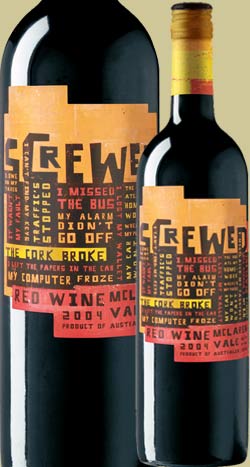 What’s this? Screwed Red Wine from McLaren Vale. Another Davey Family Wines product. At $8.99USD a bottle Screwed is a blend of Shiraz, Cabernet Sauvignon and Tempranillo. Screwed is part of Precept Brands; which I’m presuming owns Davey Family Wines. The back label reads “Your alarm doesn’t go off and you wake up an hour late…you try to open a bottle of wine and the cork breaks…get to the airport and you realize that you forgot your passport…you’re totally screwed! Unscrew yourself by unscrewing a bottle of screwed red wine from Australia’s famed Mclaren Vale. This rich and vibrant red wine has blackberry aromas and flavors. With just a touch of vanilla oak for a smooth finish. And no corkscrews involved for the accident prone.”
This could be a bit of fun. The name is topical, fitting in with the new drive to screwcaps as well as the obvious sexual connotation. If it turns out to be swill we can still get a few laughs from the label, and who knows what else a few glasses might lead to?
Tasted along with some salsa and corn chips the wine was quite attractive with aromas of cigar smoke over sweet oak, faint pepper, cola and dark fruits. Certainly confected and fruit forward. The palate was medium weight with bright acidity and soft tannins. The flavors carried well and provided nice length to the finish. However there was little depth or complexity to the wine. It scored a 16.1/20 or 81/100 from me.
How successful was I at selecting a wine? Well given that I went for something that I thought might be more fun than quality it turned out reasonably well. But I don’t envy the novice wine drinker the task of making a serious choice from the Henry’s wine selection. The lack of shelf talkers or even any staff recommendations makes wine selection difficult. The lack of information on their shelves is unfortunate given that their web site does make an attempt to introduce the consumer to wine. Dare I venture into any more supermarket wine aisles?
Oh, would I get off my tits on Screwed? That would depend on what you think getting off my tits means!
Subscribe to:
Posts (Atom)